Australian businesses face a compliance environment unlike any other. With 122 Modern Awards, state-specific long service leave rules, mandatory leave loading at 17.5%, and criminal penalties for wage theft under the Fair Work Act, getting leave management wrong is not just inconvenient — it is a genuine legal risk. The right leave management software should handle this complexity without the enterprise price tag.
We evaluated seven of the most popular leave management tools used by Australian businesses in 2026, comparing them on pricing, compliance features, integrations, and overall value. Whether you are a 10-person team in Brisbane or a 200-person company with offices across multiple states, this guide will help you choose the right tool for your needs.
What to Look for in Leave Management Software for Australia
Before diving into individual reviews, here are the features that matter most for Australian organisations:
- NES compliance — the National Employment Standards guarantee minimum entitlements including 4 weeks of paid annual leave, 10 days of personal/carer’s leave, 2 days of compassionate leave, and community service leave. Your software needs to handle all of these out of the box.
- Leave loading support — many awards and enterprise agreements require a 17.5% leave loading on annual leave pay. Your tool should either calculate this automatically or make it easy to configure.
- Multi-award policy support — if your workforce spans multiple Modern Awards (common in hospitality, retail, and healthcare), you need a tool that can manage different leave entitlements for different employee groups.
- Integration with existing tools — most Australian teams use Slack or Microsoft Teams for communication, and Xero or MYOB for accounting. Seamless integration with these platforms reduces double-handling.
- Fair Work compliance reporting — the ability to generate reports that demonstrate compliance with Fair Work obligations, particularly around leave balances, accruals, and payout calculations.
- Scalable pricing that does not punish growth — per-user pricing models can blow out quickly as your team grows. Look for transparent pricing that scales sensibly.
The 7 Best Leave Management Tools for Australian Businesses
1. Leave Balance
Best for: Growing teams that use Slack or Microsoft Teams and want simple, affordable leave tracking without a full HRIS.
Pricing: AUD $29/month flat rate — unlimited employees, unlimited policies. 14-day free trial, no credit card required.
Australian compliance features:
- Configurable leave policies for all NES entitlements (annual leave, personal leave, compassionate leave, long service leave)
- Leave loading support via custom policy configuration
- Multiple award support through unlimited custom leave policies per employee group
- State-specific long service leave rules configurable per policy
- Leave balance tracking with accrual calculations
Integrations: Slack (full workflow — request, approve, and manage leave without leaving Slack), Microsoft Teams, team calendar sync.
Pros:
- Flat-rate pricing at AUD $29/month means no cost increase as your team grows — 92% cheaper than typical per-user tools at 30 employees
- Both Slack AND Teams integration, not just one or the other
- Set up in under 15 minutes with no implementation project required
- Unlimited employees and unlimited custom leave policies
- Multi-country support for businesses with staff in New Zealand, the UK, or elsewhere
- Clean, modern interface that employees actually enjoy using
Cons:
- No direct payroll integration with Xero or MYOB (leave data must be exported or entered manually)
- No award interpretation engine — you configure policies manually rather than selecting an award
- Newer in the Australian market compared to established local players like Tanda or Employment Hero
Our take: Leave Balance offers the best value for Australian SMBs that need reliable leave tracking without the overhead or cost of a full HRIS. The flat-rate pricing is genuinely unmatched — at 30 employees, you are paying AUD $29/month while most competitors charge AUD $150-600/month for the same core functionality. If your team communicates via Slack or Teams, the native integration makes requesting and approving leave seamless. The main trade-off is the lack of payroll integration and automated award interpretation, which matters more for shift-based businesses with complex award structures.
2. Tanda
Best for: Shift-based businesses in hospitality, retail, and healthcare that need award interpretation and rostering alongside leave management.
Pricing: Modular pricing starting from approximately AUD $1.60/user/module. A typical bundle including time and attendance, rostering, and leave management runs AUD $10-16/user/month. Pricing is sales-led and not fully transparent on the website.
Australian compliance features:
- Best-in-class award interpretation engine covering all 122 Modern Awards
- Automatic penalty rate calculation based on award conditions
- Overtime and leave loading calculations built into the platform
- Fair Work-compliant timesheets and leave records
- Single Touch Payroll (STP) reporting support
Integrations: Xero, MYOB, KeyPay, various POS systems. Limited Slack/Teams integration.
Pros:
- Deep award compliance that genuinely understands the complexity of Australian industrial relations
- Integrated rostering, time and attendance, and leave management in one platform
- Particularly strong in hospitality, retail, healthcare, and other shift-based industries
- Australian-built and Australian-headquartered
- Strong mobile app for clock-in/out and shift management
Cons:
- Expensive at scale — a 50-person team could easily pay AUD $500-800/month for the full suite
- Opaque pricing that requires a sales conversation to get accurate quotes
- Significant overkill if you only need leave management without rostering or time tracking
- Sales-led buying process with demos and onboarding calls
- Limited integration with Slack or Microsoft Teams for leave workflows
Our take: Tanda is the gold standard for Australian award interpretation. If your business runs on shift work and you need a tool that genuinely understands penalty rates, overtime calculations, and the nuances of 122 Modern Awards, Tanda is hard to beat. However, most office-based SMBs do not need (and should not pay for) the full rostering and time-tracking suite. If your primary need is managing annual leave requests and approvals for salaried employees, Tanda’s complexity and cost are difficult to justify.
3. Employment Hero
Best for: Businesses that want an all-in-one HR, payroll, and leave management platform with comprehensive Australian compliance.
Pricing: From approximately AUD $20/employee/month (Lite) to AUD $60/employee/month (Unlimited). Minimum monthly spend of AUD $200-600 depending on the plan. Annual contracts are standard.
Australian compliance features:
- Comprehensive payroll with STP Phase 2 reporting
- Superannuation management and compliance
- Award interpretation (via KeyPay acquisition)
- Leave loading calculations
- Fair Work information statements and compliance tools
- Modern Award coverage across the platform
Integrations: Xero, MYOB, QuickBooks, Slack (basic), Microsoft Teams (basic), various benefits providers.
Pros:
- Everything in one platform — HR, payroll, onboarding, performance, leave, benefits, and learning
- Strong payroll integration through the KeyPay acquisition
- Comprehensive Australian compliance across all HR functions
- Good for businesses that want to consolidate multiple HR tools into one
- Employee self-service portal with benefits marketplace
Cons:
- The most expensive option on this list — a 50-person team on the mid-tier plan pays approximately AUD $1,500-2,000/month
- Minimum monthly spend of AUD $200 even for very small teams
- Complex setup and configuration that typically requires onboarding support
- Bloated for businesses that primarily need leave tracking
- Feature overload can make the platform feel overwhelming for simple use cases
Our take: Employment Hero is the right choice if you genuinely need a full HR and payroll platform for your Australian business. The KeyPay-powered payroll is solid, the compliance coverage is comprehensive, and having everything in one place has real advantages. But if leave tracking is your primary need, you are paying for a significant amount of functionality you will never use. At AUD $20-60/employee/month, a 50-person company is spending AUD $1,000-3,000/month — over 30 times what a dedicated leave tracker costs.
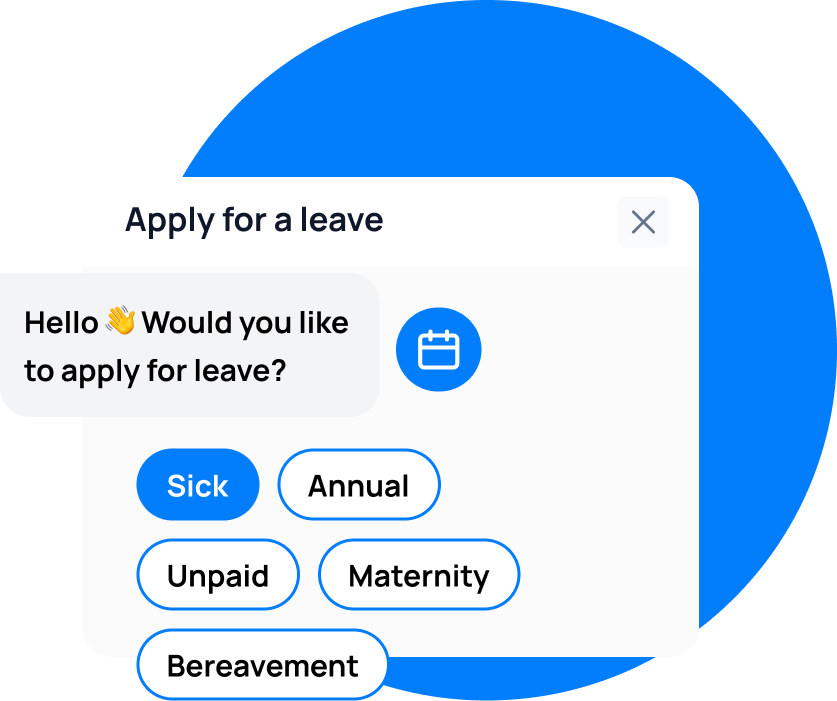
leave emails? Track your employee's leave with Leave Balance
4. Deputy
Best for: Businesses with deskless or hourly workers that need shift scheduling and leave management in the same platform.
Pricing: From AUD $5/user/month (Scheduling only) to AUD $9/user/month (Premium, includes scheduling, time tracking, and leave). Custom quotes are common for larger deployments.
Australian compliance features:
- Award-aware shift scheduling that factors in leave entitlements
- Fair Work-compliant timesheets
- Leave management with configurable leave types
- Break compliance tracking
- Integration with Australian payroll providers for leave calculations
Integrations: Xero, MYOB, ADP, various POS systems. Mobile app with geolocation. Limited Slack/Teams integration.
Pros:
- Strong mobile app that works well for deskless and field workers
- Good shift scheduling with demand forecasting
- Solid Xero integration for payroll workflows
- Well-established in Australian hospitality, healthcare, and retail
- Reasonable per-user pricing compared to full HRIS platforms
Cons:
- Leave management is secondary to scheduling — it works but lacks depth
- Per-user pricing adds up quickly (50 employees at AUD $9/user = AUD $450/month)
- Less suited for office-based teams that do not need scheduling
- No meaningful Slack or Teams integration for leave workflows
- Reporting for leave-specific analytics is limited
Our take: Deputy is an excellent choice for hospitality, healthcare, retail, and any business with a predominantly deskless workforce. The scheduling capabilities are strong, and having leave management integrated with rostering makes sense for shift-based businesses. But if your team works in an office and communicates via Slack or Teams, Deputy’s scheduling focus is not relevant to your needs, and you are paying for functionality you will not use.
5. Xero (Leave Features)
Best for: Very small businesses (under 10 employees) that already use Xero for accounting and payroll and want basic leave tracking without an additional tool.
Pricing: Included in Xero payroll plans. Xero itself costs AUD $35-130/month depending on the plan, with payroll as an add-on from approximately AUD $10/month plus AUD $4/employee/month.
Australian compliance features:
- Leave calculations integrated directly with payroll
- STP Phase 2 reporting
- Superannuation compliance
- Basic leave types (annual, personal, long service)
- Leave loading calculation within payroll runs
Integrations: Native integration with Xero accounting. Various third-party apps via the Xero App Store. No Slack or Teams integration for leave workflows.
Pros:
- No additional software cost if you already use Xero for payroll
- Leave calculations are directly connected to payroll — no data re-entry
- Simple and familiar interface for businesses already in the Xero ecosystem
- STP compliance handled automatically
Cons:
- Very basic leave management features — no team calendar, no analytics, no custom leave types beyond the standard set
- No Slack or Microsoft Teams integration for leave requests or approvals
- No manager dashboard or team visibility tools
- Employees must log into Xero to request leave (no mobile-first experience for leave)
- Difficult to manage complex leave policies across multiple awards
- Reporting is limited to basic payroll-focused leave reports
Our take: Xero’s leave features are adequate for very small businesses that already use Xero for everything and do not want another tool. The payroll integration is genuinely useful — leave calculations flow directly into pay runs without manual data entry. But Xero was built as accounting software, not leave management software, and it shows. Once your team grows past 10-15 employees, the lack of a team calendar, approval workflows in Slack/Teams, and meaningful reporting becomes a real limitation.
6. ELMO Software
Best for: Mid-market to enterprise organisations (200+ employees) that need a comprehensive, Australian-built HCM suite.
Pricing: Custom and quote-based only. Pricing is not published and requires a sales conversation. Expect enterprise-level pricing with annual contracts.
Australian compliance features:
- Enterprise-grade compliance across all HR functions
- Australian-headquartered and ASX-listed (until taken private in 2023)
- Deep understanding of Australian employment law and industrial relations
- Modern Award support across the full HCM suite
- Comprehensive reporting for Fair Work compliance and audits
Integrations: Various enterprise payroll and ERP systems. API access for custom integrations. Limited modern messaging platform integration.
Pros:
- Comprehensive HCM suite covering recruitment, onboarding, performance, learning, payroll, and leave
- Australian-built with genuine local compliance expertise
- Trusted by large Australian organisations across government, education, and corporate sectors
- Strong reporting and analytics for enterprise requirements
- Dedicated Australian support team
Cons:
- Not designed for SMBs — the platform, pricing, and sales process are all oriented toward larger organisations
- Opaque pricing that requires lengthy sales engagement
- Complex implementation that can take weeks or months
- Long sales cycles with demos, proposals, and contract negotiation
- The platform can feel dated compared to newer, more modern tools
Our take: If you have 200 or more employees and need a full enterprise HCM suite built by Australians for Australians, ELMO is worth evaluating alongside the global enterprise players. The local compliance expertise is genuine, and the breadth of the platform is impressive. But for SMBs, ELMO is simply not designed for you — the pricing, implementation, and complexity are all calibrated for a different market segment.
7. Vacation Tracker
Best for: Very small teams using Slack that want a simple, affordable leave bot without Australian-specific compliance features.
Pricing: From USD $2/user/month. Paid plans have a minimum of USD $50/month. Pricing is in US dollars only.
Australian compliance features:
- Minimal — basic leave type configuration but no NES awareness
- No leave loading support
- No award interpretation or Modern Award awareness
- No understanding of Australian state-specific long service leave rules
- No Fair Work compliance reporting
Integrations: Slack (primary), Microsoft Teams, Google Workspace. No Xero or MYOB integration.
Pros:
- Simple Slack integration that works well for basic leave requests and approvals
- Straightforward setup with minimal configuration
- Dashboard for leave balances and calendar view
- Both Slack and Teams support
Cons:
- US-focused product with no meaningful Australian compliance features
- Per-user pricing in USD means costs are higher than they appear (USD $50/month minimum is approximately AUD $75/month)
- No leave loading, no NES entitlement tracking, no award support
- Limited reporting compared to Australian-focused tools
- No integration with Australian payroll or accounting software
Our take: Vacation Tracker works for very small teams that just need a basic Slack leave bot and are not concerned about Australian compliance features. The Slack integration is genuinely simple and easy to use. But for any Australian business that needs to track NES entitlements, manage leave loading, or demonstrate Fair Work compliance, Vacation Tracker lacks the features you need. And at approximately AUD $75/month minimum (for the paid plan), the cost advantage over a tool like Leave Balance — which offers flat-rate pricing with unlimited employees — disappears quickly.
Pricing Comparison by Team Size
Here is what you will actually pay per month with each tool, depending on your team size:
| Tool | 10 employees | 25 employees | 50 employees | 100 employees |
|---|---|---|---|---|
| Leave Balance | AUD $29/mo | AUD $29/mo | AUD $29/mo | AUD $29/mo |
| Tanda | ~AUD $100-160/mo | ~AUD $250-400/mo | ~AUD $500-800/mo | ~AUD $1,000-1,600/mo |
| Employment Hero | ~AUD $200-600/mo | ~AUD $500-1,500/mo | ~AUD $1,000-3,000/mo | ~AUD $2,000-6,000/mo |
| Deputy | ~AUD $50-90/mo | ~AUD $125-225/mo | ~AUD $250-450/mo | ~AUD $500-900/mo |
| Xero (leave) | ~AUD $75-170/mo | ~AUD $135-230/mo | ~AUD $235-330/mo | ~AUD $435-530/mo |
| ELMO | Custom | Custom | Custom | Custom |
| Vacation Tracker | ~AUD $75/mo | ~AUD $75/mo | ~AUD $150/mo | ~AUD $300/mo |
Prices are approximate and converted to AUD where applicable. Actual pricing may vary based on contracts, feature tiers, and exchange rates. Xero pricing includes the payroll add-on cost.
The numbers tell a clear story. Leave Balance’s flat-rate pricing is unmatched at every team size above a handful of employees. At 50 employees, you are paying AUD $29/month while most alternatives charge AUD $250-3,000/month. Even Vacation Tracker, which markets itself as affordable, costs five times more at 50 employees — and lacks the Australian compliance features that Leave Balance provides.
Pricing Crossover Points: When Flat-Rate Beats Per-User
Understanding the exact point where flat-rate pricing becomes cheaper helps you make a confident decision:
- Leave Balance vs Tanda: Leave Balance is cheaper from 3 employees. Tanda’s modular pricing at AUD $10-16/user/month overtakes AUD $29/month almost immediately.
- Leave Balance vs Employment Hero: Leave Balance is always cheaper. Employment Hero’s minimum monthly spend of AUD $200-600 exceeds Leave Balance’s flat rate before a single employee is counted.
- Leave Balance vs Deputy: Leave Balance is cheaper from 5 employees. Deputy at AUD $5-9/user/month crosses the AUD $29 threshold quickly.
- Leave Balance vs Vacation Tracker: Leave Balance is cheaper from approximately 15 employees. Vacation Tracker’s USD $50/month minimum (approximately AUD $75) is already more expensive at any team size, but on a pure per-user basis the crossover sits around 15.
For growing businesses, the gap only widens. A team that expands from 20 to 80 employees sees per-user costs quadruple while Leave Balance stays at AUD $29/month.
Feature Prioritisation Framework
Not every feature matters equally. Use this framework to separate essentials from extras when evaluating vendors.
Tier 1: Must-Have (Non-Negotiable)
| Feature | Why It Is Essential |
|---|---|
| NES-compliant accrual calculations | Legal requirement under Fair Work — 4 weeks annual leave, 10 days personal/carer’s leave, progressive accrual from day one |
| Approval workflows | Manage requests efficiently and maintain a clear chain of accountability |
| Audit trail | Provides evidence of compliance for Fair Work Ombudsman investigations |
If a tool cannot deliver all three, rule it out regardless of price or other features.
Tier 2: Should-Have (Important)
| Feature | Why It Matters |
|---|---|
| Leave loading (17.5%) | Required by the majority of Modern Awards and many enterprise agreements |
| Team calendar | Lets managers plan coverage, avoid clashes, and spot patterns |
| Reporting and analytics | Identifies trends in absenteeism, helps optimise staffing, and supports compliance audits |
These features separate adequate tools from genuinely useful ones. Most Australian businesses will need at least leave loading and a team calendar within the first few months.
Tier 3: Nice-to-Have (Bonus)
| Feature | Value |
|---|---|
| Mobile app | Useful for deskless teams and on-the-go approvals |
| Custom branding | Professional appearance for customer-facing teams |
| Advanced analytics | Deep insights and trend forecasting for larger organisations |
Nice-to-haves should never drive the buying decision. If a vendor charges significantly more for features in this tier, question whether the extra cost is justified for your team.
ROI Calculation Framework
Leave management software is not just a cost — it is an investment with measurable returns. Here is how to calculate the business case.
Cost Components
Annual software cost Monthly price multiplied by 12. For Leave Balance: AUD $29 x 12 = AUD $348/year.
Time savings Hours saved per week multiplied by your HR hourly rate across a full year. If your HR team currently spends 5 hours per week on manual leave admin at AUD $60/hour, that is 5 x 52 x $60 = AUD $15,600/year saved.
Compliance value Estimate the cost of avoided Fair Work investigations. A single investigation typically costs AUD $5,000-$20,000 in legal fees, back-pay, and penalties. Preventing one investigation every three years delivers approximately AUD $5,000/year in average value.
Concrete Example: 30-Person Office Team
| Component | Annual Value |
|---|---|
| Time savings (5 hrs/week at $60/hr) | $15,600 |
| Compliance risk avoided (1 investigation every 3 years) | $5,000 |
| Total annual benefit | $20,600 |
| Annual software cost (Leave Balance) | $348 |
| Net benefit | $20,252 |
| ROI | 58x return |
Even conservative estimates — say 2 hours per week saved and no compliance incidents — typically show 10-30x ROI for businesses replacing spreadsheets or manual processes.
Implementation Timeline
How long does it actually take to go from decision to live system? It depends on the category of tool.
Phase 1: Evaluation (1-2 Weeks)
- Define your requirements (leave types, compliance needs, integrations)
- Shortlist 3-5 vendors
- Run demos and free trials
- Get stakeholder buy-in from HR, managers, and finance
Phase 2: Selection and Contract (1 Week)
- Final vendor selection
- Contract review and sign-off
- Implementation planning
Phase 3: Deployment
SaaS tools (Leave Balance, Vacation Tracker): 1-4 weeks
- Import employee data and existing accruals
- Configure leave policies (NES entitlements, leave loading, custom types)
- Set up integrations (Slack, Teams, payroll export)
- Brief training — typically 1-2 hours for admins, a quick overview for employees
- Go live
Enterprise HRIS (Employment Hero, BambooHR, ELMO): 2-4 months
- Multiple discovery and configuration workshops
- Complex data migration across several phases
- Manager training sessions, then employee training
- Phased rollout starting with pilot groups
- Full go-live typically 2-4 months after contract signature
Phase 4: Optimisation (Ongoing)
- Monitor adoption rates and gather feedback
- Fine-tune reporting and leave policies
- Optimise workflows as the team grows
The deployment difference is significant. If you need leave management sorted before your next reporting cycle, a SaaS tool that deploys in days or weeks is the practical choice.
Common Selection Mistakes
1. Overbuying Functionality
The mistake: Purchasing a full HRIS suite when you only need leave tracking.
The impact: Higher costs, longer implementation, and a platform full of features nobody uses.
Example: A 20-person office team chooses Employment Hero (approximately AUD $1,200/month) instead of Leave Balance (AUD $29/month) — over 40x the cost for core leave functionality that is largely identical.
2. Underestimating Implementation Time
The mistake: Assuming any software can be deployed in a few days.
The impact: Disruption to operations, rushed rollouts, poor adoption, and frustrated employees.
Reality: Enterprise HRIS platforms often take 2-6 months to fully implement. SaaS tools like Leave Balance typically deploy in 1-2 weeks.
3. Ignoring Integration Needs
The mistake: Choosing software without Slack or Teams integration when your team already lives in those platforms.
The impact: Poor adoption, duplicate workflows, and continued admin overhead.
Reality: Slack and Teams integration is a top adoption driver. Employees use the tools already open on their screen. Forcing them into a separate portal creates friction that kills uptake.
4. Focusing on Price Over Compliance
The mistake: Choosing the cheapest option without verifying it handles Australian compliance requirements.
The impact: Non-compliance risks, Fair Work investigations, and potential underpayment liabilities.
Reality: Wage theft is a criminal offence in Australia with fines up to AUD $1.65 million for individuals. Saving a few dollars a month on a tool that cannot track NES entitlements or leave loading is a false economy.
5. Not Planning for Growth
The mistake: Choosing per-user pricing when your team is growing.
The impact: Software costs scale linearly with headcount, eventually becoming a significant and unpredictable line item.
Example: A team grows from 20 to 50 employees. Per-user cost at AUD $15/month goes from AUD $300 to AUD $750/month. A flat-rate tool stays at AUD $29/month — the same price it was on day one.
Which Tool Should You Choose?
Choose Leave Balance if:
- You want the most cost-effective leave management for any team over 5-10 employees
- Your team relies on Slack or Microsoft Teams and wants native leave workflows inside those tools
- You need to manage NES entitlements, leave loading, and custom leave policies without a full HRIS
- You have employees across multiple countries or plan to expand internationally
- You want to be up and running in 15 minutes, not 15 days
Choose Tanda if:
- You run a shift-based business in hospitality, retail, or healthcare
- You need an award interpretation engine that understands all 122 Modern Awards
- Rostering and time tracking are just as important as leave management
- You are willing to pay more for deep industrial relations compliance
Choose Employment Hero if:
- You need a full HR, payroll, and leave platform in one place
- Payroll integration with STP and superannuation is a hard requirement
- You have the budget for AUD $20-60/employee/month
- You want onboarding, performance management, and benefits alongside leave tracking
Choose Deputy if:
- You manage deskless workers and need scheduling alongside leave management
- Your workforce is primarily hourly or shift-based
- You need a strong mobile app for employees in the field
- You already use Xero for payroll and want a direct integration
Choose Xero if:
- You are a very small business (under 10 employees) that already uses Xero for everything
- You want leave tracking connected directly to payroll without any additional tools
- Your leave management needs are basic and straightforward
Choose ELMO if:
- You have 200 or more employees and need an enterprise HCM suite
- You want an Australian-built platform with deep local compliance expertise
- You have the budget and timeline for an enterprise implementation
Choose Vacation Tracker if:
- You have a very small, globally distributed team that primarily needs a Slack leave bot
- Australian compliance features (leave loading, NES, awards) are not a priority
- You value simplicity above all else and are comfortable with a US-focused tool
Final Verdict
For most Australian businesses looking for dedicated leave management software in 2026, Leave Balance offers the strongest combination of value, features, and ease of use. The flat-rate pricing at AUD $29/month — with unlimited employees and unlimited policies — eliminates the cost anxiety that comes with per-user pricing models. The Slack and Teams integrations are genuinely useful for day-to-day leave workflows, and the ability to configure custom policies for NES entitlements, leave loading, and state-specific long service leave makes it suitable for the Australian compliance landscape.
If your business runs on shift work and you need deep award interpretation, Tanda is the specialist. If you need full HR and payroll, Employment Hero is the comprehensive choice. But if your primary need is managing leave requests, approvals, and balances — without overpaying for features you do not need — Leave Balance is the clear winner for Australian SMBs.
Start your 14-day free trial today at AUD $29/month with unlimited employees. No credit card required.
leave emails? Track your employee's leave with Leave Balance