You have just hired your first employee. Congratulations — you are now an employer, and with that comes a set of legal obligations around leave that apply from day one. No grace period, no startup exemption, no “we’ll sort it out when we’re bigger.”
The good news is that getting leave management right early is not complicated, it does not need to be expensive, and doing it well from the start gives you a genuine competitive advantage. This guide covers everything UK startup founders and early-stage HR leads need to know — from the legal minimums you cannot skip to building a leave culture that scales.
The Legal Minimums: What Applies From Your First Employee
The moment someone joins your payroll — whether they are employee number one or employee number fifty — the same statutory entitlements apply. Here is what you are legally required to provide:
5.6 Weeks of Paid Annual Leave
Every worker in the UK is entitled to a minimum of 5.6 weeks of paid annual leave per year. For someone working five days a week, that is 28 days (which can include bank holidays). For part-time workers, the entitlement is pro-rated — a three-day-per-week employee gets 16.8 days.
This is not optional. It is not something you “introduce when you have budget.” It applies from day one.
Statutory Sick Pay (SSP)
If an employee is off sick for four or more consecutive days (including non-working days), they are entitled to SSP at £116.75 per week (2025/26 rate) for up to 28 weeks. The first three days are “waiting days” — no SSP is payable. Note that the Employment Rights Bill proposes removing the waiting period and the Lower Earnings Limit for SSP, so keep an eye on when these changes come into force.
Time Off for Dependants
All employees have a day-one right to take reasonable unpaid time off to deal with emergencies involving dependants — a child falling ill at school, a parent having a fall, arranging care for a dependant whose usual arrangements break down. There is no set limit on the number of days, but the right is for dealing with the immediate emergency, not for ongoing care.
Maternity, Paternity, and Parental Leave
Statutory maternity leave (52 weeks), paternity leave (one or two weeks), and unpaid parental leave (18 weeks per child up to age 18) all have specific eligibility criteria and notification requirements, but you need policies for these from the start — because the first time someone needs them should not be the first time you think about them.
Other Statutory Entitlements
These also apply from day one or after short qualifying periods:
- Adoption leave — mirrors maternity leave
- Shared Parental Leave — 26 weeks’ service required
- Time off for antenatal appointments
- Bereavement leave — two weeks for parents who lose a child under 18 (Jack’s Law)
- Jury service and public duties
What You Can Skip Early (And What You Cannot)
Not everything needs to be gold-plated from the start. Here is a realistic breakdown:
Must Have From Day One
- A written leave policy covering annual leave entitlement and how to request it
- A method for tracking leave taken and remaining
- SSP procedures
- Awareness of statutory family leave entitlements
- A clear process for requesting leave
Nice to Have But Can Wait
- Enhanced sick pay above SSP
- Enhanced maternity/paternity pay
- Sabbatical policies
- Duvet days or mental health days
- Volunteer days
- Birthday leave
The key principle: you cannot skip the statutory requirements, but you do not need to offer enhanced benefits until you are ready. Just make sure you know the difference.
Building a Leave Policy That Scales
The biggest mistake startups make is not having a written policy at all. The second biggest is creating a policy so complicated it becomes impossible to administer when you add employees. Here is how to get it right.
Start Simple
Your initial leave policy should fit on one or two pages and cover:
- Annual leave entitlement — how many days, whether bank holidays are included or additional
- How to request leave — who to ask, how much notice to give
- Approval process — who approves and on what basis
- Blackout periods — if any (be specific and reasonable)
- Carry-over rules — how many days can be carried into the next year
- Sick leave — SSP eligibility, who to notify, when a GP fit note is needed (after seven days)
- Other leave types — at minimum, reference the statutory entitlements for family leave, dependants, jury service
Add As You Grow
As your headcount increases and your budget allows, layer in additional benefits:
- At 5–10 employees: Consider adding a few days of enhanced sick pay (company sick pay above SSP for the first week, for example)
- At 10–20 employees: This is often when enhanced maternity/paternity pay starts to make sense for retention
- At 20–50 employees: Think about adding wellbeing days, volunteer days, or a simple sabbatical policy for long-serving employees
- At 50+ employees: Time to benchmark your package against competitors and consider a comprehensive benefits review
The “Unlimited Leave” Question
Some startups are drawn to “unlimited annual leave” policies. Be cautious. While they sound progressive, they come with well-documented problems:
- Employees often take less leave than they would under a fixed entitlement
- They create ambiguity about the statutory minimum (you still must ensure 5.6 weeks are taken)
- They can lead to inconsistent treatment between teams, which creates discrimination risk
- They make it harder to calculate holiday pay on termination
If you like the philosophy, consider a generous fixed entitlement instead — say 30 or 33 days including bank holidays — with a culture that actively encourages people to use it. This gives you the same employer brand benefit without the legal pitfalls.
leave emails? Track your employee's leave with Leave Balance
The Spreadsheet-to-Software Transition Point
Every startup begins by tracking leave informally. A conversation in Slack, a shared Google Sheet, maybe a wall calendar. This works — until it does not.
When Spreadsheets Break Down
The tipping point typically comes at 10–15 employees, driven by a combination of factors:
- Overlap conflicts — you cannot easily see when multiple people on the same team are off
- Calculation errors — pro-rating entitlements for part-timers, starters, and leavers becomes genuinely tricky
- Audit trail — you have no clear record of who approved what
- Accrual tracking — carrying over leave, tracking bank holiday adjustments, and managing different leave years becomes a spreadsheet nightmare
- Compliance risk — without proper tracking, you may not notice if someone has not taken their statutory minimum (you have a duty to ensure they can)
- Manager time — whoever manages the spreadsheet is spending hours on it each month
What to Look For in a Leave Management Tool
As a startup, you need something that is:
- Quick to set up — you do not have weeks to spend on implementation
- Affordable — you are watching cash flow
- Easy to use — if it is complicated, people will not use it
- Compliant — it must handle UK statutory requirements correctly
- Scalable — it should grow with you without requiring a migration to a different system later
- Integrated — ideally connecting with the communication tools you already use (Slack, Teams)
Free Options vs Paid: When to Upgrade
Free tools and basic spreadsheet templates can work below 10 employees, but they typically lack:
- Automated entitlement calculations
- Approval workflows
- Calendar integration
- Reporting and absence analytics
- Multi-policy support (which you will need as you add different leave types)
The cost of a dedicated tool is almost always less than the cost of the HR time spent managing spreadsheets — and far less than the cost of a compliance mistake. Even a basic paid tool at £10–15 per month pays for itself many times over.
Setting Competitive Leave Packages Without Breaking the Bank
In a tight hiring market, your leave package is a genuine differentiator — especially for startups competing against larger companies for talent. Here is how to be competitive without overspending.
What Candidates Actually Value
Research consistently shows that after salary, annual leave and flexible working are the most valued benefits for UK workers. Specifically:
- Additional annual leave beyond the statutory 28 days is the most common differentiator — even 2–3 extra days makes a difference
- Enhanced sick pay signals that you care about wellbeing (even one week at full pay above SSP is meaningful)
- Flexible leave — the ability to buy or sell annual leave days, or to take leave in half-day or hourly increments
- Life event leave — moving home day, wedding leave, pet bereavement (low cost, high impact)
Budget-Friendly Ways to Stand Out
- Offer 25 days plus bank holidays (33 total) — this costs you roughly 1–2 extra days beyond the statutory minimum per employee, but puts you above average
- Add a day for each year of service up to a cap of 30 — rewards loyalty at minimal cost
- Offer one wellbeing day per quarter — four days per year that employees can take without notice for mental health
- Provide a “life admin” half-day per month — for appointments, errands, and personal tasks that otherwise eat into productivity
- Be genuinely flexible — allowing people to work their bank holidays and take the days elsewhere costs nothing and is highly valued by employees who do not celebrate traditional UK holidays
Budgeting for Leave Costs
The real cost of annual leave is the salary you pay for days not worked, plus any cover costs. A rough rule of thumb:
- Each day of annual leave costs approximately 0.4% of an employee’s annual salary (1 day out of approximately 260 working days)
- For an employee earning £40,000, each additional day of leave costs roughly £160
- Offering 5 extra days beyond the statutory minimum costs about £800 per employee per year
For most startups, this is an excellent return on investment when weighed against recruitment and retention costs.
Common Startup Mistakes to Avoid
Having worked with hundreds of startups, these are the patterns we see again and again:
1. No Written Policy
“We’re only five people, everyone just sorts it out” works until it does not. The first disagreement, the first tribunal claim, or the first new hire who expects clarity will expose the gap. Write it down.
2. Informal Tracking
When leave is tracked in people’s heads or via casual Slack messages, it is inevitable that someone’s holiday gets forgotten, entitlements are miscounted, or approval decisions are inconsistent. You need a single source of truth.
3. Inconsistent Treatment
If one team lead is generous with approvals and another is strict, you have a discrimination risk. Consistency does not mean inflexibility — it means having clear criteria that are applied fairly.
4. Ignoring the Statutory Requirements
Not knowing about the duty to allow rest breaks, the rules on bank holiday entitlement for part-time workers, or the requirement to allow time off for dependants does not excuse non-compliance.
5. Not Calculating Pro-Rata Entitlements
Part-time employees, mid-year starters, and leavers are all entitled to pro-rated annual leave. Getting this wrong is one of the most common sources of underpayment claims.
6. Confusing Workers and Employees
Contractors, freelancers, and agency workers may still be “workers” for the purposes of annual leave entitlement. If someone works regular hours for you under your direction, they likely qualify — regardless of what their contract says.
7. Forgetting to Plan for Absence Cover
In a small team, one person being off can create significant disruption. Build a culture of handover notes and documented processes early, and it will serve you well as you grow.
Making Leave Culture Part of Your Employer Brand
Your approach to leave says a lot about your company culture. Here is how to make it work for your brand:
Lead by Example
Founders who never take leave create a culture where nobody feels comfortable taking leave. If you want people to use their entitlement — and you should, because rested employees are more productive — you need to model the behaviour.
Talk About It in Hiring
Include your leave package prominently in job adverts and on your careers page. If you offer anything above the statutory minimum, say so. Candidates notice.
Celebrate It Internally
When someone books a holiday, that is a good thing. A quick “enjoy your break” in the team channel normalises leave-taking and combats the presenteeism culture that plagues many startups.
Measure and Report
Track leave utilisation. If people are consistently not taking their entitlement, that is a red flag for burnout and a compliance risk. Share anonymised utilisation stats with the team.
leave emails? Track your employee's leave with Leave Balance
Why Leave Balance Is Built for Startups
Leave Balance was designed with exactly this situation in mind — small, growing teams that need proper leave management without the overhead of enterprise HR software.
Set up in minutes, not days. Configure your UK leave policies with the correct statutory entitlements, add your team, and you are done. No implementation consultants, no training sessions.
Affordable and predictable. At $10 per month (or $100 per year) for unlimited employees and unlimited policies, you never need to worry about per-seat pricing as your team grows from 5 to 50 and beyond.
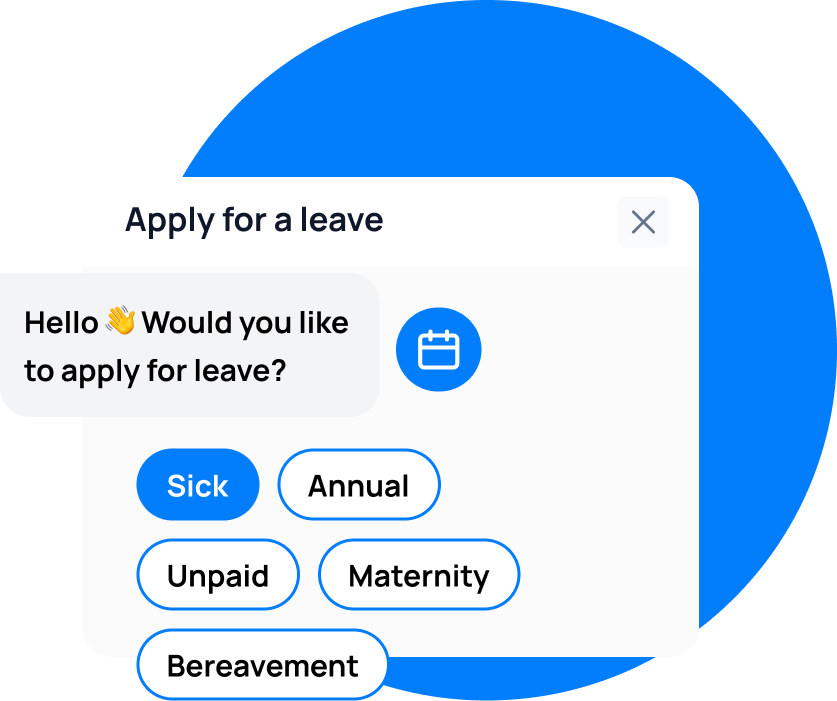
Integrated where you work. With native Slack and Teams integration, leave requests and approvals happen in the tools your team already uses — no extra apps to check.
Built to scale. When you expand into Europe, add contractors with different entitlements, or introduce new leave types, Leave Balance handles it all from the same dashboard with multi-country support and custom policies per region.
Start your 14-day free trial — no credit card required — and see how Leave Balance can be the leave management foundation your startup grows on.