Deputy is one of Australia’s most widely used workforce management platforms, with a strong reputation in shift scheduling, time and attendance, and mobile-first workforce coordination. It’s particularly popular in hospitality, retail, and healthcare — industries where scheduling is the core operational challenge. Leave Balance takes a fundamentally different approach, purpose-built for leave management with flat-rate pricing and native Slack and Microsoft Teams integration.
Both tools handle leave, but they exist to solve different problems. Deputy is a comprehensive shift scheduling and workforce management platform where leave management is one module among many. Leave Balance is a dedicated leave management tool designed to be simple, affordable, and deeply integrated into where your team already communicates.
If you’re evaluating both, this comparison covers everything you need to make an informed decision: pricing models, feature scope, integrations, reporting, and the day-to-day experience of using each platform.
We’ll be straightforward about where each tool excels and where it falls short.
The Core Difference: Per-User Shift Scheduling vs Flat-Rate Leave Tracking
The most fundamental difference between Deputy and Leave Balance is not just pricing — it’s what you’re paying for.
Deputy uses per-user pricing across tiered plans:
- Scheduling plan: AUD $5/user/month (scheduling only)
- Time & Attendance plan: AUD $5/user/month (time tracking only)
- Premium plan: AUD $7/user/month (scheduling + time + performance)
- Enterprise plan: Custom pricing (AUD $9+/user/month estimated)
- Leave management is included within the broader platform modules
- A typical team using scheduling and time tracking pays AUD $5-9/user/month
Leave Balance uses flat-rate pricing:
- AUD $29/month (monthly billing)
- AUD $290/year (annual billing)
- Unlimited employees and policies included
- 14-day free trial, no credit card required
Here’s what that looks like in practice, using a mid-range Deputy estimate of $7/user/month (Premium plan):
| Team size | Deputy (~$7/user) | Leave Balance |
|---|---|---|
| 5 employees | AUD $35/mo | AUD $29/mo |
| 10 employees | AUD $70/mo | AUD $29/mo |
| 25 employees | AUD $175/mo | AUD $29/mo |
| 50 employees | AUD $350/mo | AUD $29/mo |
| 100 employees | AUD $700/mo | AUD $29/mo |
| 200 employees | AUD $1,400/mo | AUD $29/mo |
The crossover point is around 4-5 employees. Above that, Leave Balance is cheaper — and the gap widens dramatically with headcount. At 50 employees, you’re saving AUD $321/month. At 100, you’re saving AUD $671/month. At 200, you’re saving AUD $1,371/month.
Even on Deputy’s lower-tier Scheduling plan at $5/user/month, a 30-person team is paying AUD $150/month compared to Leave Balance’s flat AUD $29/month. On the Premium plan, that same 30-person team pays AUD $210/month. The economics are straightforward: per-user pricing always scales with headcount, flat-rate pricing doesn’t.
It’s worth noting that Deputy’s pricing reflects the breadth of its platform — you’re paying for shift scheduling, time and attendance, demand forecasting, and more. If you need all of those capabilities, the per-user cost may be justified. If you primarily need leave management, you’re paying for functionality you won’t use.
Shift Scheduling and Workforce Management
This is where the comparison gets interesting, because Deputy has a genuine competitive advantage that deserves honest recognition.
Deputy’s Scheduling Engine
Deputy’s biggest strength is its shift scheduling and workforce management suite. It does this exceptionally well:
- Drag-and-drop roster building — create and publish schedules quickly, with templates for recurring patterns
- Demand forecasting — predict staffing needs based on historical sales data, weather, events, and other business metrics
- Auto-scheduling — algorithmically assign shifts based on employee availability, skills, labour costs, and compliance rules
- Shift swapping and availability — employees can set availability, swap shifts, and pick up open shifts through the mobile app
- Labour cost optimisation — real-time visibility into scheduled labour costs versus budgets
- Break compliance — automated break scheduling and compliance tracking
- Multi-location support — manage schedules across multiple venues or sites from a single account
This is genuinely excellent functionality. For businesses where scheduling is the daily operational challenge — restaurants, retail stores, healthcare facilities, warehouses — Deputy’s scheduling engine is one of the best in the market. The demand forecasting alone can save hospitality businesses significant money by matching staffing levels to expected demand rather than guessing.
Deputy’s Mobile App
Deputy’s mobile app deserves specific mention because it’s a real strength:
- Employees can view schedules, clock in/out, swap shifts, and request leave from their phones
- GPS-verified clock-in ensures employees are at the correct location
- Push notifications for schedule changes, new shifts, and leave updates
- Facial recognition for time clock verification
- Available on iOS and Android with strong reviews in both app stores
For shift-based workforces where employees don’t sit at desks, the mobile app is the primary interface — and Deputy has invested heavily in making it excellent. If your team needs to manage their work life from their phone, Deputy’s app experience is polished and reliable.
Leave Balance’s Approach
Leave Balance is not a scheduling tool — and it doesn’t claim to be. It doesn’t offer rostering, shift scheduling, demand forecasting, or time clocks. It focuses entirely on leave management, and does that one thing with depth and focus that a broader platform typically doesn’t match.
Which Approach Suits You?
If your business runs on shifts and rosters — particularly in hospitality, retail, healthcare, or logistics — Deputy’s scheduling engine is genuinely valuable. The ability to forecast demand, auto-schedule shifts, and manage availability across a large casual or part-time workforce is a real operational advantage. Leave management within Deputy makes sense because your team is already using the platform for scheduling.
If your team is primarily office-based with standard working hours and doesn’t need shift scheduling, Deputy’s core value proposition doesn’t apply. You’d be paying for a scheduling platform to get access to a leave module. That’s like buying a Swiss Army knife when you only need the bottle opener.
Slack and Microsoft Teams Integration
This is where the two tools diverge significantly in their approach to daily use.
Deputy
Deputy is primarily a standalone web and mobile platform. Employees interact with leave through the Deputy app or web portal:
- Leave requests are submitted through the Deputy interface or mobile app
- Approvals happen within the Deputy platform
- No native Slack or Microsoft Teams integration for leave workflows
- Push notifications through the Deputy mobile app
- Integrations exist with payroll platforms and POS systems, but not with workplace chat tools
- Designed for workforces that interact with dedicated mobile apps and physical time clocks
For shift-based workforces where employees clock in and out and check their rosters on the Deputy app, this makes perfect sense. Workers are already interacting with Deputy every shift, so adding leave into the same interface is logical. However, for office-based teams where nobody is clocking in, checking rosters, or swapping shifts, the Deputy app becomes yet another tool employees need to download, remember their login for, and check periodically.
Leave Balance
Leave Balance was built with Slack and Teams integration as a core feature, not an afterthought:
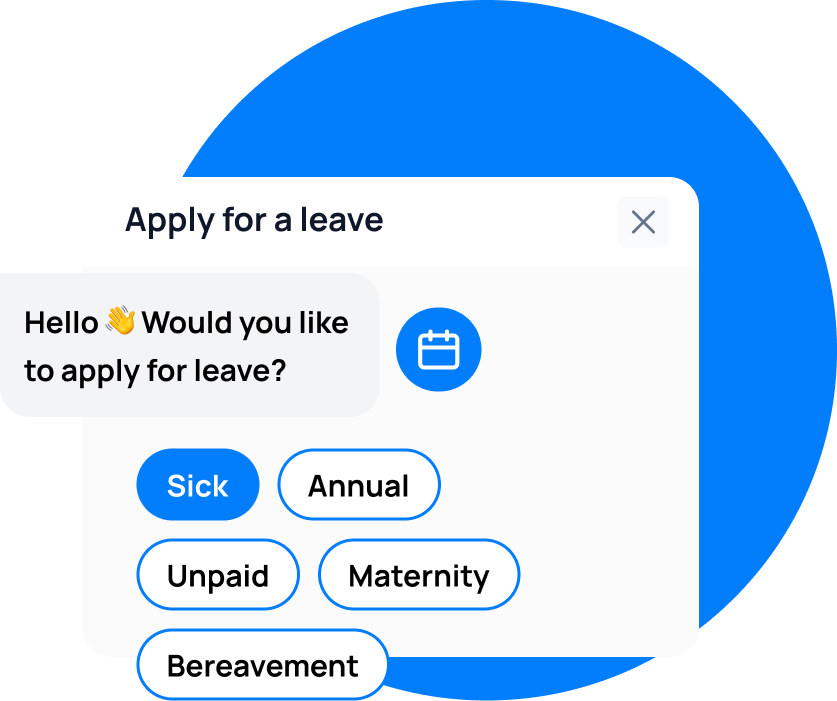
- Full workflow in Slack/Teams — employees request leave, managers approve or decline, all within the chat app
- Balance checks — employees can check their remaining entitlement without leaving Slack or Teams
- Team visibility — see who’s off today, this week, or any date range
- Both platforms supported — works in Slack and Microsoft Teams, useful for organisations using both or planning to switch
- Minimal context-switching — leave management happens where work conversations already happen
If your team lives in Slack or Teams — as most office-based knowledge workers do — Leave Balance fits into existing workflows without asking anyone to learn another tool. There’s no adoption hurdle because employees are already in Slack or Teams every day. A leave request takes seconds, and managers can approve from a notification without breaking their flow.
If your team is on the shop floor, in a kitchen, or on a hospital ward, they’re not in Slack all day — they’re checking their shifts on an app between customers. In that context, Deputy’s mobile-first approach makes more sense. The key question is: where do your employees spend their working day? If it’s in Slack or Teams, meet them there. If it’s behind a counter or on the floor, a dedicated app is the right call.
leave emails? Track your employee's leave with Leave Balance
What Each Tool Actually Does
It’s important to understand the scope of each platform, because they’re solving fundamentally different problems.
Deputy Is a Shift Scheduling and Workforce Management Platform
Deputy offers a comprehensive suite of workforce management tools:
- Shift scheduling and rostering — drag-and-drop roster building with templates, auto-scheduling, and demand forecasting
- Time and attendance — clock in/out via mobile app, web, or kiosk mode with GPS and facial recognition verification
- Leave management — one module within the larger platform for managing leave requests and balances
- Demand forecasting — predict staffing needs using sales data, weather, and historical patterns
- Shift swapping and open shifts — employees can manage availability and trade shifts through the app
- Labour cost management — real-time budget tracking against scheduled and actual labour costs
- Break compliance — automated break scheduling to meet regulatory requirements
- News feed and communications — internal messaging for team updates and announcements
- Payroll and POS integrations — connects with Xero, MYOB, ADP, and major point-of-sale systems
Leave Balance Is a Leave Management Tool
Leave Balance focuses entirely on leave management:
- Leave requests and approvals — streamlined workflows through Slack, Teams, or web
- Team calendar and visibility — see who’s off at a glance, plan around absences
- Leave policy configuration — unlimited custom policies for different groups, locations, and leave types
- Analytics and reporting — leave trends, utilisation rates, and team absence patterns
- Slack and Teams integration — native, deep integration with the tools your team already uses
- Multi-country support — manage leave across multiple countries with different statutory requirements
Deputy does many things, and does several of them very well — particularly scheduling. Leave management is one module within a larger workforce management suite. Leave Balance does one thing — leave management — and goes deep on it. The question is whether you need the full suite or just the leave management piece.
This is the classic “platform vs point solution” decision. Platforms offer breadth and consolidation — one vendor, one login, one invoice. Point solutions offer depth and focus — better at the specific problem they solve, often at a lower cost. Neither approach is inherently better; it depends on what your business actually needs.
Reporting and Analytics
Deputy
Deputy’s reporting reflects its workforce management focus:
- Labour cost reporting tied to scheduled and actual hours worked
- Shift efficiency and scheduling adherence analytics
- Attendance and punctuality tracking with late clock-in reporting
- Demand vs staffing analysis to identify over- and under-staffing
- Payroll-ready exports with detailed hour breakdowns
- Leave balances and usage within the broader workforce context
- Location-based reporting for multi-site operations
Deputy’s analytics are powerful when you need to understand the full picture of workforce costs — how much labour is costing you per shift, per location, per role. This is invaluable for hospitality and retail operations managing tight margins where a few percent improvement in scheduling efficiency translates directly to profitability.
Leave Balance
Leave Balance’s reporting is focused entirely on leave:
- Real-time dashboards with visual breakdowns of leave usage
- Leave trends over time — spot patterns before they become problems
- Department and team comparisons for absence rates
- Custom date range reporting for any period
- Policy utilisation tracking — understand which leave types are being used and which aren’t
- Exportable data for payroll integration and compliance records
For teams that need to understand absence patterns, plan for peak holiday periods, or identify potential burnout signals from unused leave, Leave Balance provides focused, actionable insights. For teams that need to optimise shift costs and labour efficiency, Deputy’s broader analytics are more relevant.
Setup and Daily Experience
Deputy
Deputy’s setup reflects the scope of its platform:
- Roster templates need to be created for your team structure and shift patterns
- Employee profiles include availability, skills, pay rates, and location assignments
- Time clock configuration — choosing between mobile, web, or kiosk clock-in methods
- Integration setup with your payroll provider and POS system
- Leave policies need to be configured within the workforce management context
- Onboarding is generally straightforward but requires configuration across multiple modules
- Setup time varies from a few hours to a few days depending on the number of locations and complexity
The daily experience depends on your role and industry. For shift workers, Deputy is a regular companion — checking rosters, clocking in, swapping shifts. For managers, it’s a scheduling and operational tool used throughout the day. The mobile app is polished and well-designed, which matters for platforms where the app is the primary interface.
Leave Balance
Leave Balance is designed for quick setup:
- Connect Slack and/or Microsoft Teams
- Add employees and configure leave policies
- Set approval workflows
- Operational in under 15 minutes
The daily experience centres around Slack and Teams. An employee wants to take leave — they submit a request in Slack. Their manager gets a notification and approves it in Slack. The team calendar updates automatically. There’s no separate app to open, no portal to log into for routine leave tasks. The web dashboard is there when you need it for configuration, reporting, and policy management, but day-to-day leave management happens in the tools your team already uses.
The difference in setup time reflects the difference in scope. Deputy needs more configuration because it manages more — scheduling, time tracking, integrations, and leave. Leave Balance is quick to set up because it’s focused on doing one thing well.
For small businesses without a dedicated HR team, setup complexity matters. If you’re a founder or office manager trying to get leave tracking sorted on a Friday afternoon, the difference between “operational in 15 minutes” and “operational after configuring rosters, time clocks, and integrations” is meaningful.
The Honest Limitations
No tool is perfect for every situation. Here’s where each falls short.
Where Deputy Falls Short
- Leave is a secondary feature — Deputy was built for shift scheduling, and leave management is one module within a much larger platform, not the core focus
- Per-user pricing scales with headcount — costs grow linearly with your team size, which can become significant for larger organisations
- No Slack or Teams integration for leave workflows — for office-based teams that live in chat tools, this is a notable gap
- Overkill for office-based teams — if you don’t have shift workers, rosters, or time clock requirements, much of Deputy’s functionality sits unused
- Scheduling-centric design — the platform’s UX and feature priorities reflect its scheduling DNA, which means leave management doesn’t get the same depth of attention as rostering
- Feature breadth can mean complexity — even if you only need leave tracking, you’re navigating a platform designed for comprehensive workforce management
Where Leave Balance Falls Short
- No shift scheduling or rostering — if you need to create and manage employee rosters, you’ll need a separate tool
- No time and attendance tracking — no clock in/out functionality, GPS tracking, or timesheet management
- No demand forecasting — if you need to predict staffing levels based on business data, Leave Balance doesn’t do this
- No direct payroll integration — leave data can be exported but doesn’t feed directly into payroll calculations the way Deputy connects with Xero, MYOB, or ADP
- Not designed for shift-based workforces — if your employees work variable shifts and need to manage availability, swap shifts, and check rosters, Leave Balance doesn’t address those needs
- Newer in the market — Deputy has a larger install base and longer track record, particularly in the Australian hospitality and retail sectors
Choose Deputy If:
- Your business is shift-based — hospitality, retail, healthcare, logistics, or similar industries where scheduling is the daily operational challenge
- You need demand forecasting and auto-scheduling to optimise labour costs against expected business volume
- Time and attendance tracking with GPS-verified clock-in/out is a requirement
- Your employees primarily interact with work tools through a mobile app rather than Slack or Teams
- You need shift swapping, availability management, and open shift broadcasting for a casual or part-time workforce
- You want a single platform for scheduling, time tracking, and leave rather than separate tools
- You operate multiple physical locations and need to manage staffing across sites
- Your workforce includes employees who don’t sit at desks and need a mobile-first experience
Choose Leave Balance If:
- Your team is primarily office-based and doesn’t require shift scheduling, rosters, or time clocks
- Your team uses Slack or Microsoft Teams as its main communication tool and you want leave management to happen there
- You want simple, affordable leave tracking without paying for scheduling, time and attendance, and demand forecasting you don’t need
- Your team is 5+ people and you want flat-rate pricing that doesn’t scale with headcount
- You have (or plan to have) employees in multiple countries — Leave Balance supports multi-country leave policies natively
- Budget matters — AUD $29/month vs AUD $350/month for a team of 50 is a significant difference
- You want to be set up in 15 minutes rather than configuring rosters, time clocks, and integrations
- Your payroll provider already handles everything else and you just need a clean leave management layer on top
The Bottom Line
Deputy is an excellent shift scheduling and workforce management platform, particularly strong in Australian hospitality, retail, and healthcare. Its scheduling engine, demand forecasting, and mobile app are genuinely best-in-class for shift-based operations. If you need to build rosters, track time and attendance, forecast staffing requirements, and manage a workforce that operates in shifts — Deputy delivers real value. Leave management within Deputy makes sense when your team is already using it for everything else.
But most office-based Australian SMBs don’t need shift scheduling, time clocks, demand forecasting, or auto-rostering. They need a clean, affordable way to track who’s off and manage leave requests — ideally without asking everyone to download yet another app. That’s exactly what Leave Balance does, at a fraction of the cost, integrated directly into Slack and Microsoft Teams where your team already works.
The pricing difference is clear. At 50 employees, you’re looking at AUD $350/month for Deputy versus AUD $29/month for Leave Balance. At 100 employees, it’s AUD $700/month versus AUD $29/month. If you’re not using the scheduling and workforce management capabilities that justify Deputy’s per-user pricing, that’s a meaningful amount of money going to unused functionality.
The best way to decide is to be honest about what your business actually needs. If your team works in shifts and you need a scheduling platform, choose a scheduling platform. If your team sits at desks and you need leave management, choose a leave management tool. Deputy does the former exceptionally well. Leave Balance does the latter — simply, affordably, and right where your team already works.
The best way to decide is to try both. Deputy offers a free trial for teams to explore its scheduling and workforce management features, and Leave Balance offers a 14-day free trial with no credit card required. If you’re an office-based team that primarily needs leave tracking, start with Leave Balance and see whether it covers your needs. If you discover you also need shift scheduling and time tracking, you’ll know Deputy is worth evaluating.
Most teams know within a few days which tool fits their workflow better.
leave emails? Track your employee's leave with Leave Balance