Smartly was one of New Zealand’s most popular payroll platforms for small and medium businesses. It handled pay runs, tax calculations, and basic leave tracking for thousands of Kiwi employers. Then Deel acquired it, and the landscape shifted. Many NZ businesses are now reassessing their leave management setup — either because the Deel transition changed their workflow, because pricing structures evolved, or simply because they realise a payroll platform’s leave module was never quite enough.
Leave Balance takes a fundamentally different approach. It is a dedicated leave management tool with flat-rate pricing, native Slack and Microsoft Teams integration, and support for New Zealand’s Holidays Act requirements. It does not do payroll. It does one thing — leave management — and does it well.
If you are a New Zealand business evaluating your options after the Smartly-to-Deel transition, this comparison covers what matters: pricing, Holidays Act compliance, daily workflow, feature depth, and where each tool falls short.
Key Takeaways
- Smartly (now Deel) is a payroll platform with basic leave tracking built in. Leave management is a secondary feature alongside pay runs, tax, and compliance reporting.
- Leave Balance is a purpose-built leave management tool at NZD $29/month flat — unlimited employees, unlimited policies, native Slack and Teams integration.
- The Deel acquisition means Smartly’s future direction is shaped by a global payroll company, not a NZ-focused SMB tool. Feature priorities and pricing may continue to shift.
- If your primary need is leave management with Holidays Act compliance, a dedicated tool gives you more depth, better daily workflow, and dramatically lower cost than a payroll platform’s leave module.
The Smartly-to-Deel Transition: What Changed for NZ Businesses
Smartly built a strong reputation among New Zealand SMBs as a straightforward payroll platform. It was locally built, reasonably priced, and understood the nuances of PAYE, KiwiSaver, and Holidays Act calculations. For many small businesses, it was the first step away from manual payroll.
Deel’s acquisition changed the equation in several ways:
- Global focus replaces local focus. Deel is a global payroll and contractor management platform operating in 150+ countries. New Zealand SMB needs are no longer the primary product roadmap driver.
- Pricing model evolution. Deel’s pricing structure differs from Smartly’s original model. As the platform integrates into Deel’s broader offering, pricing transparency for NZ-only features may shift.
- Feature bloat risk. A global payroll platform naturally accumulates features that NZ small businesses do not need — contractor management, employer of record services, global compliance modules. You end up paying for complexity that is irrelevant to a 20-person Wellington consultancy.
- Leave management remains a secondary feature. Whether under the Smartly brand or Deel, leave tracking is a module within a payroll product. It handles the basics — leave balances, accruals, simple requests — but it is not the product’s core focus.
None of this means Deel is a bad platform. For businesses that need global payroll, contractor management, and multi-country compliance, Deel is a serious contender. But if your primary pain point is managing leave for a New Zealand team, you are using a global payroll platform to solve a leave management problem.
Pricing: Payroll Platform vs Dedicated Leave Tool
Smartly’s original pricing was competitive for NZ payroll. Under Deel, the pricing model has evolved to reflect a broader global platform.
Deel (formerly Smartly):
- Payroll pricing varies by plan and employee count
- NZ-specific payroll starts from approximately NZD $10-20 per employee per month
- Leave management is included as part of the payroll module — not available as a standalone product
- You must use Deel’s payroll to access its leave features
Leave Balance:
- NZD $29/month flat (monthly billing)
- NZD $290/year flat (annual billing — saves approximately 17%)
- Unlimited employees and leave policies included
- 14-day free trial, no credit card required
Here is what the cost comparison looks like if you are evaluating leave management specifically:
| Team size | Deel payroll (~NZD $15/emp) | Leave Balance |
|---|---|---|
| 5 employees | NZD $75/mo | NZD $29/mo |
| 10 employees | NZD $150/mo | NZD $29/mo |
| 25 employees | NZD $375/mo | NZD $29/mo |
| 50 employees | NZD $750/mo | NZD $29/mo |
| 100 employees | NZD $1,500/mo | NZD $29/mo |
The comparison is not entirely apples-to-apples — Deel’s price includes payroll processing, which Leave Balance does not do. But if you already have a payroll solution (Xero, MYOB, or another provider) and you are paying Deel primarily because its leave module is convenient, the cost difference is significant. At 25 employees, you would save over NZD $4,000 per year by using Leave Balance for leave management and a simpler payroll solution for pay runs.
The flat-rate model also means your leave management cost stays the same as you hire. A business growing from 15 to 50 employees pays the same NZD $29/month throughout. With per-employee pricing, that growth triples your software cost.
Holidays Act Compliance: Payroll Module vs Dedicated Leave Tracking
New Zealand’s Holidays Act 2003 is notoriously complex, particularly for businesses with part-time or irregular-hours employees. The “greater of” rule for annual leave payment — comparing Ordinary Weekly Pay (OWP) against Average Weekly Earnings (AWE) — trips up employers regularly. The Holidays Act Taskforce found widespread non-compliance across New Zealand businesses of all sizes.
And the landscape is changing. The Employment Leave Bill 2026, introduced to Parliament in March 2026, replaces the Holidays Act entirely. Under the new legislation, leave accrues from day one at 0.0769 hours per contracted hour worked, is recorded in hours rather than days or weeks, and can be taken in partial-day increments. Sick leave and bereavement leave also become available from day one. A 24-month transition period follows Royal Assent.
Smartly/Deel’s Approach
Smartly’s leave module was built to serve payroll calculations. It tracks leave balances, calculates the OWP/AWE comparison for payment purposes, and integrates those calculations into pay runs. This is functional — it ensures employees get paid correctly when they take leave.
However, payroll-integrated leave tracking tends to be limited in scope:
- Leave requests and approvals happen within the payroll platform, which employees may only access during pay periods
- Visibility into team availability is typically secondary to payroll reporting
- Leave policy configuration is constrained by the payroll system’s structure
- Reporting focuses on payroll implications rather than absence patterns and workforce planning
Leave Balance’s Approach
Leave Balance handles Holidays Act compliance through configurable leave policies:
- Annual leave accrual aligned with statutory requirements — 4 weeks after 12 months of continuous employment, with progressive accrual
- Sick leave tracking — 10 days per year after 6 months, carrying over up to 20 days
- Bereavement leave — 3 days for immediate family, 1 day for others
- Family violence leave — 10 days paid from day one
- Public holiday tracking — all 11 national public holidays plus regional anniversary days
- Alternative holiday (lieu day) management — for employees who work on public holidays
- Unlimited custom policies — configure leave types for any scenario your business requires
- Part-time pro-rata calculations — automatic adjustment for employees on reduced hours
Leave Balance does not calculate OWP/AWE for payment purposes — that remains your payroll provider’s responsibility. What it does is give you a complete, accurate picture of who is entitled to what leave, who has taken what, and who is off when. Your payroll provider handles the payment calculation; Leave Balance handles everything else about leave management.
This separation of concerns is actually an advantage. Your payroll system is optimised for calculating pay. Leave Balance is optimised for managing leave workflows. Each tool does what it does best.
leave emails? Track your employee's leave with Leave Balance
Daily Workflow: Where Leave Actually Happens
This is where the difference between a payroll module and a dedicated leave tool becomes most apparent in day-to-day operations.
Smartly/Deel
Leave management within a payroll platform typically means:
- Employees log into the payroll portal to submit leave requests
- Managers approve or decline within the same portal
- The payroll system updates leave balances and reflects them in the next pay run
- Visibility into team schedules requires accessing the payroll platform
For many employees, the payroll portal is something they visit once a fortnight — to check their payslip. Submitting a leave request means remembering their login, navigating to the leave section, and filling out a form. It is functional but not where people naturally spend their working day.
Leave Balance
Leave Balance was built around the tools your team already uses:
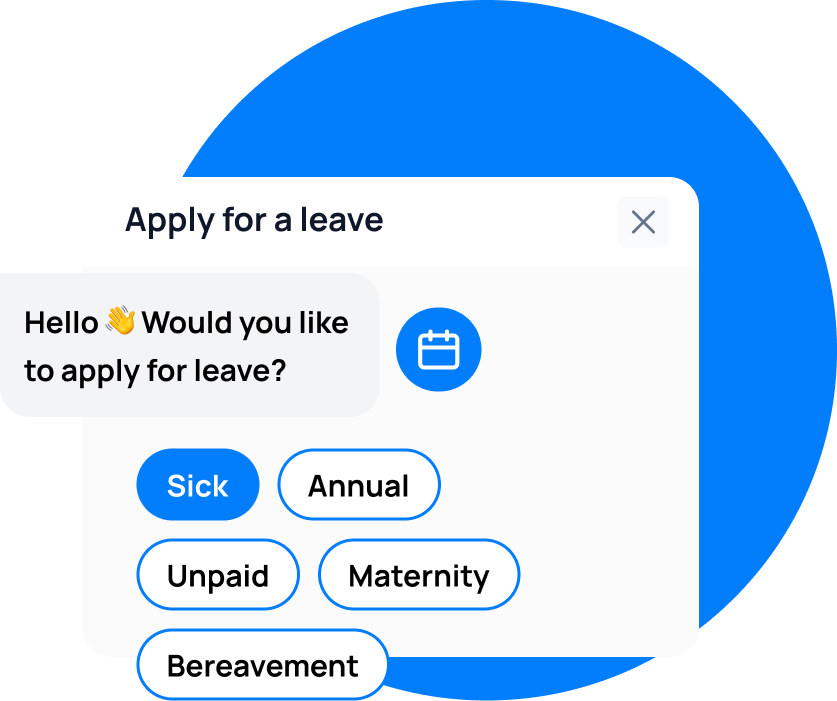
- Leave requests in Slack or Teams — employees submit a request without leaving their chat app. It takes seconds.
- Manager approvals in Slack or Teams — a notification arrives, the manager taps approve or decline. Done.
- Balance checks in Slack or Teams — employees type a command and see their remaining entitlements instantly.
- Team calendar — visual overview of who is off today, this week, or any period. Accessible via web dashboard or Slack/Teams.
- No separate login required — for routine leave tasks, employees and managers never leave Slack or Teams.
The web dashboard is there for configuration, policy management, and detailed reporting. But the daily workflow — requesting leave, approving it, checking balances, seeing who is available — happens where your team already communicates.
For a New Zealand business where the team lives in Slack or Teams, this is a meaningful difference. Adoption is near-instant because there is no new tool to learn. Leave requests do not get lost in email threads or forgotten because someone could not find their payroll portal login.
Feature Comparison
| Feature | Smartly/Deel | Leave Balance |
|---|---|---|
| Payroll processing | Yes (core feature) | No |
| Leave request/approval workflow | Basic (within payroll portal) | Full (Slack, Teams, web) |
| Slack integration | No | Yes (native) |
| Microsoft Teams integration | No | Yes (native) |
| Team calendar/visibility | Limited | Yes (real-time, visual) |
| Custom leave policies | Limited by payroll structure | Unlimited |
| Leave analytics and reporting | Payroll-focused | Leave-focused (trends, patterns) |
| OWP/AWE payment calculation | Yes | No (handled by payroll provider) |
| Multi-country support | Yes (Deel’s global platform) | Yes (configurable per country) |
| Alternative holiday tracking | Basic | Yes |
| Public holiday calendars (NZ) | Yes | Yes (including regional days) |
| Employee self-service | Via payroll portal | Via Slack, Teams, or web dashboard |
| Setup time | Days to weeks (payroll configuration) | Under 15 minutes |
| Pricing model | Per employee | Flat rate |
| Price (25 employees) | ~NZD $375/mo | NZD $29/mo |
Who Should Stay with Deel (Smartly)
Deel makes sense if your situation matches one or more of these:
- You need payroll processing and leave management in a single platform and do not want to manage two tools
- You operate in multiple countries and need Deel’s global payroll, EOR, or contractor management capabilities
- You have no existing payroll provider and need to set up both payroll and leave from scratch
- The Deel transition has been smooth for your team and you are satisfied with the leave module’s functionality
- You need OWP/AWE calculations integrated directly into payroll without exporting data between systems
Who Should Switch to Leave Balance
Leave Balance is the better choice if:
- Your primary frustration is leave management, not payroll — you want better visibility, simpler workflows, and Slack or Teams integration
- You already use Xero, MYOB, or another payroll provider and Deel’s payroll is redundant
- Your team uses Slack or Microsoft Teams and you want leave management to happen there instead of a separate portal
- Budget matters — NZD $29/month flat versus NZD $375/month (at 25 employees) is a significant saving
- You want deeper leave-specific features — team calendars, absence analytics, custom policies, and reporting focused on leave patterns rather than payroll outputs
- You are growing and want a leave management cost that does not increase with every new hire
- You want to be operational in 15 minutes, not days or weeks of payroll configuration
Preparing for the Employment Leave Bill 2026
The Employment Leave Bill 2026 will fundamentally change how leave works in New Zealand. Under the new law:
- Leave accrues from day one of employment, not after qualifying periods
- Accrual is recorded in hours (0.0769 hours per contracted hour for annual leave, 0.0385 for sick leave)
- Employees can take leave in partial-day increments
- A Leave Compensation Payment (LCP) of 12.5% replaces the current 8% pay-as-you-go option for casual and irregular hours
- Bereavement and family violence leave are available from day one
- Employers must provide itemised pay statements showing leave accrual each period
The 24-month transition period means businesses need to start preparing now. Whichever tool you use, it needs to adapt to hourly accrual tracking and the new calculation methods.
Leave Balance’s policy configuration is designed to be flexible — custom accrual rules, hourly tracking, and policy-per-group settings mean the platform can adapt to the new legislative framework as it takes effect. A dedicated leave tool has a structural advantage here: its entire product roadmap is focused on leave management changes. A global payroll platform has to balance NZ legislative changes against feature requests from 150+ other countries.
Frequently Asked Questions
Can I use Leave Balance alongside my existing payroll provider?
Yes. Leave Balance is designed to work alongside your payroll system, whether that is Xero, MYOB, or another provider. Leave Balance handles leave requests, approvals, balances, and team visibility. Your payroll provider handles payment calculations and pay runs. Data can be exported from Leave Balance for payroll processing.
Does Leave Balance calculate Ordinary Weekly Pay and Average Weekly Earnings?
No. OWP and AWE calculations for payment purposes remain your payroll provider’s responsibility. Leave Balance tracks entitlements, balances, and usage — ensuring you have accurate leave data to feed into your payroll system.
What happens to my leave data if I switch from Smartly/Deel?
Leave balances and accrued entitlements can be entered into Leave Balance during setup. Historical leave data stays in your payroll system. Going forward, Leave Balance tracks all new leave activity.
Is Leave Balance compliant with the Holidays Act 2003?
Leave Balance supports configurable leave policies that align with Holidays Act requirements — annual leave, sick leave, bereavement leave, family violence leave, public holidays, and alternative holidays. It does not replace your payroll provider’s obligation to calculate correct leave payments, but it ensures your leave tracking and entitlement management is accurate.
How long does it take to set up?
Under 15 minutes. Connect Slack or Teams, add your employees, configure your leave policies, and set approval workflows. Compare that to payroll platform onboarding, which typically takes days to weeks.
The Bottom Line
Smartly served New Zealand businesses well as a local payroll platform with competent leave tracking. The Deel acquisition shifted its focus toward global payroll and workforce management — a different product for a different market. If you need global payroll capabilities, Deel delivers. If you need focused, affordable leave management for a New Zealand team, it is more tool than you need at a higher price than you should pay.
Leave Balance costs NZD $29/month regardless of team size. It lives inside Slack and Microsoft Teams where your team already works. It handles Holidays Act leave entitlements, gives you real-time visibility into who is off, and takes 15 minutes to set up. No payroll complexity, no per-employee pricing, no features you will never use.
The best way to decide is to try it. Leave Balance offers a 14-day free trial with no credit card required. If your current leave workflow involves logging into a payroll portal and navigating three menus to submit a leave request, the difference will be apparent within minutes.
leave emails? Track your employee's leave with Leave Balance