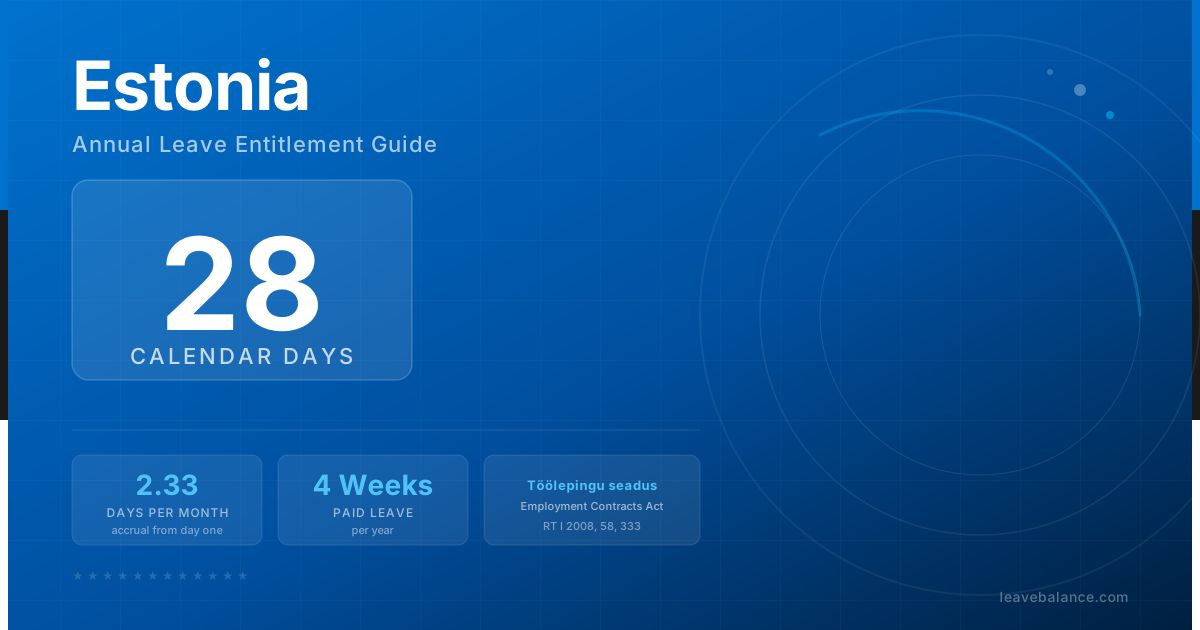
Estonia’s Töölepingu seadus (Employment Contracts Act), enacted as RT I 2008, 58, 333, guarantees every employee 28 calendar days of paid annual leave per year — equivalent to four full weeks. That figure places Estonia at or above the European Union’s minimum directive floor of four weeks, and it applies from the very first day of employment with no qualifying period to navigate. For employers operating in Tallinn or anywhere across the country, getting annual leave right is straightforward in concept but easy to get wrong on the details, particularly around how leave pay is calculated and what happens to unused leave at the end of a contract.
This guide walks through every layer of Estonia’s statutory annual leave system: the 28-day entitlement, how it accrues at 2.33 calendar days per month, the average earnings rule for leave pay, and the obligations that fall on the employer from day one of the employment relationship.
Key Takeaways
- Every employee in Estonia is entitled to 28 calendar days (four weeks) of paid annual leave per year under the Töölepingu seadus.
- Leave accrues from the first day of employment at 2.33 calendar days per month — there is no waiting period.
- Annual leave pay is calculated on the basis of average earnings, not just base salary.
- Unused annual leave must be paid out in full when employment ends — this is a statutory requirement, not a discretionary benefit.
- Estonia’s 28-day entitlement is expressed in calendar days, not working days, which is an important distinction for payroll teams used to working-day systems.
The Statutory Entitlement
Under the Töölepingu seadus, the minimum entitlement is 28 calendar days of paid annual leave per year. The law is explicit that this figure is counted in calendar days, which means weekends and public holidays that fall within the leave period are counted as part of the 28 days rather than added on top.
This calendar-day framing is worth pausing on. In countries such as the United Kingdom, statutory leave is measured in working days (28 working days for a full-time employee, which also happens to be four weeks, but calculated differently). In Estonia, the 28 calendar days means that a two-week holiday break starting on a Monday will consume 14 of an employee’s 28 calendar day entitlement — including both Saturdays and Sundays. For payroll teams running multi-country operations, this distinction matters when building leave balance trackers or configuring HR software.
Collective agreements or individual employment contracts may improve on the 28-day statutory floor, but they cannot reduce it. The Töölepingu seadus sets a minimum that applies across all employment relationships in Estonia, regardless of industry, contract type, or seniority.
How Leave Accrues
Annual leave under the Töölepingu seadus accrues continuously from the start of the employment relationship. The monthly accrual rate is 2.33 calendar days per month (28 days divided by 12 months), and there is no qualifying period before accrual begins.
This means an employee who joins on 1 January and resigns on 31 March has accrued approximately 7 calendar days of leave (3 months × 2.33 days). They are entitled to take that leave before the contract ends or receive payment in lieu on termination — the employer cannot withhold it.
The absence of a qualifying period is significant for employers who rely on probationary periods to manage new starters. Even during a probationary period, annual leave continues to accrue, and the employer’s obligations under the Töölepingu seadus apply in full from day one.
For part-time employees, the 2.33-days-per-month rate applies proportionally to their working pattern, ensuring that part-time and full-time employees accrue leave on a consistent basis relative to the time they work.
Eligibility
Annual leave entitlement under the Töölepingu seadus applies to all employees. The law does not distinguish between full-time and part-time employees, employees on fixed-term contracts, or employees on probationary periods. If a person is employed under an employment contract in Estonia, they accrue annual leave from the first day of that contract.
Self-employed individuals, freelancers, and those working under service agreements rather than employment contracts are outside the scope of the Töölepingu seadus and do not have a statutory annual leave entitlement from the Act. Employers should ensure that worker classification is correct before applying the leave rules — misclassification is a separate compliance risk.
Annual Leave Pay
One of the features of Estonian leave law that surprises employers most is the rule on how leave pay is calculated. The Töölepingu seadus requires that employees receive their average earnings during annual leave, not merely their basic salary.
Average earnings takes into account the full picture of what an employee typically earns — including variable elements such as bonuses, overtime, commissions, and allowances that form part of regular remuneration. The practical effect is that an employee who regularly earns a performance bonus on top of their base salary is entitled to have that bonus factored into their leave pay, so that taking a holiday does not leave them financially worse off than if they had worked.
For payroll teams, this means leave pay calculations require a look-back period to establish what the employee has actually earned, not just what their employment contract specifies as a fixed monthly figure. Employers who pay only the basic contract salary during leave are under-paying their employees and exposing themselves to a statutory liability.
Employer Obligations
The Töölepingu seadus places a clear set of obligations on every employer operating in Estonia:
- Grant 28 calendar days of paid annual leave per year to every employee, from the first day of employment.
- Allow leave to accrue without a qualifying period — employees do not need to complete a probationary period or a set number of months before annual leave begins to build.
- Calculate leave pay on the basis of average earnings, not just the base salary stated in the employment contract.
- Pay out all unused annual leave on termination of employment, whether the termination is initiated by the employer or the employee.
- Keep accurate records of leave accrued, leave taken, and leave pay calculated — the burden of demonstrating compliance sits with the employer, not the employee.
leave emails? Track your employee's leave with Leave Balance
Common Pitfalls
Not paying for unused leave on termination. This is the most common compliance failure we see when employers wind down an Estonian employment relationship. Unused annual leave does not lapse when a contract ends — it is a statutory debt owed to the employee, and it must be paid out in full on the termination date. Treating unused leave as forfeited on resignation or dismissal is a breach of the Töölepingu seadus.
Paying only base salary during leave. Because the average earnings rule requires a look-back calculation that includes variable pay, employers who simply pay the monthly contract salary during annual leave risk underpaying employees who receive bonuses, commissions, or regular overtime on top of their base. The gap may seem small month to month but accumulates into a material liability over the course of an employment relationship.
Treating calendar days as working days. If your HR system is configured to track leave in working days and you are operating in Estonia, the 28-calendar-day entitlement will not translate directly. A five-day working week means that a working-day system needs to account for weekends falling within leave periods separately. Misconfiguring this leads to employees appearing to have more leave than they are actually entitled to.
Forgetting accrual during probation. Estonian law does not pause leave accrual during a probationary period. An employee dismissed at the end of a three-month probationary period has accrued approximately seven calendar days of leave that must be paid out on termination.
Frequently Asked Questions
How many calendar days of annual leave does an employee in Estonia get? Every employee is entitled to 28 calendar days of paid annual leave per year under the Töölepingu seadus. This is equivalent to four weeks and applies from the first day of employment.
Does annual leave accrue from day one in Estonia? Yes. There is no qualifying period under the Töölepingu seadus. Leave accrues at 2.33 calendar days per month from the very first day of the employment relationship, including during any probationary period.
How is annual leave pay calculated in Estonia? Leave pay must be based on the employee’s average earnings, not just their base salary. Average earnings take into account all regular remuneration, including bonuses, commissions, and allowances, calculated over the relevant reference period.
What happens to unused annual leave when an employee leaves? Unused annual leave must be paid out in full on termination of employment. This applies regardless of whether the employee resigns, is dismissed, or the fixed-term contract expires. Unused leave cannot be forfeited.
Is the 28-day entitlement the same for part-time employees? All employees, including part-time employees, are entitled to 28 calendar days of annual leave per year. In practice, part-time employees may accrue leave proportionally to their working pattern, but the 28-day statutory entitlement applies as the annual floor.
How does Estonia’s annual leave compare to its Baltic neighbours? Estonia’s 28-calendar-day entitlement is consistent with the Baltic region. For a direct comparison, see our guides to annual leave in Latvia and annual leave in Lithuania. Estonia also sits close to its Nordic neighbours — Finland’s annual leave system uses a working-day framework with a higher ceiling for long-service employees, while Sweden’s annual leave rules combine a statutory minimum with one of Europe’s strongest collective-agreement cultures.
How Leave Balance Helps
Managing annual leave across multiple jurisdictions is precisely the kind of task that slips through the cracks when you rely on spreadsheets or a single-country HR tool. Estonia’s calendar-day accrual model, the average earnings pay rule, and the termination payout obligation each require accurate tracking from day one — there is no grace period once a dispute arises.
Leave Balance is built for exactly this situation. You can configure a leave policy for Estonian employees that tracks entitlement in calendar days, applies the correct accrual rate, and flags unused balances before they become a termination liability. And because Leave Balance charges a flat rate of $10 per month regardless of headcount, you can add your Estonian team members without worrying about per-seat pricing climbing alongside your payroll.
A 14-day free trial gives you time to import your employee records, configure your Estonian leave policies, and see how the platform handles the specifics of the Töölepingu seadus before committing.
leave emails? Track your employee's leave with Leave Balance
Sources
- Töölepingu seadus (Employment Contracts Act), RT I 2008, 58, 333 — Riigi Teataja, the official Estonian State Gazette
- Estonian Labour Inspectorate — annual leave guidance — ti.ee
- Social Insurance Board (Sotsiaalkindlustusamet) — sm.ee