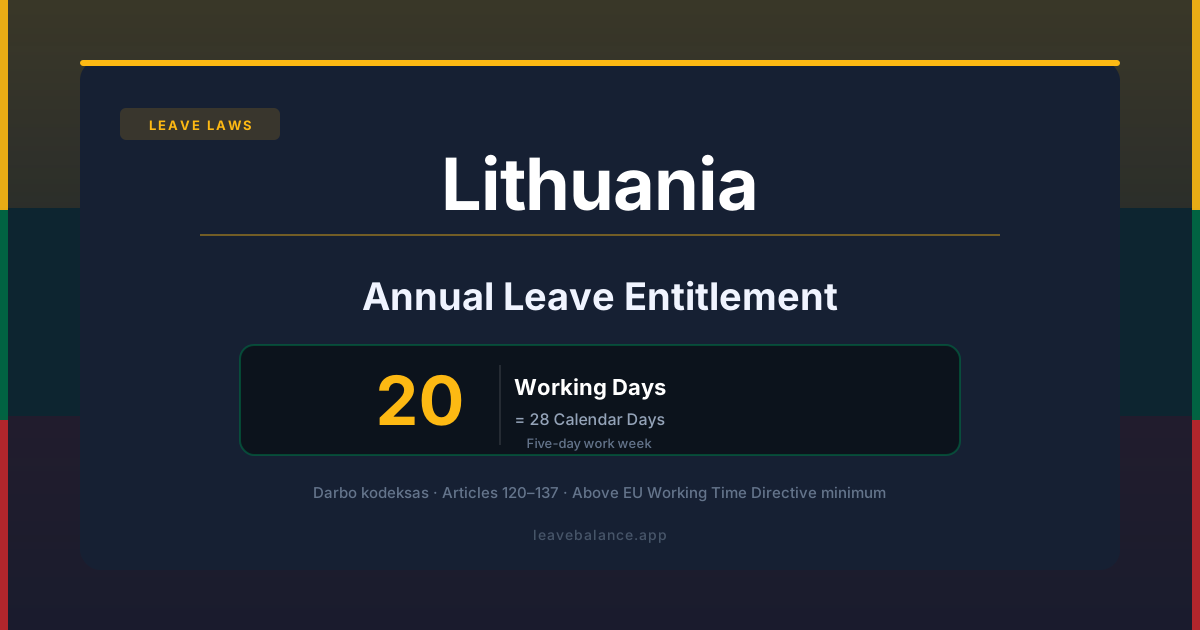
Lithuania’s Darbo kodeksas (Labour Code) sets one of the more generous annual leave floors in Central and Eastern Europe. Under Articles 120–137, every employee is entitled to a minimum of 20 working days of paid annual leave per year — equivalent to 28 calendar days for a standard five-day worker. That floor sits above the EU Working Time Directive’s 20-day calendar-day minimum, giving Lithuanian workers stronger baseline protection than the EU requires. For employers operating in Lithuania, understanding the mechanics of this entitlement — how leave accrues, how it must be paid, and what happens on termination — is both a compliance requirement and a core part of treating employees fairly.
Key Takeaways
- Lithuanian employees are entitled to a minimum of 20 working days (28 calendar days) of paid annual leave per year under the Darbo kodeksas, Articles 120–137.
- The entitlement applies to all employees regardless of contract type or length of service.
- In the first year of employment, leave is pro-rated based on months worked.
- Leave pay must equal the employee’s average earnings, not just basic salary.
- Unused annual leave must be paid out on termination — this is non-negotiable under Lithuanian law.
- Leave must be granted, not just offered; employers carry an active obligation to schedule leave.
The Statutory Entitlement
The legal basis for annual leave in Lithuania is the Lietuvos Respublikos darbo kodeksas (Lithuanian Labour Code), specifically Articles 120–137. These provisions establish a unified framework covering entitlement, accrual, scheduling, pay calculation, and carry-over rules.
The minimum entitlement is 20 working days per year. For a standard five-day working week, this converts to 28 calendar days — a measure that accounts for weekends falling within a leave period. The working-day calculation means that if an employee takes leave that spans a weekend, the weekend days do not count against their entitlement; only Monday through Friday (or whichever days the employee ordinarily works) are deducted.
This 20-working-day floor is a statutory minimum. Collective agreements or individual employment contracts can and often do provide more generous entitlements, but no agreement can lawfully reduce leave below this threshold.
Compared to Baltic neighbours, Lithuania’s entitlement is broadly aligned. You can compare the approach with annual leave entitlement in Latvia and annual leave entitlement in Estonia to see how the three countries differ in their calculation methods and carry-over rules. Further afield, Poland grants 20 or 26 working days depending on length of service, while Germany sets a 24-working-day minimum based on a six-day reference week.
Eligibility
Annual leave entitlement under the Lithuanian Labour Code applies to all employees. There is no qualifying period before an employee becomes entitled to annual leave — the right arises from the first day of employment.
First-year pro-ration. In the first year of employment, leave is pro-rated based on the number of months worked. An employee who joins mid-year accrues a proportionate share of the 20-working-day annual entitlement for the remainder of the leave year. This prevents a situation where a new joiner immediately takes the full annual entitlement before they have worked a meaningful portion of the year.
Contract type. The entitlement applies whether the employment contract is indefinite or fixed-term. Part-time employees are entitled to annual leave on the same basis; their leave is typically calculated proportionally to reflect their working hours and days.
Statutory leave year. The leave year in Lithuania generally runs on a calendar-year basis, though the specific scheduling of leave is subject to agreement between employer and employee and the employer’s approved leave schedule.
Employer Obligations
Lithuanian law places clear, affirmative obligations on employers regarding annual leave. These are not optional or discretionary — they are statutory duties.
-
Grant at least 20 working days of paid annual leave per year. Employers must actively ensure that employees take their annual leave entitlement. It is not sufficient to make leave available in theory; employers are expected to schedule and approve leave in a timely manner. The Darbo kodeksas places the scheduling responsibility partly on the employer, who must draw up a leave schedule for the year.
-
Pay the employee’s average earnings during annual leave. Leave pay is not calculated on basic salary alone. Lithuanian law requires that employees receive their average earnings during annual leave. Average earnings are calculated based on the employee’s actual remuneration over a reference period, including variable pay components such as bonuses and allowances that form part of normal pay. This means an employee who regularly receives performance bonuses should see those reflected in their leave pay calculation.
-
Pay for unused annual leave on termination of employment. When an employment relationship ends — whether by resignation, redundancy, or dismissal — the employer must pay out any accrued but unused annual leave. This payment is calculated at the employee’s average earnings rate. There is no option to forfeit unused leave on termination; the obligation to compensate is absolute under the Labour Code.
leave emails? Track your employee's leave with Leave Balance

Common Pitfalls
Even well-intentioned employers can fall into compliance gaps with Lithuanian annual leave rules. The following are the most frequently encountered problems:
Not paying out unused leave on termination. This is the single most common compliance failure. Some employers treat unused leave as simply lapsing when an employee departs. Under Lithuanian law, this is unlawful. Every day of accrued, untaken leave must be compensated at the time of termination. Employers who fail to do this expose themselves to claims and penalties.
Calculating leave pay on basic salary only. Because Lithuanian law requires payment at average earnings — not just basic salary — employers who exclude bonuses, shift allowances, or other regular pay components from the leave pay calculation are underpaying their employees. This underpayment can accumulate over time and become a significant liability.
Failing to draw up and follow a leave schedule. The Labour Code requires employers to have an annual leave schedule in place. Ad hoc leave approval without a formal schedule, or repeatedly deferring employees’ leave requests, can create legal exposure.
Assuming part-time employees have no entitlement. Part-time employees are fully entitled to annual leave. The entitlement is pro-rated to reflect their working pattern, but it exists and must be granted and paid correctly.
Allowing leave to accumulate without a carry-over plan. While carry-over rules exist, allowing large balances to accumulate without a plan creates both a financial liability and operational risk. Managing leave balances proactively — rather than reactively — is a hallmark of good leave administration.
Frequently Asked Questions
Does the 20-working-day entitlement apply from day one? Yes. All employees are entitled to annual leave from the start of employment. In the first year, the entitlement is pro-rated based on months worked rather than granted in full immediately.
What does “average earnings” mean for leave pay purposes? Average earnings are calculated over a reference period specified in Lithuanian law and typically include the employee’s base salary plus any regular additional pay components such as bonuses and allowances. The exact calculation follows rules set out in the Labour Code and related regulations. If in doubt, calculate using total remuneration divided by days worked over the reference period.
Can an employee carry over unused leave to the next year? The Labour Code permits carry-over of unused leave under certain conditions, but accumulated leave should not be allowed to roll over indefinitely. Employers are expected to ensure employees actually take their leave within a reasonable timeframe.
What happens to unused leave when an employee is made redundant? Unused annual leave must be paid out in full at the employee’s average earnings rate as part of the termination settlement. This applies whether the employee is resigning, being made redundant, or leaving for any other reason.
Can an employer and employee agree to reduce annual leave below 20 working days? No. The 20-working-day minimum is a statutory floor that cannot be reduced by any agreement — individual contract or collective agreement. Any such clause would be void under Lithuanian law.
Do public holidays count as annual leave days? Public holidays that fall during a period of annual leave do not generally count against the employee’s annual leave entitlement. The leave period is effectively extended by the number of public holidays that fall within it, ensuring employees receive the full benefit of their entitlement.
How Leave Balance Helps
Managing annual leave compliance manually — tracking accruals, calculating average earnings for leave pay, monitoring carry-over balances, and ensuring nothing slips through the cracks on termination — is time-consuming and error-prone. Leave Balance is designed to remove that administrative burden.
For a flat rate of $10 per month (unlimited employees), Leave Balance gives you a clear view of every employee’s leave balance, accrual status, and outstanding entitlement. You can set up leave policies that reflect Lithuanian statutory minimums, configure pro-rated accrual for new joiners, and generate balance reports before any termination to ensure you calculate the correct payout.
Whether you employ five people or five hundred in Lithuania, the compliance obligations are the same. Leave Balance makes it straightforward to meet them — without spreadsheets, without manual calculations, and without the risk of overlooking an entitlement on someone’s last day.
leave emails? Track your employee's leave with Leave Balance
Sources
- Lietuvos Respublikos darbo kodeksas — e-seimas.lrs.lt — the authoritative text of the Lithuanian Labour Code, including Articles 120–137 governing annual leave
- Socialinės apsaugos ir darbo ministerija (Ministry of Social Security and Labour) — socmin.lrv.lt — official guidance and policy documents on employment law in Lithuania