Annual leave in Malaysia is one of the most frequently misapplied entitlements under the Employment Act 1955 — particularly after the 2022 amendments expanded coverage to almost every employee earning a wage. Get the calculation wrong and you risk a complaint to the Department of Labour (Jabatan Tenaga Kerja Semenanjung Malaysia, or JTKSM), back-pay orders, and avoidable disputes on termination.
This guide explains exactly what you owe employees in 2026: how the 8-, 12-, and 16-day tiers work, who qualifies, how to pro-rate for new joiners, and the obligations that catch employers out at termination.
The Statutory Entitlement: 8, 12, or 16 Days
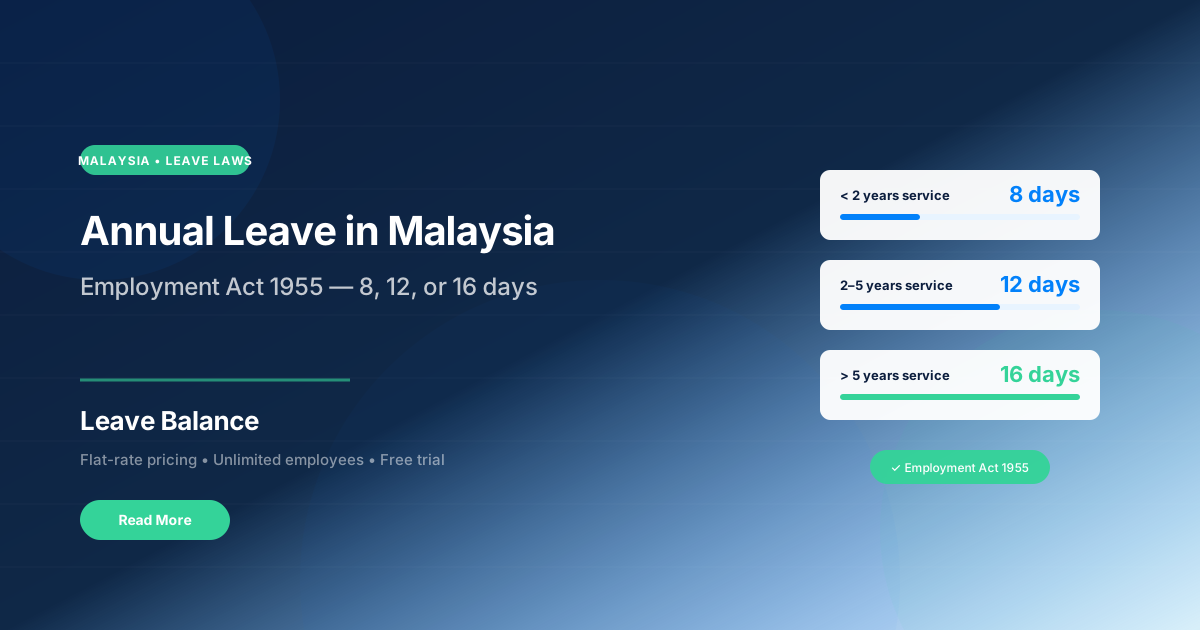
Under Part XIIC of the Employment Act 1955 (Act 265), paid annual leave is tiered by length of service with the same employer:
- Less than 2 years of service: 8 days per year
- 2 to 5 years of service: 12 days per year
- More than 5 years of service: 16 days per year
Annual leave must be paid at the employee’s ordinary rate of pay. Employers cannot deduct wages for any annual leave day taken within the statutory entitlement, and they cannot require employees to waive the entitlement. Many employers offer more generous leave through individual contracts or collective agreements — that is permitted, but the floor set by the Act always applies.
Why the tiers exist
The progressive structure rewards continuous service. An employee who joins in 2026 starts on 8 days, moves to 12 days once they cross their second anniversary, and steps up to 16 days after their fifth. The clock resets if the employment relationship ends and a new one begins, so re-employment after a break does not automatically preserve the higher tier — check the contract carefully if continuity is in dispute.
Eligibility and the 12-Month Qualifying Rule
To be entitled to the full statutory annual leave, an employee must have been employed for at least 12 months of continuous service with the same employer.
That does not mean new joiners get nothing. The Act provides for pro-rated leave based on the months worked for employees whose service is less than 12 months. The accepted approach is to grant one-twelfth of the annual entitlement for each completed month of service.
Worked example: pro-rating a new joiner
A new sales associate joins on 1 March 2026. Her contract sits within Employment Act coverage and she has no prior service, so her tier is 8 days.
- Months worked from 1 March to 31 December: 10 months
- Pro-rated entitlement: 8 ÷ 12 × 10 = 6.67 days
Most employers round up to 7 days for clean record-keeping, but the legal minimum is the calculated figure. If she leaves before completing 12 months, the same pro-rata logic governs any unused leave that must be paid out on termination.
Coverage After the 2022 Amendments
Historically, the Employment Act covered only employees earning below a wage threshold or doing manual work. The Employment (Amendment) Act 2022, in force since 1 January 2023, extended coverage to all employees regardless of wage — but with a key exception. Employees earning more than RM 4,000 per month are excluded from a small set of provisions (such as overtime and termination benefits), though paid annual leave under Part XIIC continues to apply to them.
In practice this means almost every private-sector employee in Peninsular Malaysia is now entitled to statutory annual leave. Sabah and Sarawak have their own labour ordinances with broadly similar tiers; check the Sabah Labour Ordinance or Sarawak Labour Ordinance if your employees are based in East Malaysia.
Employees outside the Employment Act
Senior executives and other employees not covered by the Act are governed by their individual employment contracts. There is no statutory minimum for these workers, but in a competitive market most contracts replicate the Employment Act tiers as a baseline, then add additional days as a benefit. If your contract is silent, the courts will often imply a reasonable entitlement consistent with industry practice.
How Annual Leave Accrues
The Employment Act does not prescribe a daily or weekly accrual mechanism the way some other jurisdictions do. The simplest compliant model is to credit the full annual entitlement at the start of each year of service for employees past their first 12 months, and to apply the one-twelfth-per-month formula during the qualifying year.
Most leave management systems track accrual continuously to make termination calculations easier. If you do that, the monthly accrual for each tier is straightforward:
- 8 days ÷ 12 = 0.667 days per month
- 12 days ÷ 12 = 1.0 day per month
- 16 days ÷ 12 = 1.33 days per month
For a comparison of how this differs from neighbouring jurisdictions, see our guides on annual leave entitlements in Australia and annual leave in New Zealand.
Public Holidays and Annual Leave Are Separate
This is one of the most common points of confusion. Public holidays do not count as annual leave in Malaysia. They are a separate statutory entitlement.
If a gazetted public holiday falls during a period of annual leave, the employer must either:
- Grant an additional day of leave in lieu, or
- Pay the employee at the ordinary rate for that day so it is not deducted from the annual leave balance
The practical effect is that an employee who takes a week of annual leave that includes Hari Kebangsaan (National Day) only uses four annual leave days, not five. Configure your leave system to detect public holidays inside annual leave windows automatically — manual handling is where most errors creep in.
Employer Obligations
Pulling the statutory rules together, employers in Malaysia must:
- Grant the statutory minimum of 8, 12, or 16 days based on length of service.
- Pay the employee’s ordinary rate of pay for every annual leave day taken.
- Inform the employee of their leave entitlement in writing — usually in the appointment letter or staff handbook.
- Allow the employee to actually take their leave within the calendar year, not just accrue it on paper.
- Pay out any unused statutory annual leave on termination of employment.
- Treat public holidays as separate from annual leave when they overlap.
A failure on any of these points exposes the employer to a complaint at JTKSM, which can order back-pay and impose penalties under the Act.
leave emails? Track your employee's leave with Leave Balance
Termination Payouts
When employment ends — for any reason, including resignation, dismissal, redundancy, or end of a fixed-term contract — the employer must pay out all unused annual leave. This is a statutory requirement, not a contractual one, so a clause in the employment contract that purports to forfeit unused leave on termination is unenforceable for the statutory portion.
Calculating the payout
Use the employee’s ordinary rate of pay at the time of termination, multiplied by the number of unused leave days.
Example: A finance executive with 4 years of service (12-day tier) earns RM 6,000 per month and works 26 ordinary days a month. He resigns with 5 days of unused annual leave for the current year.
- Daily ordinary rate: RM 6,000 ÷ 26 = RM 230.77
- Termination payout: 5 × RM 230.77 = RM 1,153.85
If he had not yet completed 12 months of service in the current year cycle, the payout would still be calculated on the pro-rated entitlement minus any leave already taken — never on a lower figure. For a deeper look at termination obligations across the region, our leave payout on termination guide for Australia walks through similar mechanics under the Fair Work Act.
Carry-Over of Unused Leave
The Employment Act does not require employers to carry over unused annual leave into the next calendar year. In strict legal terms, an employer can apply a “use it or lose it” policy provided the employee was given a genuine opportunity to take their leave during the year.
In practice, most Malaysian employers permit carry-over of a few days through company policy or collective agreement, often capped at 5 to 7 days. If your policy is to forfeit unused leave at year-end, document clearly that:
- The employee was reminded of their balance during the year
- Leave requests were not unreasonably refused
- The forfeiture rule is in the staff handbook or contract
Without that documentation, an employee who lost leave at year-end can credibly claim they were prevented from taking it — which converts the lost balance into a payable obligation on termination.
Part-Time Employees
The Employment Act, read with the Employment (Part-Time Employees) Regulations 2010, entitles part-time employees to pro-rated annual leave based on their hours of work compared with a full-time employee in the same establishment.
The formula:
(Part-time hours per week ÷ Full-time hours per week) × Full-time annual leave days = Part-time entitlement
Example: A part-time customer support agent works 24 hours a week. The full-time week is 45 hours, and the company gives full-timers 12 days. Her entitlement is (24 ÷ 45) × 12 = 6.4 days.
Tracking part-time leave in hours rather than days avoids ambiguity when working patterns change mid-year. For a step-by-step approach, see our part-time vs full-time leave guide — the mechanics are similar even though the legal source differs.
Common Pitfalls That Trigger JTKSM Complaints
The same errors come up again and again in Malaysian leave disputes. Audit your processes against this list:
1. Refusing leave to employees with under 12 months service
The Act does not allow you to deny annual leave entirely to employees in their first year. Pro-rated leave is a legal entitlement, not a discretionary benefit. Configure your HR system to grant the one-twelfth-per-month accrual from the day of joining.
2. Forgetting to pay out leave on termination
The single most common complaint at JTKSM is unpaid annual leave on termination. This is a statutory obligation that survives any contractual clause to the contrary. Build the payout calculation into your final settlement workflow so it cannot be missed.
3. Applying a single tier to all employees
A blanket “12 days for everyone” policy breaches the Act for any employee with more than 5 years of service, who is entitled to 16 days. Equally, an employer cannot reduce a long-tenured employee back to 8 days by reclassifying them. Track each employee’s continuous service date and tier them automatically.
4. Treating public holidays as part of annual leave
Counting Hari Raya, Deepavali, or Chinese New Year as annual leave days when they fall during a leave period is an underpayment. Either restore the day to the balance or pay it at the ordinary rate.
5. Losing the carry-over evidence trail
If you operate a strict “use it or lose it” rule, document the reminders and the opportunities to take leave. Without that evidence, a former employee can recover the lost days as a termination payout.
Frequently Asked Questions
Can annual leave be carried forward to the next year?
The Employment Act does not require carry-over of unused annual leave. Employers may allow it through company policy or employment contracts, and many do — typically capping carry-over at 5 to 7 days. If your policy forfeits unused leave at year-end, ensure employees were given a genuine opportunity to take it during the year.
What happens if an employee does not take their annual leave?
Unused annual leave must be paid out on termination of employment. During employment, the employer should actively encourage the employee to take their leave. If the employer prevents leave from being taken (for example, by repeatedly refusing requests), the unused balance crystallises as a debt payable at termination regardless of any forfeiture clause.
Are part-time employees entitled to annual leave?
Yes. Under the Employment (Part-Time Employees) Regulations 2010, part-time employees are entitled to pro-rated annual leave calculated by comparing their working hours to a full-time employee performing similar work. Track their entitlement in hours, not days, to handle changing work patterns cleanly.
Do annual leave entitlements apply to employees earning above RM 4,000?
Yes. Since the 2022 amendments, paid annual leave under Part XIIC of the Employment Act applies to all employees regardless of wage. The wage threshold only excludes higher-earning employees from a narrow set of other provisions, not from annual leave.
How is leave pro-rated for an employee with less than 12 months of service?
The standard approach is one-twelfth of the annual entitlement for each completed month of service. For an 8-day tier employee who has completed 6 months, the entitlement is 8 ÷ 12 × 6 = 4 days.
How Leave Balance Helps Malaysian Employers
Tracking three service tiers, pro-rating the first year, separating public holidays from annual leave, and paying out unused balances on termination is a real operational load — especially with a mixed Employment Act and non-Employment Act workforce.
Leave Balance handles every part of this automatically. Tiers update on each employee’s anniversary without manual intervention. Public holidays are excluded from annual leave windows by default. Termination payouts are calculated on the current ordinary rate of pay and exported with the final payslip. And because pricing is flat-rate at USD $10 per month with unlimited employees, you can roll it out across a Malaysian team of 5 or 500 without changing the bill.
Leave requests and approvals happen directly inside Slack or Microsoft Teams, where your team already works — no new app to learn, no extra logins to manage.
leave emails? Track your employee's leave with Leave Balance
Sources
- JTKSM — Department of Labour Peninsular Malaysia
- Employment Act 1955 (Act 265)
- Employment (Amendment) Act 2022
- Employment (Part-Time Employees) Regulations 2010
Last updated: 3 May 2026. This guide is general information for Malaysian employers and is not legal advice. The Employment Act and its regulations may change — always verify the current text on the JTKSM website or seek legal counsel for specific situations.