
Most Australian businesses start tracking leave in a spreadsheet. A shared Google Sheet, an Excel file on the company drive, maybe a hybrid of email requests and calendar entries. It works for a while — until it does not. Miscalculated leave loading, missed long service leave thresholds, accrual errors that compound over years, and the constant background risk that a Fair Work audit finds your records non-compliant. The question is not whether manual tracking costs you money. It is how much.
This article puts real numbers on the hidden costs of spreadsheet-based leave tracking for Australian businesses, builds a worked example for a 50-person company, and compares those costs to the alternative.
The Hidden Costs of Spreadsheet Leave Tracking
Manual leave tracking looks free. There is no subscription fee, no implementation project, no vendor to evaluate. But the real costs sit in four categories that most businesses never quantify: admin time, payroll errors, compliance risk, and employee experience.
A. Admin Time
For a business with around 50 employees, the person responsible for leave tracking — whether that is an HR administrator, an office manager, or a founder wearing yet another hat — typically spends 8 to 12 hours per month on leave-related administration. That time breaks down roughly as follows:
| Task | Monthly Time Estimate |
|---|---|
| Processing leave requests received via email, Slack, or verbal conversation | 2–3 hours |
| Updating the spreadsheet with approved leave, rejections, and cancellations | 1.5–2 hours |
| Calculating accruals and checking current balances | 1.5–2.5 hours |
| Answering employee queries about their remaining leave | 1–1.5 hours |
| Preparing leave data for payroll each cycle | 1–1.5 hours |
| Generating reports for managers or leadership | 0.5–1 hour |
| Total | 7.5–12 hours |
At the average Australian HR administrator salary of approximately AUD $70,000 per year (roughly $36 per hour including on-costs), those 8 to 12 hours per month translate to AUD $3,450 to $5,180 per year in direct labour costs — spent entirely on data entry and manual calculations.
For a founder or operations manager performing this work themselves, the effective hourly cost is significantly higher. If you are billing at $100 per hour or more, or if those hours could be spent on revenue-generating activity, the true opportunity cost of manual leave tracking rises well above $10,000 per year.
Every hour spent reconciling a spreadsheet is an hour not spent on hiring, onboarding, employee development, workforce planning, or any of the strategic work that actually moves a business forward.
B. Payroll Errors
Leave balance miscalculations feed directly into incorrect pay. When the spreadsheet says an employee has 12 days remaining but the correct figure is 10, or when leave loading is calculated at the wrong rate, the payroll run inherits that error.
The most common leave-related payroll errors in Australian businesses include:
- Incorrect leave loading calculations. Many Modern Awards require a leave loading of 17.5% on annual leave payments. Spreadsheets that track days taken but not the loading component create systematic underpayments — or overpayments that are difficult to claw back.
- Missed accrual during paid leave periods. Under the National Employment Standards, annual leave continues to accrue during periods of paid leave. A spreadsheet formula that stops accrual when an employee is marked as “on leave” will understate their balance.
- Incorrect pro-rata calculations for part-time employees. Part-time employees accrue leave proportional to their ordinary hours. When those hours change — which they frequently do — spreadsheet formulas need manual updating. Missed updates create compounding errors.
- Long service leave threshold miscalculations. Long service leave accrual varies by state and territory. Tracking it manually across employees with different start dates, employment types, and state jurisdictions is a recipe for error.
Research from the Australian Payroll Association indicates that payroll errors cost businesses an average of AUD $2,000 to $5,000 per incident when you account for the time required to investigate the error, calculate the correct amount, process back-pay or recovery, update records, and communicate with the affected employee.
Each underpayment — no matter how small or unintentional — creates a potential Fair Work claim. And under the current legislative framework, the consequences of underpayment have never been more severe.
C. Compliance Risk
Since January 2025, intentional wage theft is a criminal offence in Australia under amendments to the Fair Work Act 2009. The penalties are significant:
- Up to AUD $1.65 million in fines for individuals
- Up to 10 years’ imprisonment
- Up to AUD $8.25 million in fines for body corporates
The Fair Work Act requires employers to keep accurate and complete employee records for a minimum of 7 years. Those records must include leave balances, leave taken, and the basis on which leave was calculated. They must be readily accessible for inspection.
Spreadsheets fail this requirement in several critical ways:
- No audit trail. A spreadsheet does not record who changed a value, when they changed it, or what the previous value was. If Fair Work requests your leave records, a spreadsheet with no change history has limited evidentiary value.
- No version control. Overwritten cells, deleted rows, and formula errors are invisible once they occur. There is no way to reconstruct what the spreadsheet showed at a specific point in time.
- Manual compliance gaps. Common compliance failures with spreadsheet tracking include not calculating leave loading correctly under the applicable Modern Award, failing to accrue leave during paid leave periods, not distinguishing between casual and permanent employees for entitlement purposes, and missing long service leave thresholds that vary by state.
The Fair Work Ombudsman has recovered over AUD $500 million in unpaid wages and entitlements in recent years. The agency has been clear that inadequate record-keeping is treated as an aggravating factor in enforcement actions — not a mitigating one. If your records are poor, the assumption is that the underpayment was larger than what can be proved.
D. Employee Experience
The costs that are hardest to quantify are often the most corrosive. Manual leave tracking degrades the employee experience in ways that erode trust and engagement over time.
Slow approvals. When leave requests arrive by email and sit in a manager’s inbox alongside hundreds of other messages, approval times stretch from minutes to days. Employees cannot book flights, arrange childcare, or confirm plans until they hear back. In a competitive labour market, this friction matters.
No visibility into balances. In a spreadsheet-based system, the only way for an employee to check their remaining leave is to ask HR. That query interrupts the HR person’s workflow, and the answer may not come until the next business day. Employees who cannot see their own balances feel less in control and less trusted.
Disputes with no resolution path. When an employee believes their balance is wrong and the only evidence is a spreadsheet with no change history, there is no objective way to resolve the dispute. These disagreements damage the relationship between employee and employer, and they disproportionately affect the employees who are paying closest attention to their entitlements.
Reduced trust. Repeated balance errors — even small ones — signal to employees that the business does not take their entitlements seriously. In an environment where wage theft is national news, that perception carries real weight.
The Real Cost: A Worked Example
Let us put concrete numbers on this for a typical Australian business with 50 employees.
| Cost Category | Annual Cost (AUD) |
|---|---|
| Admin time (10 hours/month x $36/hour x 12 months) | $4,320 |
| Payroll error corrections (estimated 2–3 incidents/year) | $2,000–$4,000 |
| Compliance audit/remediation risk (probability-weighted) | $3,000–$10,000 |
| Employee productivity loss (approval delays, balance queries) | $1,500–$3,000 |
| Total estimated annual cost | $10,820–$21,320 |
Now compare that to the cost of Leave Balance: AUD $29 per month, which works out to AUD $348 per year. That price covers unlimited employees — it does not increase as your team grows.
The return on investment is between 31x and 61x.
Even if you discount the compliance risk entirely and only count the admin time and payroll error costs, the ROI still exceeds 18x. The numbers are not close.
leave emails? Track your employee's leave with Leave Balance
“But Our Spreadsheet Works Fine”
This is the most common objection, and it is understandable. If you have not yet experienced a compliance issue, a costly payroll error, or a leave dispute that escalated, the spreadsheet feels adequate. The problem is that spreadsheet-based leave tracking fails at precisely the moments when accuracy matters most.
When someone goes on parental leave. Parental leave interacts with annual leave accrual, personal leave, and sometimes long service leave. Calculating the correct balances across a 12-month absence with spreadsheet formulas is error-prone and time-consuming.
When a part-time employee’s hours change. Pro-rata leave accrual needs to be recalculated each time ordinary hours change. If an employee moves from 3 days per week to 4 days per week mid-year, the spreadsheet formula needs manual adjustment — and someone needs to remember to make it.
When you hire employee number 51. Spreadsheets do not scale linearly. The time required to maintain them grows faster than headcount because of the increased complexity of cross-referencing, the higher probability of formula errors, and the additional reporting requirements.
When Fair Work requests your leave records. An auditor asking for a complete leave history for a specific employee over the past 7 years will not accept “we think this is right, but we cannot prove when the values were entered or by whom.” Spreadsheets without audit trails are a liability in an enforcement action.
The risk also compounds over time. A small accrual error — say, 0.5 days per year for a single employee — becomes a 1.5-day underpayment after three years. Multiply that across 50 employees and you are looking at a potential liability that far exceeds the cost of prevention.
What Good Leave Management Software Does
The right leave management tool eliminates the manual work and the risk simultaneously. Here is what to look for:
- Automatic accrual calculations. The system calculates leave accruals based on employment type, ordinary hours, and the applicable Modern Award or enterprise agreement. No manual formulas, no risk of missed updates when hours change.
- Configurable policies per award, employee type, or location. Australia’s award system means that different employees in the same business may have different leave entitlements. Good software handles this without requiring the administrator to maintain separate spreadsheet tabs.
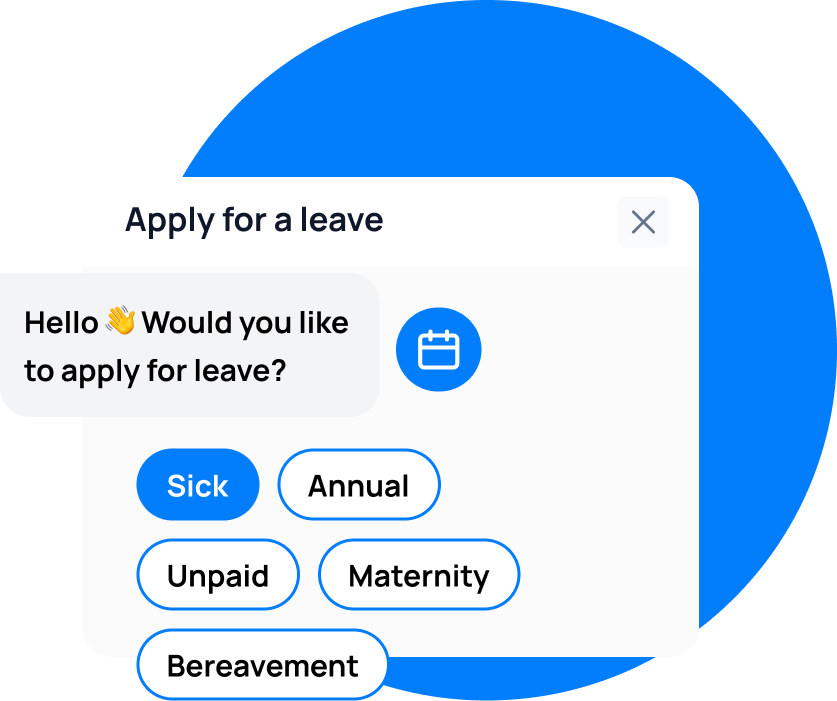
- Self-service requests and approvals. Employees submit requests through the tool, managers approve or decline with a single click, and the system updates balances automatically. No email chains, no waiting days for a response.
- Audit trail for every transaction. Every request, approval, cancellation, and balance adjustment is logged with a timestamp and the identity of the person who made the change. This is the record-keeping standard that Fair Work expects.
- Real-time balances visible to employees and managers. Employees can check their own balance at any time without asking HR. Managers can see their team’s leave at a glance for workforce planning.
- Reports for payroll, compliance, and workforce planning. Exportable reports that show leave taken, leave accrued, leave liability, and team availability — generated in seconds rather than hours.
- Integration with tools your team already uses. Slack and Microsoft Teams integrations mean that leave requests and approvals happen where your team already communicates, without switching between applications.
The Cost of Leave Management Software in Australia
One of the reasons businesses stick with spreadsheets is the assumption that leave management software is expensive. Some of it is. But the range is wide, and the cheapest option is not always the one with the lowest sticker price.
Here is a quick comparison for a 50-employee Australian business:
| Tool | Monthly Cost (50 employees) |
|---|---|
| Spreadsheet | “Free” (but AUD $10,000–$21,000/year in hidden costs) |
| Tanda | AUD $640+/month |
| Employment Hero | AUD $1,000+/month |
| Deputy | AUD $487+/month |
| Leave Balance | AUD $29/month |
The pricing models vary significantly. Most workforce management platforms charge per employee per month, which means your costs scale linearly with headcount. A platform charging $10 per employee per month costs $500/month for 50 employees and $1,000/month for 100 — and that is before implementation fees, training costs, and add-on modules.
Leave Balance takes a different approach: a flat monthly fee regardless of team size. Whether you have 10 employees or 500, the price stays the same.
How Leave Balance Helps
Leave Balance replaces spreadsheet leave tracking for AUD $29 per month — flat, with unlimited employees.
- 15-minute setup. No IT team required, no multi-week implementation. Add your team, configure your leave policies, and you are running.
- Slack and Microsoft Teams integration. Employees request leave and managers approve it without leaving the tools they already use every day.
- Automatic accrual and balance calculations. Set your policies once and the system handles the maths — including pro-rata for part-timers, leave loading, and accrual during paid leave.
- Team calendar and analytics. See who is off, when peak leave periods fall, and how leave patterns affect your team’s capacity.
- Audit trail and compliance-ready records. Every transaction is logged. If Fair Work ever asks, you have complete, timestamped records ready to export.
- Unlimited employees. The price does not change as you grow. Hire 20 more people next quarter and your leave management cost stays at $29/month.
For a 50-person Australian business spending $10,000 to $21,000 per year on the hidden costs of manual leave tracking, switching to Leave Balance pays for itself in the first week.
leave emails? Track your employee's leave with Leave Balance