Most organisations that invest in leave management software only scratch the surface of what it can do. They set up basic annual leave tracking, get everyone logged in, and call it done. The tool works, but it could be working much harder.
Whether you are using Leave Balance or another platform, the difference between a leave tool that merely exists and one that actively improves how your organisation runs comes down to configuration and habit. A well-configured system saves HR hours every week, gives managers real visibility into team capacity, and gives employees a frictionless experience that they actually want to use.
Here are five practical ways to get significantly more value from the leave management software you are already paying for.
1. Set Up Custom Leave Types Beyond the Basics
Most leave tools come with annual leave and sick leave out of the box. That is the bare minimum. If you stop there, you are missing an opportunity to make your leave system a genuine reflection of your organisation’s culture and policies.
Why It Matters
Modern workplaces offer more than just holiday and sick days. If those additional entitlements live in a separate spreadsheet, a policy document nobody reads, or worst of all, in someone’s memory, they are effectively invisible. Employees do not use what they cannot easily find, and HR ends up fielding questions that a well-configured system would answer automatically.
Leave Types Worth Adding
Consider adding these to your system:
- Volunteering days — Many organisations offer one or two paid days per year for charity work. Tracking these separately lets you report on uptake and demonstrate your CSR commitments.
- Duvet days — Increasingly popular, especially in tech and creative industries. These are no-notice mental health days that employees can take without a reason. Having them in the system normalises their use.
- Training and development days — If your organisation allocates dedicated learning time, tracking it as a leave type ensures it actually gets used and does not quietly disappear into project deadlines.
- Moving day — A common perk that employees often forget they have until they are mid-move and panicking about annual leave balances.
- Compassionate leave — Rather than handling these on a case-by-case basis through email, having a formal leave type ensures consistency and gives employees a dignified way to request time off during difficult periods.
- Time off in lieu (TOIL) — If employees work overtime and accrue compensatory time off, tracking it within the leave system prevents disputes and ensures it is actually taken.
- Religious or cultural observance days — For organisations with diverse teams, offering flexible leave for religious holidays beyond the standard bank holidays is both inclusive and practical.
How to Do It
In Leave Balance, you can create unlimited custom leave policies at no extra cost. Navigate to your policy settings, create a new leave type, set the annual allowance (or make it unlimited), and configure whether it requires approval. You can also set different policies per team, department, or country — which is particularly useful if your UK office offers volunteering days but your European offices have different arrangements.
The key is to set these up proactively, not wait until someone asks. Review your employee handbook, identify every type of leave you offer, and make sure each one has a corresponding entry in your system.
2. Use Analytics to Spot Absence Patterns Before They Become Problems
Your leave management software is sitting on a goldmine of data that most organisations never look at. Every approved request, every sick day, every pattern of behaviour is recorded — but data is only valuable if someone is actually reviewing it.
Why It Matters
Absence patterns are often the earliest indicator of deeper organisational issues. A team with consistently high Monday absence might have a workload problem. An individual whose sick leave has doubled over the past quarter might be heading for burnout. A department where nobody is taking annual leave might be understaffed and heading for a wave of exhaustion-related absence later in the year.
If you only look at absence data when there is already a problem, you have missed the window where intervention is easy and low-cost.
What to Look For
Start by reviewing these patterns monthly:
- Day-of-week trends — Are Monday and Friday absences significantly higher than mid-week? This can indicate morale issues, though it is important not to jump to conclusions. Some variation is perfectly normal.
- Team-level disparities — If one team’s absence rate is double another’s, that is worth investigating. It could signal management issues, workload imbalance, or simply that one team has had a run of genuine illness.
- Seasonal spikes — Beyond the obvious summer and Christmas peaks, look for unexpected patterns. A spike in January sick leave, for example, might correlate with seasonal affective disorder or post-holiday burnout.
- Leave balance hoarding — Employees who are not taking their leave are a risk, not a benefit. They are more likely to burn out, and in the UK, you may face carry-over complications at year end.
- Return-to-work patterns — Are certain employees regularly extending their leave with a sick day on either side? This is a sensitive area but one that data can surface objectively.
How to Do It
In Leave Balance, the analytics dashboard provides team-level and organisation-wide views of absence data. You can filter by leave type, date range, team, and individual. Set a monthly calendar reminder to review the dashboard for fifteen minutes — that small habit will surface issues weeks or months before they would otherwise reach your desk.
For UK organisations, you can also configure Bradford Factor calculations to flag absence patterns that warrant a conversation, without relying on subjective manager impressions.
leave emails? Track your employee's leave with Leave Balance
3. Configure Approval Workflows Per Team and Department
A one-size-fits-all approval workflow is better than no workflow at all, but it creates unnecessary bottlenecks and does not reflect how most organisations actually operate. Different teams have different needs, and your leave system should accommodate that.
Why It Matters
Consider the difference between a customer support team and a product development team. The support team needs strict minimum-coverage rules — you cannot have everyone off on the same day. The development team might be more flexible, but their lead needs to approve leave to manage sprint commitments. A senior executive might need board-level approval for extended leave, while a junior team member only needs their line manager’s sign-off.
When every request goes through the same approval chain, two things happen: approvals take too long because the wrong people are in the loop, and managers become approval-fatigued and rubber-stamp everything without actually checking team coverage.
What to Configure
Think about these variables for each team:
- Who approves? — Direct manager, department head, HR, or a combination? Some organisations use a two-tier system where short leave (one to two days) only needs the line manager, but longer leave requires an additional approval.
- Auto-approval rules — For certain leave types, consider whether approval is even necessary. If you offer duvet days as a no-questions-asked benefit, requiring manager approval defeats the purpose. Auto-approve them and simply notify the manager.
- Minimum coverage thresholds — Can you set rules that prevent approval if it would take a team below minimum staffing? This removes an awkward conversation from the manager’s plate and makes the policy feel objective rather than personal.
- Delegation during manager absence — What happens when the approver is on leave themselves? Configure a backup approver so requests do not sit in limbo.
- Notification timing — Some managers want instant notifications for every request. Others prefer a daily digest. Configuring this per manager reduces notification fatigue.
How to Do It
In Leave Balance, approval workflows are configured at the policy level, and you can create different workflows per team or department. Set up your team structure first, then work through each team’s needs with their manager. A fifteen-minute conversation with each team lead during initial setup will save hours of back-and-forth later.
4. Integrate With Slack or Microsoft Teams for Frictionless Adoption
The single biggest factor in whether a leave management tool succeeds or fails is adoption. And adoption is almost entirely about friction. Every extra click, every separate login, every time someone has to remember a URL — that is friction that pushes people back towards emailing their manager or updating a shared spreadsheet.
Why It Matters
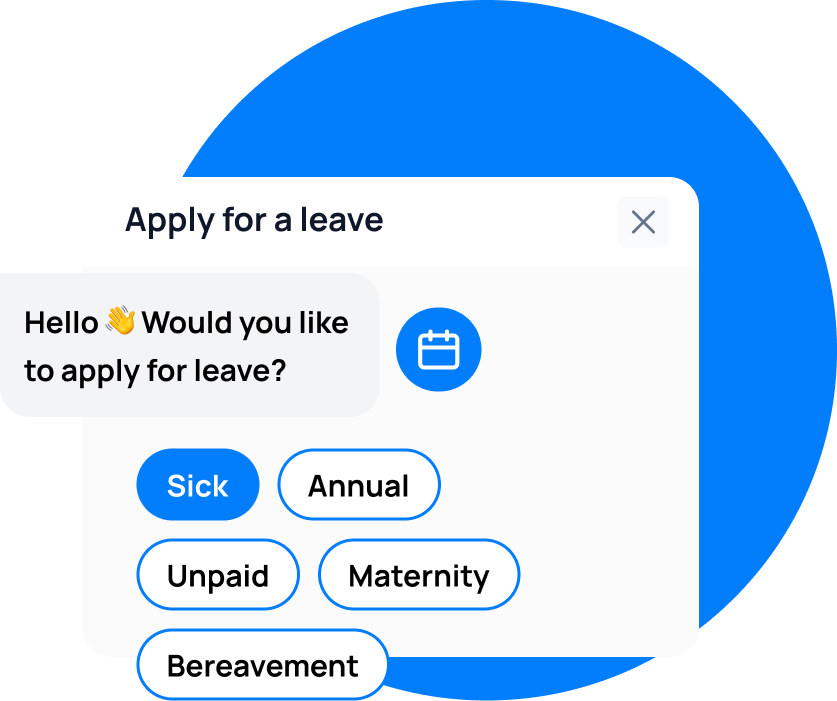
Your team already lives in Slack or Microsoft Teams. They have it open all day. Bringing leave management into that environment means employees can request leave, check their balance, and see who is off today without leaving the tool they are already using. For managers, it means approvals happen in seconds rather than hours, because the notification appears in the same place as everything else.
The data backs this up. Organisations that integrate their leave tool with their messaging platform consistently see higher adoption rates, faster approval times, and fewer “I forgot to log it in the system” situations.
What Integration Enables
A good Slack or Teams integration should let employees and managers do the following without leaving the chat platform:
- Submit leave requests — A simple command or button that opens a request form directly in Slack or Teams.
- Approve or reject requests — Managers receive a notification with all the context they need (dates, leave type, team calendar snapshot) and can approve with a single click.
- Check remaining balances — Employees can type a command and instantly see how many days they have left across all leave types.
- See who is out today — A daily summary posted to a team channel showing who is on leave. This replaces the “is Sarah in today?” messages that clutter every workplace.
- Get reminders — Nudges for employees who have not taken enough leave, or alerts when a request is pending approval.
How to Do It
In Leave Balance, the Slack integration takes under five minutes to set up. Install the app from the Slack App Directory, connect it to your Leave Balance account, and choose which channels receive notifications. The Teams integration follows a similar process through the Microsoft Teams app store.
The most important step is not technical — it is communication. When you roll out the integration, send a short message to your team explaining what they can now do in Slack or Teams, with two or three specific examples. “You can now type /leave to request time off directly in Slack” is far more effective than a generic announcement.
5. Use the Team Calendar for Capacity Planning
Most people think of the team calendar as a nice-to-have feature that shows who is on holiday. That is true, but it undersells the real value. A well-used team calendar is a capacity planning tool that prevents project delays, staffing crunches, and the awkward “we cannot deliver this because half the team is off” conversations.
Why It Matters
Without a shared view of upcoming absences, managers make commitments based on full-team availability. Then reality hits: two developers are off in the same week, the only person who knows the client account is on annual leave during the critical review period, or the entire finance team has booked the same Friday off before a bank holiday weekend.
These clashes are preventable, but only if someone is looking at the calendar before making commitments — not after.
How to Use It Effectively
Move beyond passive calendar viewing and make it an active part of your planning:
- Check the calendar before committing to deadlines — Make this a habit for every project kickoff and sprint planning session. A thirty-second glance at the team calendar can prevent a week of scrambling later.
- Identify coverage gaps early — Look two to four weeks ahead at minimum. If you see a period where multiple team members are off, you have time to adjust workloads, bring in temporary support, or reschedule deliverables.
- Use it during leave approval — When an employee requests time off, do not just check whether they have the balance. Look at the team calendar to see who else is already off during that period. This is where minimum-coverage rules (from tip three) become invaluable.
- Share it with stakeholders — If your team calendar can be shared or exported, consider giving project managers and key stakeholders read access. This reduces the “can your team deliver this by the 15th?” back-and-forth.
- Plan around predictable peaks — You already know when your busy periods are. Use the calendar to proactively manage leave around those times. Some organisations set blackout periods for critical dates; others simply encourage employees to book early so there is visibility.
How to Do It
In Leave Balance, the team calendar provides a visual overview of all approved and pending leave across your organisation. You can filter by team, department, or location. Managers can access it directly from their dashboard, and the Slack and Teams integrations can post a weekly summary of upcoming absences to relevant channels.
For maximum value, make the team calendar the first thing managers check on Monday morning. A two-minute review of the week ahead sets expectations and prevents surprises.
Making These Changes Stick
The common thread across all five tips is intentionality. A leave management tool does not improve your organisation on its own — it improves your organisation when it is configured thoughtfully and used consistently.
Here is a practical action plan:
- This week: Audit your current leave types against your employee handbook. Add any that are missing.
- Next week: Review your approval workflows with each team lead. Adjust where needed.
- This month: Set up the Slack or Teams integration and communicate it to your team.
- Ongoing: Schedule a monthly fifteen-minute review of your absence analytics dashboard.
- Quarterly: Check the team calendar for upcoming coverage gaps and adjust plans proactively.
None of these steps take more than thirty minutes. Together, they transform your leave management software from a basic tracking tool into something that actively makes your organisation run better.
leave emails? Track your employee's leave with Leave Balance