You started with a UK team. Then you hired a developer in Berlin, a designer in Amsterdam, and a marketing lead in Paris. Suddenly your simple annual leave policy — 25 days plus bank holidays — doesn’t work anymore.
Germany has different public holidays depending on which state your employee lives in. France has RTT days. The Netherlands has a different statutory minimum. And you need to track all of this in one place without creating a compliance mess.
This is the multi-country leave management problem, and it’s one of the most common growing pains for European businesses. Here’s how Leave Balance solves it — practically, with a real scenario.
The Multi-Country Leave Problem
Let’s say you run a 45-person company. Your team is distributed like this:
- United Kingdom: 28 employees (London and Manchester)
- Germany: 8 employees (Berlin and Munich)
- France: 5 employees (Paris)
- Netherlands: 4 employees (Amsterdam)
Each country has different rules. Here’s what you’re dealing with:
United Kingdom
- Statutory minimum: 5.6 weeks (28 days including bank holidays)
- Your policy: 25 days annual leave + 8 bank holidays (England) = 33 days total
- Bank holidays: 8 in England, with regional variations for Scottish and Northern Irish employees
- Carry-over: You allow 5 days to be carried over, must be used by 31 March
- Sick leave: SSP after 3 waiting days, tracked separately
Germany
- Statutory minimum: 20 days (based on 5-day working week)
- Your policy: 30 days annual leave (competitive for the German market)
- Public holidays: 10 in Berlin, 13 in Bavaria — your employees are split between both
- Carry-over: German law requires that unused leave can be carried into the next year and must be used by 31 March
- Sick leave: Employees receive full pay for 6 weeks, then Krankengeld from health insurance — you need to track the absence for both purposes
- Special leave types: Bildungsurlaub (educational leave) — 5 days per year in most states
France
- Statutory minimum: 25 working days
- Your policy: 25 days annual leave + RTT days
- RTT (Reduction du Temps de Travail): Employees working more than 35 hours per week accumulate additional days off — typically 8-12 per year
- Public holidays: 11 national public holidays
- Carry-over: Unused leave can typically be carried over, with employer agreement, but the rules are complex
- Special leave: Conge pour evenements familiaux (family event leave) for marriages, births, bereavements
Netherlands
- Statutory minimum: 20 days (based on full-time equivalent)
- Your policy: 25 days annual leave
- Public holidays: There are approximately 8 commonly observed public holidays, though not all are legally mandated
- Carry-over: Statutory leave expires 6 months into the new year; additional (bovenwettelijke) leave can have a longer carry-over period of up to 5 years
- Sick leave: Employer pays 70% of salary for up to 2 years — sickness tracking is critical
Managing all of this in a single spreadsheet is a nightmare. Managing it in software designed for a single country requires constant workarounds. Managing it in Leave Balance takes about 30 minutes of initial setup.
Setting Up Multi-Country Policies in Leave Balance
Here’s how you’d set up Leave Balance for this 45-person, four-country team.
Step 1: Create Country-Specific Leave Policies
In Leave Balance, a leave policy is a set of rules that applies to a group of employees. You can create unlimited policies at no extra cost — there’s no per-policy or per-country surcharge.
For our scenario, you’d create the following policies:
Policy 1: UK Annual Leave
- Entitlement: 25 days per year
- Accrual: Granted in full at the start of the leave year
- Carry-over: Maximum 5 days, expires 31 March
- Leave year: 1 January to 31 December
Policy 2: UK Sick Leave
- No entitlement cap (tracked for SSP and record-keeping purposes)
- Self-certification for 1-7 days, fit note required after 7 days
Policy 3: Germany Annual Leave (Berlin)
- Entitlement: 30 days per year
- Accrual: Granted in full at start of year
- Carry-over: Unlimited (with 31 March expiry per statutory requirement)
- Leave year: 1 January to 31 December
Policy 4: Germany Annual Leave (Munich/Bavaria)
- Same as Berlin policy, but linked to the Bavarian public holiday calendar (3 additional public holidays)
Policy 5: Germany Bildungsurlaub
- Entitlement: 5 days per year
- Separate tracking from annual leave
- Not carried over
Policy 6: Germany Sick Leave
- Tracked separately
- Important for monitoring the 6-week employer payment period
Policy 7: France Annual Leave
- Entitlement: 25 days per year
- Accrual: Monthly (the French system accrues leave)
- Carry-over: Configurable per company agreement
Policy 8: France RTT
- Entitlement: 10 days per year (based on your company’s agreement)
- Separate from annual leave
- Tracked and reported independently
Policy 9: Netherlands Annual Leave
- Entitlement: 25 days per year
- Carry-over: Statutory days expire after 6 months; additional days have 5-year window
- Leave year: 1 January to 31 December
Policy 10: Netherlands Sick Leave
- Tracked separately due to the 2-year employer obligation
- Critical for HR and payroll coordination
Ten policies covering four countries, two German regions, and various leave types. In Leave Balance, creating each policy takes 2-3 minutes. Total setup time: approximately 25 minutes.
Step 2: Configure Public Holiday Calendars
Each country (and region) needs its own public holiday calendar. Leave Balance includes pre-built calendars for European countries, including regional variations.
For our scenario:
- UK (England): 8 bank holidays — New Year’s Day, Good Friday, Easter Monday, Early May Bank Holiday, Spring Bank Holiday, Summer Bank Holiday, Christmas Day, Boxing Day
- Germany (Berlin): 10 public holidays — including International Women’s Day (specific to Berlin)
- Germany (Bavaria): 13 public holidays — including Epiphany, Corpus Christi, Assumption of Mary, All Saints’ Day
- France: 11 public holidays — New Year’s Day, Easter Monday, Labour Day, Victory in Europe Day, Ascension Day, Whit Monday, Bastille Day, Assumption of Mary, All Saints’ Day, Armistice Day, Christmas Day
- Netherlands: 8 commonly observed holidays — New Year’s Day, Good Friday (many employers), Easter Monday, King’s Day, Ascension Day, Whit Monday, Christmas Day, Boxing Day
Employees assigned to each country/region automatically see the correct public holidays in their calendar. They don’t need to know or care about the holidays in other countries.
Step 3: Assign Employees to Policies
Each employee is assigned to the leave policies that apply to them based on their location:
- London-based employees get: UK Annual Leave + UK Sick Leave + UK (England) public holidays
- Berlin-based employees get: Germany Annual Leave (Berlin) + Germany Bildungsurlaub + Germany Sick Leave + Berlin public holidays
- Munich-based employees get: Germany Annual Leave (Munich) + Germany Bildungsurlaub + Germany Sick Leave + Bavaria public holidays
- Paris-based employees get: France Annual Leave + France RTT + France public holidays
- Amsterdam-based employees get: Netherlands Annual Leave + Netherlands Sick Leave + Netherlands public holidays
Each employee sees only their own policies and public holidays. A developer in Berlin doesn’t see UK bank holidays. A marketer in London doesn’t see German Bildungsurlaub options. The interface stays clean and relevant.
leave emails? Track your employee's leave with Leave Balance
How It Works Day-to-Day
Once set up, the daily experience is seamless — for employees, managers, and HR.
For Employees
An employee in Paris wants to take a week off in August:
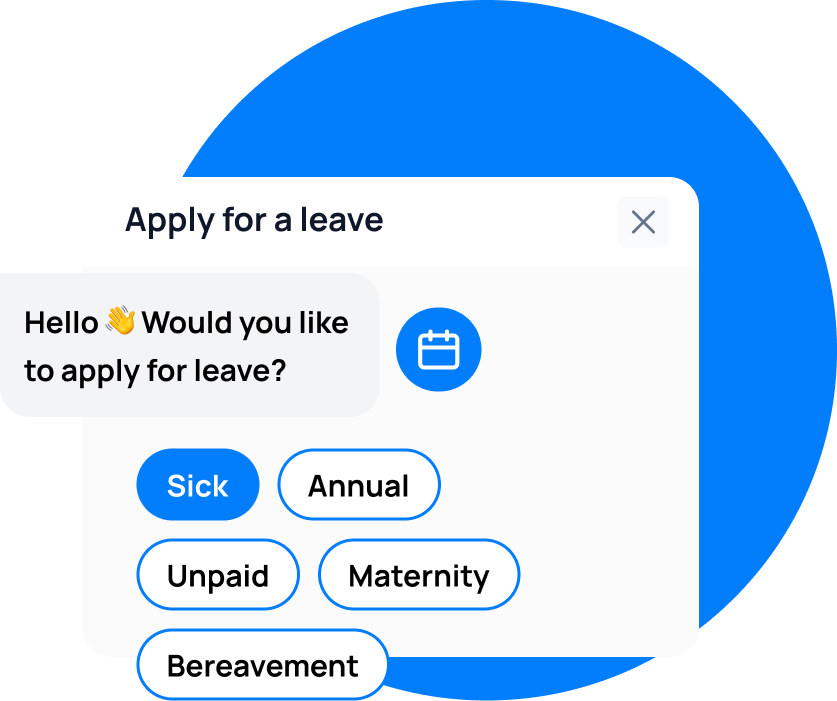
- Opens Slack (or Teams) and submits a leave request for 5 days
- The system automatically checks their French annual leave balance
- French public holidays are excluded from the count (if Assumption of Mary falls during that week, it’s not deducted from their balance)
- The request goes to their manager for approval
- Once approved, it appears on the team calendar and syncs to their personal calendar
A developer in Berlin needs Bildungsurlaub for a training course:
- Submits a request in Slack, selecting “Bildungsurlaub” as the leave type
- The system checks their Bildungsurlaub balance (5 days)
- Manager approves
- Tracked separately from their 30 days of annual leave
A team lead in London is feeling unwell:
- Submits a sick day through Slack or the web app
- Recorded under UK Sick Leave policy
- HR can monitor for SSP threshold if the absence extends beyond 3 days
For Managers
A manager with team members across countries sees everyone’s leave in one unified calendar. They can:
- View who’s off this week across all locations
- See how leave requests affect team coverage
- Approve or decline with a single click in Slack or Teams
- Review leave balances across their team
- Identify potential coverage gaps during popular holiday periods
The key insight: managers don’t need to understand every country’s leave rules. The software handles the compliance — the manager just needs to know who’s off and whether the team has coverage.
For HR and People Ops
HR gets a centralised view of leave across the entire organisation:
- Dashboard: Real-time overview of leave usage by country, department, and team
- Compliance monitoring: Track that employees in each country are taking their statutory minimum leave
- Reporting: Export leave data per country for local payroll providers
- Carry-over tracking: Monitor unused leave approaching expiry — particularly important in Germany and the Netherlands where the rules differ
- Pattern identification: Spot high absence rates by team or location
Handling Common Multi-Country Scenarios
An Employee Transfers from London to Berlin
When an employee relocates:
- Update their policy assignments — remove UK policies, add Germany policies
- Pro-rata their entitlement for the transition year
- Determine how unused UK leave is handled (this is a policy decision, but the software tracks both)
- The employee now sees German public holidays and their new entitlement
Leave Balance preserves the historical data from their UK period — you don’t lose the record of leave taken under the previous policy.
A New Country: You Hire Your First Employee in Spain
- Create a new leave policy: Spain Annual Leave (22 working days is statutory, you offer 25)
- Select the Spanish public holiday calendar (14 national holidays)
- Add any Spain-specific leave types (e.g., asuntos propios)
- Assign the new employee to these policies
Time to add a new country: approximately 10 minutes.
Year-End Carry-Over Across Countries
Leave Balance handles carry-over processing per policy. Since each country has different rules:
- UK employees: Up to 5 days carry over, must be used by 31 March
- German employees: Unused leave carries over and must be used by 31 March (statutory)
- French employees: Carry-over per company agreement
- Dutch employees: Statutory leave expires 1 July; additional leave has a longer window
The system processes each policy’s carry-over rules independently. HR doesn’t need to manually calculate carry-over country by country — it happens automatically at the configured dates.
Multi-Country Reporting for Payroll
Each country likely uses a different payroll provider or Employer of Record. Leave Balance allows you to:
- Export leave data filtered by country
- Customise export fields to match each payroll provider’s requirements
- Generate separate reports for UK payroll (Sage, Xero), German payroll (DATEV), French payroll (PayFit), and Dutch payroll (Nmbrs)
This eliminates the manual step of sorting through a single global spreadsheet to extract country-specific data.
Why Flat-Rate Pricing Matters for Multi-Country Teams
Most leave management tools charge per employee, per country, or per policy. When you have employees across four countries with 10 separate policies, the costs add up quickly.
Leave Balance charges a flat £8/month (or £80/year). That includes:
- All 45 employees across 4 countries
- All 10 (or more) custom policies
- All public holiday calendars
- Unlimited leave types
- Slack and Teams integration
If you added 20 more employees across two additional countries, the price stays the same. This predictability is particularly valuable for growing European businesses where headcount and geographic footprint change frequently.
The Multi-Country Problem, Solved
Managing leave across European countries doesn’t need to be the administrative headache it’s often made out to be. The complexity is real — different statutory minimums, different public holidays, different sick leave rules, different carry-over requirements — but it’s the kind of complexity that software handles well.
The key is choosing a tool that was designed for multi-country from the start, not one that bolted it on as an afterthought. Leave Balance’s unlimited policies, built-in European public holiday calendars, and flat-rate pricing make it particularly well-suited for companies with European teams.
If you’re currently managing multi-country leave in spreadsheets or struggling with a single-country tool, start a free 14-day trial and set up your actual country configurations. The setup takes about 30 minutes, and you’ll immediately see whether it solves your problem.
leave emails? Track your employee's leave with Leave Balance