Still validating the process? Request the free Leave Tracker Spreadsheet Template before deciding when to automate.
For many UK companies, leave tracking starts in a spreadsheet because it feels sensible. Excel is already there, everyone understands rows and columns, and a small team can usually keep the file accurate by memory.
The problem is that leave tracking stops being a list once the team grows. It becomes a compliance record, a payroll input, a manager planning tool, and an employee self-service system. A spreadsheet can imitate each of those jobs for a while, but it cannot do them reliably at scale.
Why spreadsheets break for UK leave management
Spreadsheets break because UK leave is not a single balance column. Employers need to account for statutory annual leave, bank holidays, part-time working patterns, irregular-hours workers, carry-over rules, sick leave, compassionate leave, TOIL, and payroll cut-offs.
The breaking point usually arrives around 15 to 25 employees. At that size, the business has enough requests, working patterns, and manager handoffs that one shared file becomes a source of delay and risk.
Common spreadsheet failure points include:
- Formulas copied from one employee row to another without updating working patterns
- Bank holidays treated inconsistently for part-time employees
- Leave approved in Slack or email but never entered in the tracker
- Managers approving overlapping absences because they cannot see team availability quickly
- Payroll receiving stale leave data at month-end
- Carry-over balances reset without a clear audit trail
- Former employee rows hidden or deleted, weakening record history
None of those mistakes require negligence. They happen because a spreadsheet depends on people remembering every step.
The UK compliance risk is specific
UK employers cannot treat leave tracking as informal admin. Paid holiday sits inside the Working Time Regulations, payroll errors can become unlawful deduction of wages claims, and leave records often contain personal data covered by UK GDPR.
The highest-risk spreadsheet mistakes are usually mundane:
| Risk area | Spreadsheet problem | Business impact |
|---|---|---|
| Part-time entitlement | Pro-rata formulas use the wrong full-time baseline | Underpaid holiday or inconsistent treatment |
| Irregular hours | Accrual assumptions do not match current rules | Incorrect entitlement and payroll corrections |
| Carry-over | Balances reset without separating allowed carry-over | Disputes and manual back-pay calculations |
| Sick leave | Absence reasons are stored in a broad shared file | Privacy and access-control risk |
| Payroll | Approved leave is transferred manually | Overpayment, underpayment, and correction work |
If you want the cost model behind those risks, read our detailed guide to the true cost of manual leave tracking for UK businesses.
Why companies switch before the spreadsheet completely fails
The smartest time to move is before a payroll mistake or employee dispute forces the decision. Most UK companies switch when they start seeing operational friction every week.
Employees keep asking for their balance
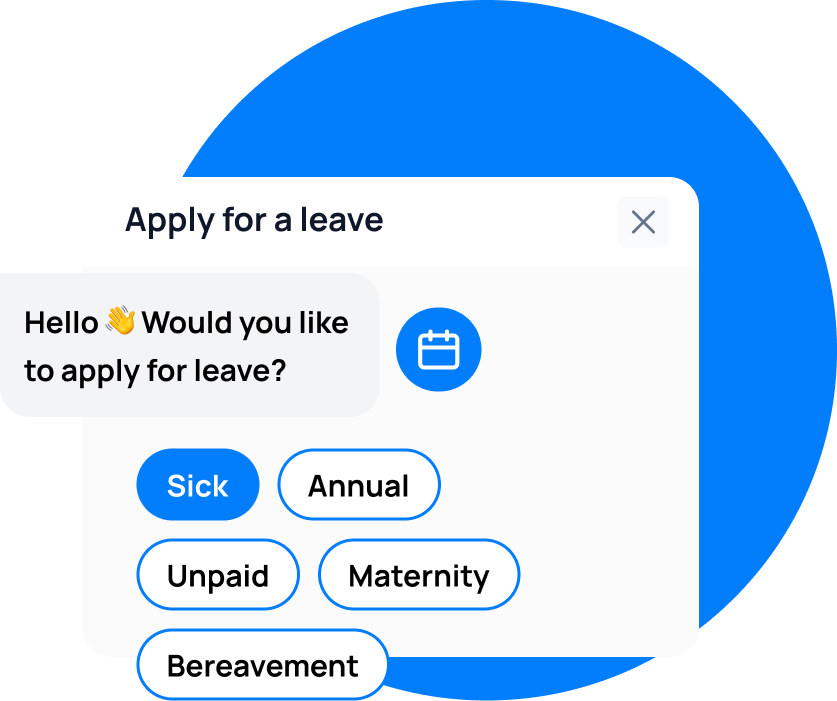
When employees cannot trust the spreadsheet or cannot access it safely, they ask HR or managers for updates. Those questions look small, but they are a recurring interruption. A self-service leave system turns balance checks into a login or Slack command instead of a message thread.
Managers need a live team calendar
A spreadsheet records leave. It does not help managers make quick coverage decisions. Managers need to know who is off next week, whether two key people overlap, and whether a request should be approved before the employee books travel.
Payroll needs clean cut-off data
Payroll teams do not need a pretty spreadsheet. They need accurate approved leave data, consistent units, and a clear history of changes. Manual copying from a tracker into payroll is where small errors become expensive.
Growth creates different leave rules
One simple policy may work for a five-person team. A growing UK company may quickly add part-time staff, remote employees, new regions, TOIL, enhanced parental leave, or different carry-over rules. At that point, one spreadsheet template becomes a patchwork.
What dedicated leave software changes
Leave management software does not just replace a spreadsheet with a nicer interface. It changes who owns each step of the workflow.
| Spreadsheet workflow | Leave software workflow |
|---|---|
| Employee messages a manager | Employee submits a structured request |
| Manager checks a file manually | Manager sees balance and team coverage in context |
| HR updates the tracker | Balance updates automatically after approval |
| Payroll asks for a month-end export | Approved leave is already reportable |
| Employees ask for balances | Employees check balances themselves |
| Disputes require spreadsheet history | Audit trail shows requests, approvals, and adjustments |
That workflow change matters because leave tracking touches everyone. HR wants fewer interruptions. Managers want visibility. Employees want certainty. Finance wants clean records.
How to decide whether your spreadsheet is still good enough
You can keep using a spreadsheet if the process is still simple and controlled. The warning signs are more useful than a strict employee count.
You have probably outgrown the spreadsheet if:
- More than one person edits it every week
- Employees regularly ask HR how much leave they have left
- Managers cannot tell who is off without opening a file
- You have part-time or irregular-hours employees
- Payroll corrections have involved leave data
- Carry-over takes more than an hour at year-end
- Leave requests happen across email, Slack, Teams, and verbal conversations
- You cannot explain an employee balance without reconstructing history
If three or more are true, the spreadsheet is no longer free. It is costing time, accuracy, and confidence.
The ROI case for switching
The basic ROI calculation is straightforward:
Monthly admin cost = hours spent on leave admin x loaded hourly cost
For example, if an office manager spends six hours per month checking balances, updating the tracker, chasing approvals, and preparing payroll data, and their loaded cost is GBP 25 per hour, the process costs GBP 150 per month before errors.
That does not include manager time, employee interruptions, payroll corrections, or the risk of an entitlement dispute.
This is why flat-rate leave software is easy to justify for UK SMBs. Leave Balance costs USD 10 per month for the Leave tier, with unlimited employees and unlimited policies. For a 30-person UK company, the subscription is usually less than the cost of one hour of admin time.
For a broader buyer comparison, see our guide to the best leave management software for UK businesses.
How to switch without losing trust in the numbers
The fear with moving away from spreadsheets is not the software. It is the data migration. The cleanest approach is simple:
- Freeze the current spreadsheet at a chosen cut-off date
- Export employee names, managers, leave types, current balances, and carry-over
- Configure leave policies before importing employees
- Import the team and spot-check a sample of balances
- Run the new system and spreadsheet in parallel for one pay cycle
- Retire the spreadsheet as an editable tracker and keep it as a historical record
Do not try to recreate years of every spreadsheet edit unless there is a legal or payroll reason. Start with accurate current balances, preserve the old file, and make the new system the source of truth from a clear date.
What to look for in UK leave management software
UK companies should prioritise practical leave depth over broad HR suite branding.
Look for:
- Custom leave policies for annual leave, sick leave, TOIL, compassionate leave, and company-specific types
- Part-time and irregular-hours support
- Regional bank holiday handling
- Carry-over controls
- Employee self-service
- Manager approval workflows
- Slack or Microsoft Teams notifications
- Exportable reports for payroll
- Clear audit history
- Pricing that does not punish every new hire
If you need recruitment, performance reviews, document management, and payroll in one system, a full HRIS may make sense. If the immediate problem is leave tracking, a focused tool is faster to adopt and easier to justify.
The bottom line
UK companies are not ditching spreadsheets because spreadsheets are bad tools. They are ditching them because leave management has become too important to run on memory, manual formulas, and scattered approvals.
A dedicated leave system gives employees self-service, managers visibility, HR fewer interruptions, and finance cleaner payroll data. Once a company has enough people that leave tracking is a weekly operational process, the spreadsheet has usually done its job. The next job needs software.
Leave Balance gives UK teams flat-rate leave management with unlimited employees, unlimited policies, Slack and Microsoft Teams workflows, and a 14-day free trial.
leave emails? Track your employee's leave with Leave Balance