A single leave record-keeping failure can cost your business up to $82,500 per contravention under the Fair Work Act 2009. Multiply that across 50 employees and the exposure reaches nearly $5 million — before any back-pay order. Since January 2025, intentional underpayment of leave entitlements is a criminal offence carrying fines of up to $8.25 million for companies and up to 10 years’ imprisonment for individuals.
The question is no longer whether you need leave management software. It is whether the software you choose actually meets Fair Work compliance requirements. Not every tool on the market does.
This article breaks down what the Fair Work Act and National Employment Standards (NES) require from your leave records, then evaluates six popular tools — Leave Balance, Employment Hero, Tanda, Deputy, Xero, and ELMO — against those requirements.
Disclaimer: This article is for informational purposes only and does not constitute legal advice. Consult an employment lawyer or the Fair Work Ombudsman for guidance specific to your organisation.
What Fair Work Requires for Leave Records
Before comparing tools, you need to understand what the law demands. The Fair Work Act 2009 and the Fair Work Regulations 2009 impose specific obligations on every employer in the national workplace relations system.
Seven-Year Record Retention
Under the Fair Work Regulations, employers must retain all employee records — including leave records — for a minimum of 7 years after the relevant action was recorded. This applies to current and former employees. Records must be in English (or readily translatable), legible, and available to a Fair Work Inspector on request.
If you cannot produce complete records, the reverse onus of proof applies under sections 557B and 557C of the Fair Work Act. The burden shifts to you to prove that you did not underpay the employee. In practical terms, an employee’s estimate of what they are owed will be accepted unless you can disprove it with records.
Progressive Accrual Tracking
Annual leave accrues progressively from day one based on ordinary hours worked — not on anniversary dates, not in lump sums. Your system must calculate accruals each pay period. It must also handle:
- Pro-rata accrual for part-time employees based on ordinary hours
- Shift worker entitlements of 5 weeks (190 hours) where the applicable Modern Award defines shift work
- Accrual during paid leave (annual leave, personal leave, compassionate leave) but not during unpaid leave
- No “use it or lose it” — any policy that forces employees to forfeit accrued leave is unlawful under the Fair Work Act
NES Entitlement Coverage
Your software must support all seven categories of leave under the NES:
- Annual leave — 4 weeks (5 for shift workers), paid out on termination
- Personal/carer’s leave — 10 days, accumulates with no cap
- Compassionate leave — 2 days per occasion, including for casuals (unpaid)
- Family and domestic violence leave — 10 days paid, strict confidentiality, must not appear on payslips
- Parental leave — 12 months unpaid; government-funded scheme expanding to 26 weeks from 1 July 2026
- Community service leave — including jury duty (paid for up to 10 days)
- Long service leave — governed by state/territory legislation with varying thresholds and accrual rates
Leave Loading (17.5%)
The majority of Australia’s 122 Modern Awards require a 17.5% leave loading on annual leave pay. Your system must calculate this correctly against the employee’s base rate — not gross pay. For shift workers, many awards apply a “greater of” test: pay the higher of 17.5% loading or the shift/penalty rates the employee would have earned.
Termination Payout
All accrued but unused annual leave must be paid out on termination, regardless of the reason (resignation, redundancy, dismissal, or end of contract). Leave loading must also be paid on termination where required by the applicable award. This is an NES requirement that cannot be contracted out of.
The Fair Work Compliance Matrix: 6 Tools Compared
The following matrix evaluates each tool against the core compliance requirements outlined above. Ratings are based on publicly available product documentation, pricing pages, and independent reviews as of April 2026.
| Compliance Requirement | Leave Balance | Employment Hero | Tanda | Deputy | Xero | ELMO |
|---|---|---|---|---|---|---|
| 7-year record retention | Yes | Yes | Yes | Yes | Partial (accounting focus) | Yes |
| Progressive accrual from day one | Yes | Yes | Yes | Yes | No (manual) | Yes |
| Pro-rata for part-time employees | Yes | Yes | Yes | Yes | No (manual) | Yes |
| Shift worker 5-week entitlement | Yes (custom policies) | Yes | Yes | Yes | No | Yes |
| All 7 NES leave categories | Yes | Yes | Yes | Partial (leave is secondary) | No (accounting tool) | Yes |
| Leave loading (17.5%) | Yes (configurable) | Yes (award interpretation) | Yes (award interpretation) | Partial | No | Yes |
| Termination payout calculation | Yes | Yes | Yes | Partial | Partial (via payroll) | Yes |
| Family violence leave confidentiality | Yes | Yes | Yes | Yes | N/A | Yes |
| Long service leave (multi-state) | Yes | Yes | Yes | Partial | No | Yes |
| Digital audit trail | Yes | Yes | Yes | Yes | Partial | Yes |
| Modern Award configuration | Custom policies | Built-in interpretation | Built-in interpretation | Limited | No | Built-in |
Compliance Score Summary
| Tool | Compliance Score | Best For |
|---|---|---|
| Leave Balance | 11/11 | SMBs wanting full compliance at a flat rate |
| Employment Hero | 11/11 | Businesses needing a full HR + payroll suite |
| Tanda | 11/11 | Hourly/shift workforces with complex award needs |
| Deputy | 7/11 | Scheduling-first teams where leave is secondary |
| Xero | 3/11 | Accounting — not a leave management tool |
| ELMO | 11/11 | Enterprises with 200+ employees |
Tool-by-Tool Evaluation
Leave Balance
Compliance strength: Full NES coverage with configurable leave policies for any Modern Award or enterprise agreement. Supports progressive accrual from day one, pro-rata calculations, shift worker entitlements, and leave loading configuration per policy. Digital audit trail meets the 7-year record-keeping requirement.
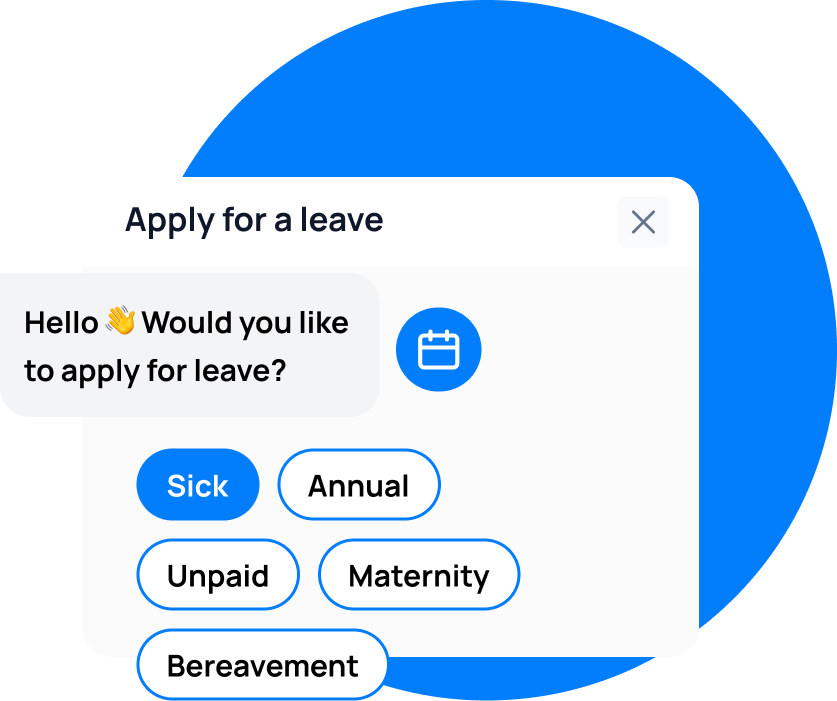
How it works: Leave Balance lives inside Slack and Microsoft Teams. Employees submit leave requests where they already work. Managers approve with a single click. The system tracks accruals automatically, maintains a complete audit trail, and calculates termination payouts.
Pricing: AUD $29/month flat — unlimited employees, unlimited policies. That is not AUD $29 per employee per month. It is AUD $29 total. A 50-person team pays the same as a 10-person team.
Setup time: Under 15 minutes. Import employees via CSV, configure your leave policies, connect Slack or Teams, and you are live.
Limitation: Leave Balance is purpose-built for leave management. It does not include payroll processing, rostering, or award interpretation engines. You configure your policies to match your award requirements — the system enforces them. For payroll, you continue using Xero, MYOB, or your existing provider.
Employment Hero
Compliance strength: Best-in-class for businesses that need a full HR, payroll, and compliance platform. Built-in award interpretation engine (from the KeyPay acquisition) covers all 122 Modern Awards. Handles leave loading, superannuation, Single Touch Payroll, and termination calculations automatically.
Pricing: Approximately AUD $20-60 per employee per month, with minimum monthly charges of AUD $200-600 depending on the plan. A 30-person team pays AUD $600-1,800/month.
Limitation: Expensive for businesses that only need leave tracking. Mandatory yearly contracts. Complex setup that can take months to fully implement. The breadth of features creates a steep learning curve for small teams that need leave management, not a full HRIS.
Tanda
Compliance strength: Australia’s strongest award interpretation engine. Originally built for rostering and time tracking in award-heavy industries (hospitality, retail, construction). Handles penalty rates, minimum engagement periods, and award-specific leave rules with a high degree of automation.
Pricing: Approximately AUD $10-16 per user per month depending on modules. A 30-person team pays AUD $384-480/month. Pricing is not publicly listed — requires a sales conversation.
Limitation: Overkill for salaried teams that do not need rostering or time tracking. Poor usability scores (4/10 in independent reviews). Opaque pricing with no free plan. Reports of aggressive contract tactics. Australia-only focus limits multi-country teams.
Deputy
Compliance strength: Strong scheduling and time-tracking tool with leave management as a secondary feature. Handles basic leave approvals and balance tracking. Less robust for NES-specific requirements like leave loading, long service leave across states, and termination payout calculations.
Pricing: AUD $5-9 per user per month. A 30-person team pays AUD $150-270/month. Transparent pricing with a 31-day free trial.
Limitation: Leave management is not Deputy’s core product. Businesses with complex Modern Award requirements may find the leave features insufficient. No built-in payroll — relies on integrations. Some users report sync issues with Xero.
Xero
Compliance strength: Xero is an accounting platform, not a leave management tool. It offers basic leave tracking within its payroll module, but accruals are often manual, there is no progressive accrual engine, and NES-specific leave types (compassionate leave, community service leave, family violence leave) are not natively supported.
Pricing: AUD $35-130/month for accounting. Leave tracking is included in the payroll module but lacks the depth needed for Fair Work compliance.
Limitation: Using Xero for leave management is a compliance risk. It was not designed for this purpose. Most Australian businesses that rely solely on Xero for leave tracking end up with gaps in their records — exactly the kind of gaps that trigger the reverse onus of proof in a Fair Work investigation.
ELMO
Compliance strength: Enterprise-grade HRIS with deep Australian compliance features. Covers all NES categories, Modern Award configuration, and Superstream integration. Used by 3,000+ organisations with over 2 million users across Australia and New Zealand.
Pricing: Custom enterprise pricing. Not publicly available — requires a sales conversation and typically involves yearly contracts. Not designed for small businesses.
Limitation: Complex implementation (months, not minutes). Steep learning curve. Slow support response times (up to 48 hours). The platform is built for large organisations with dedicated HR teams, not SMBs.
Fair Work Compliance Checklist for Software Selection
Use this checklist when evaluating any leave management tool for your Australian business. Every item reflects a legal requirement, not a nice-to-have feature.
Record-Keeping
- The system retains all leave records for a minimum of 7 years
- Records include dates, leave type, hours taken, and approval details for every occasion of leave
- Current accrued balances are visible and updated each pay period
- The system produces a complete audit trail (timestamps, user attribution, change history)
- Records are exportable in a format that a Fair Work Inspector can review
- Family and domestic violence leave records are stored separately with restricted access
Accrual and Entitlement
- Leave accrues progressively from day one — not on anniversary dates
- Pro-rata accruals are calculated correctly for part-time employees based on ordinary hours
- Shift workers can be assigned 5 weeks of annual leave where the applicable award requires it
- Accrual continues during periods of paid leave and pauses during unpaid leave
- No “use it or lose it” functionality exists (or it is disabled for Australian employees)
- Accumulated personal/carer’s leave carries over year to year with no cap
Leave Loading and Payments
- Leave loading of 17.5% can be configured per policy or award
- The “greater of” test can be applied for shift workers (loading vs. penalty rates)
- Leave loading is calculated on the base rate of pay, not gross pay
- The system can calculate termination payouts including accrued leave and leave loading
NES Leave Types
- Annual leave — configurable for 4 or 5 weeks
- Personal/carer’s leave — 10 days with unlimited accumulation
- Compassionate leave — 2 days per occasion, available to casuals
- Family and domestic violence leave — 10 days paid, confidential, not shown on payslips
- Parental leave — tracking for unpaid and government-funded leave
- Community service leave — including paid jury duty
- Long service leave — configurable per state or territory
Cost Comparison: What Each Tool Costs at Scale
Compliance features matter, but cost determines whether a tool is sustainable for your business. The following table compares monthly costs at different team sizes.
| Team Size | Leave Balance | Employment Hero | Tanda | Deputy | Xero (payroll) | ELMO |
|---|---|---|---|---|---|---|
| 10 employees | AUD $29 | AUD $200-600 | AUD $128-160 | AUD $50-90 | AUD $35-130 | Custom |
| 25 employees | AUD $29 | AUD $500-1,500 | AUD $320-400 | AUD $125-225 | AUD $35-130 | Custom |
| 50 employees | AUD $29 | AUD $1,000-3,000 | AUD $640-800 | AUD $250-450 | AUD $35-130 | Custom |
| 100 employees | AUD $29 | AUD $2,000-6,000 | AUD $1,280-1,600 | AUD $500-900 | AUD $35-130 | Custom |
| 200 employees | AUD $29 | AUD $4,000-12,000 | AUD $2,560-3,200 | AUD $1,000-1,800 | AUD $35-130 | Custom |
Leave Balance’s flat-rate model means your leave management cost stays the same as you grow. A 200-person company pays AUD $29/month — the same as a 10-person company. Every per-user tool on this list becomes more expensive with each hire.
Frequently Asked Questions
What records must I keep under the Fair Work Act?
You must keep records of every leave entitlement, every occasion of leave taken (dates, type, hours), current balances, leave loading payments, agreements to cash out leave, and parental leave details. All records must be retained for 7 years and be available to a Fair Work Inspector on request. Failure to keep adequate records shifts the burden of proof to you in any underpayment claim.
Does my leave software need to handle all 122 Modern Awards?
Your software does not need to interpret all 122 awards automatically. What it does need is the ability to configure leave policies that match your specific award requirements — including leave loading rates, shift worker entitlements, and accrual rules. Tools like Employment Hero and Tanda offer built-in award interpretation. Leave Balance offers fully configurable policies that you set up to match your award.
Is Xero sufficient for Fair Work leave compliance?
No. Xero is an accounting platform with basic leave features in its payroll module. It does not progressively accrue leave from day one, does not support all seven NES leave categories, and does not provide the audit trail required for 7-year record retention. If you use Xero for accounting, pair it with a dedicated leave management tool.
What happens if the Fair Work Ombudsman audits my leave records?
If your records are complete, the audit is straightforward — you produce the records and demonstrate compliance. If your records are incomplete or missing, the reverse onus of proof applies. The employee’s estimate of what they are owed is accepted unless you can disprove it. Penalties for record-keeping failures alone can reach $82,500 per contravention per employee.
How does Leave Balance handle Australian compliance at AUD $29/month?
Leave Balance is purpose-built for leave management — not payroll, not rostering, not performance reviews. By focusing on one function, we deliver full compliance features (progressive accrual, configurable policies, 7-year audit trails, all NES leave types) at a flat rate. You configure your leave policies to match your award or agreement, and the system enforces them automatically with unlimited employees and unlimited policies.
Choosing the Right Tool for Your Business
The right tool depends on what your business actually needs.
If you need leave management and nothing else, Leave Balance gives you full Fair Work compliance at AUD $29/month flat. No per-user fees, no minimum spend, no yearly contracts. Set up in 15 minutes, manage leave through Slack or Teams, and produce a complete audit trail for any Fair Work inspection.
If you need a full HR and payroll platform, Employment Hero or ELMO (for enterprises) provide the broadest feature set — at a corresponding price point.
If your workforce is primarily hourly and award-covered, Tanda’s award interpretation engine is the strongest in the market, though it comes with per-user pricing and a complex setup.
If scheduling is your primary need, Deputy is a strong choice, but supplement it with a dedicated leave management tool for full NES compliance.
If you are relying on Xero alone for leave tracking, you have a compliance gap. Address it before your next Fair Work interaction.
For further reading on Fair Work obligations, see our Fair Work Leave Compliance Checklist for 2026. For a broader comparison of leave management tools available in Australia, see Best Leave Management Software for Australian Businesses.
leave emails? Track your employee's leave with Leave Balance