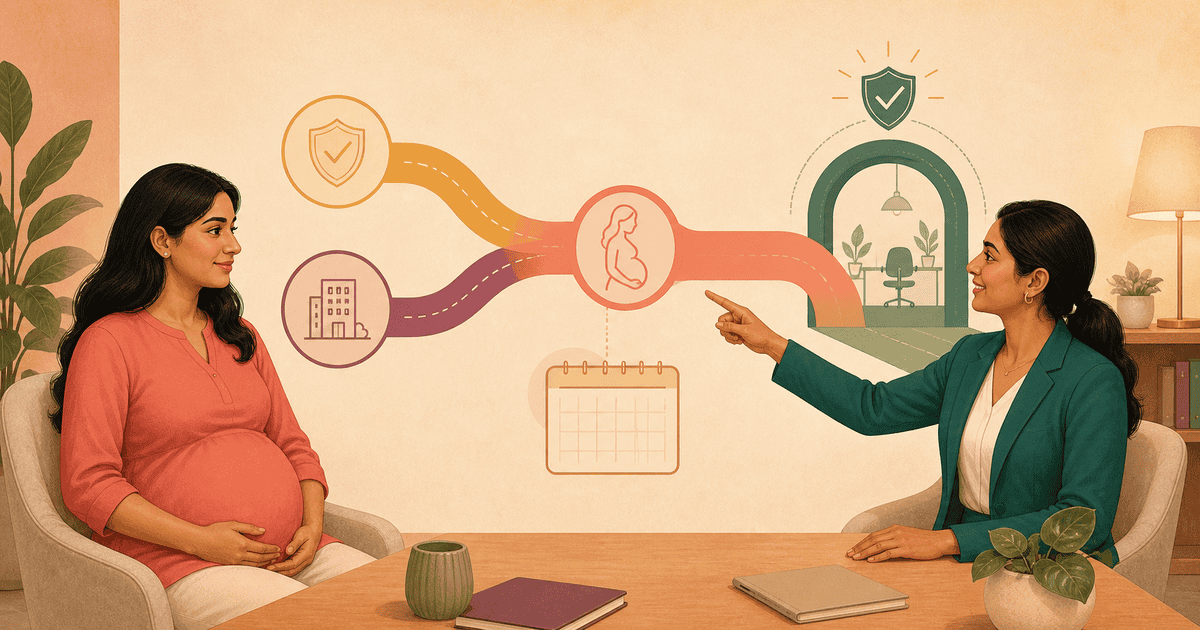
Maternity leave in India grants eligible women 26 weeks of paid leave under the Maternity Benefit Act 1961, as amended in 2017. The employer pays wages during the leave period, or the Employees’ State Insurance Corporation (ESIC) covers the benefit for insured workers. Understanding who pays, what the entitlement covers, and how work-from-home options fit in is essential for any employer operating in India.
This guide covers maternity leave in India in 2026: the 26-week entitlement, eligibility criteria, ESIC vs employer payment, the work-from-home provision, and the obligations that come with managing maternity leave compliance.
Key takeaways
- Eligible women receive 26 weeks of maternity leave — increased from 12 weeks after the Maternity Benefit (Amendment) Act 2017.
- First two children qualify for the full 26 weeks; the third child qualifies for 12 weeks.
- Employers with 10 or more employees must provide maternity benefit under the Act.
- ESIC-insured employees receive the benefit from ESIC; employers with no ESIC coverage pay directly.
- A work-from-home option must be offered after the leave period where the nature of work allows it.
Who is eligible for maternity leave in India?
The Maternity Benefit Act 1961 applies to every establishment with 10 or more employees — factories, mines, plantations, shops, and establishments notified by the government. An employee is eligible if she has worked for the employer for at least 80 days in the 12 months preceding the expected date of delivery.
The 80-day qualifying period counts actual days of work, including paid leave days, but excludes periods of suspension or layoff. For new hires, this means the entitlement may not apply if they joined recently.
| Eligibility criterion | Requirement |
|---|---|
| Establishment size | 10 or more employees |
| Minimum service | 80 days in the 12 months before delivery |
| Employee type | Women employees (including contract workers in some states) |
| Notice period | Written notice to the employer, with a medical certificate from a registered doctor |
How long is maternity leave in India?
After the 2017 amendment, the entitlement is 26 weeks for the first two children and 12 weeks for the third child onwards. The leave can begin up to 8 weeks before the expected date of delivery, with the remainder taken after childbirth.
For adoptive mothers and commissioning mothers (through surrogacy), the entitlement is 12 weeks from the date the child is handed over.
| Situation | Duration |
|---|---|
| First and second child | 26 weeks |
| Third child onwards | 12 weeks |
| Adoptive mother | 12 weeks |
| Commissioning mother (surrogacy) | 12 weeks |
Who pays maternity leave in India?
Payment depends on whether the employee is covered under ESIC.
ESIC-covered employees
Employees earning up to ₹21,000 per month are covered under the Employees’ State Insurance Act 1948. ESIC pays the maternity benefit directly to the insured employee at the rate of her average daily wage for the leave period. The employer is not required to pay wages during the leave, though they must grant the leave and facilitate the claim.
Employees not covered by ESIC
For employees earning above ₹21,000 per month or working in establishments not registered under ESIC, the employer pays the full wages during the 26-week leave period. The wages are calculated at the rate of the employee’s average daily wages for the three months preceding the leave.
Payment comparison
| Payment aspect | ESIC-covered | Not ESIC-covered |
|---|---|---|
| Who pays | ESIC (government fund) | Employer |
| Rate | Average daily wage | Average daily wages (last 3 months) |
| Medical bonus | ₹1,000 (if no employer medical scheme) | ₹1,000 (if no employer medical scheme) |
| Employer obligation | Grant leave, process ESIC claim | Pay full wages for 26 weeks |
The work-from-home requirement
The 2017 amendment added a critical provision: where the nature of work permits, the employer must allow the woman to work from home after the maternity leave period. This is not optional for the employer if the work can be performed remotely.
The terms of work from home — hours, schedule, availability — are to be mutually agreed upon between the employer and the employee. There is no fixed statutory template for the arrangement, but it should be documented to avoid disputes.
This provision applies to both ESIC and non-ESIC employees. The employer cannot refuse a work-from-home request where the work genuinely permits it, and the arrangement continues until the child is 15 months old if both parties agree.
Employer obligations
Employers managing maternity leave in India must fulfil the following obligations:
- Grant the leave — Refusal to grant maternity benefit is a punishable offence under the Act.
- Pay wages or facilitate ESIC claims — Depending on the employee’s ESIC status.
- Not dismiss or disadvantage the employee — Section 12 of the Act prohibits dismissal, discharge, or any alteration unfavourable to the employee’s service conditions during or on account of maternity leave.
- Provide a medical certificate — The employee must submit a certificate from a registered medical practitioner certifying the expected date of delivery.
- Offer work from home — Where the nature of work permits, after the leave period ends.
- Maintain records — The employer must maintain prescribed records of maternity benefit payments and leave granted.
Maternity benefit and dismissal protection
Section 12 of the Maternity Benefit Act provides strong protection: no woman shall be dismissed or have her conditions of service altered unfavourably during or on account of her absence in maternity leave. This protection extends to retrenchment, termination, and any change in designation or remuneration.
An employer who terminates a woman during maternity leave faces penalties under Section 21 of the Act, which can include imprisonment of up to three months and a fine of up to ₹5,000.
Worked examples
Example 1: Non-ESIC employee, first child
Priya earns ₹45,000 per month and has worked for her employer for 14 months. Her expected delivery date is 1 October 2026.
- She is entitled to 26 weeks of maternity leave.
- She begins leave on 6 August 2026 (8 weeks before delivery).
- She receives full wages from 6 August 2026 to approximately 3 February 2027.
- After leave, her employer must offer work from home if her role permits it.
Example 2: ESIC-covered employee, third child
Kavitha earns ₹18,000 per month. This is her third child. She has worked for the employer for 3 years.
- She is entitled to 12 weeks (third child).
- She begins leave 8 weeks before delivery.
- ESIC pays her average daily wage for the 12-week period.
- Her employer grants the leave and processes the ESIC claim.
Example 3: Adoptive mother
Aarti adopts a 3-month-old baby. She has been with her employer for 2 years.
- She is entitled to 12 weeks from the date of handover.
- Her employer pays full wages if she is not ESIC-covered.
- Work from home must be offered after the leave period if the role allows.
Common pitfalls
1. Not counting the 80-day threshold correctly
Employers sometimes miscalculate the 80-day qualifying period, either including days the employee was on unpaid suspension or excluding paid leave days. The count should reflect actual days worked plus paid leave.
2. Refusing work from home
The work-from-home provision after leave is mandatory where the nature of work permits. Refusing a reasonable request exposes the employer to legal risk.
3. Dismissing an employee during or after maternity leave
Dismissing a woman during the leave period or shortly after her return, citing “business reasons,” is prohibited. Courts examine the timing closely and the burden of proof is on the employer.
4. Ignoring state-specific rules
Some states have additional rules or notifications under the Maternity Benefit Act. Check whether your state has specific provisions that supplement the central Act.
For more context, see our guide to leave management best practices and our overview of the main types of leave employers manage.
Frequently asked questions
How many weeks of maternity leave is an employee entitled to in India?
A woman employee is entitled to 26 weeks of maternity leave for her first two children and 12 weeks for her third child onwards, under the Maternity Benefit Act 1961 as amended in 2017.
Does the employer pay or does ESIC pay?
Employees earning up to ₹21,000 per month covered under ESIC receive the benefit from ESIC. Employees earning above ₹21,000 per month or not covered by ESIC receive full wages from the employer.
Can an employer terminate a woman on maternity leave?
No. Section 12 of the Maternity Benefit Act prohibits dismissal, discharge, or unfavourable alteration of service conditions during or on account of maternity leave.
Is work from home mandatory after maternity leave?
Yes, if the nature of the work permits it. The 2017 amendment requires employers to offer work-from-home arrangements after the leave period ends, with terms mutually agreed upon.
Does the 80-day qualifying period include paid leave?
Yes. The 80 days count includes days of actual work plus paid leave days. Unpaid suspension periods are not counted.
Sources
- Maternity Benefit Act 1961 (primary source)
- Maternity Benefit (Amendment) Act 2017
- Employees’ State Insurance Corporation (ESIC)
This article is general information, not legal advice. Indian labour laws are subject to state-level variations and notifications — confirm current requirements with your legal adviser and the relevant state labour authority.