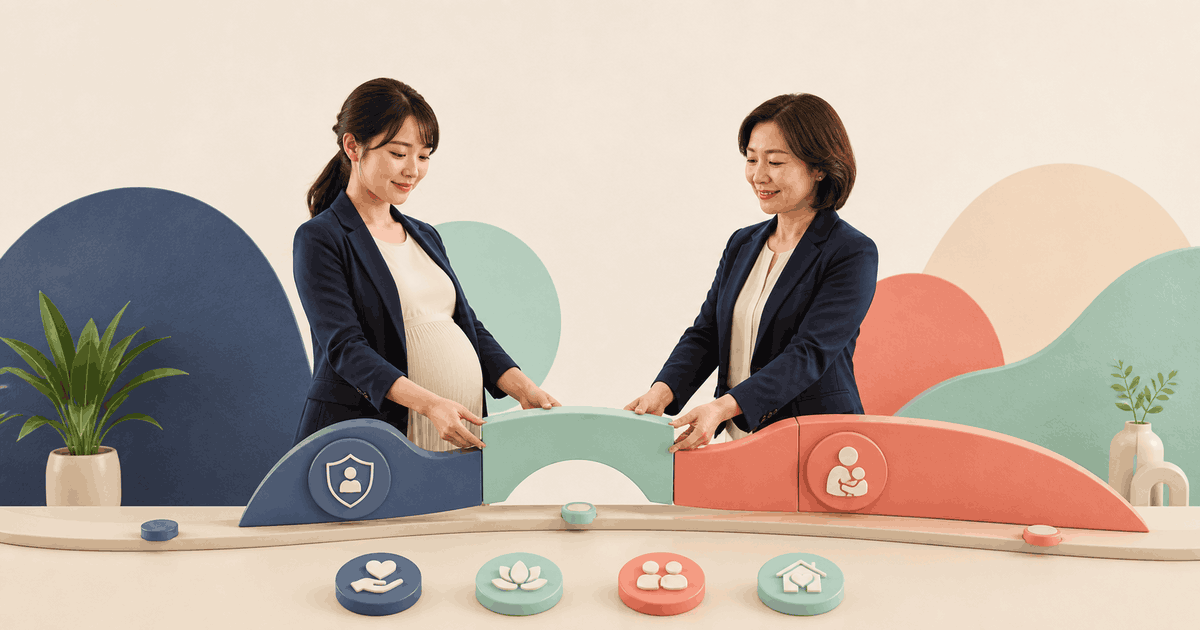
Maternity leave in Japan is 14 weeks under the Labour Standards Act, with income replacement through the Employment Insurance (EEI) system at 67% of the employee’s salary for the first six weeks. Japan’s leave system is distinctive because maternity leave transitions into a separate childcare leave (ikuji kyūka) system, allowing employees to remain on leave for up to one year — or 18 months for a third child — after the maternity period ends.
This guide covers Japanese maternity leave in 2026: the 14-week entitlement, the EEI benefit, the transition to childcare leave, and employer obligations.
Key takeaways
- Article 65 of the Labour Standards Act grants female employees 14 weeks of maternity leave, of which 6 weeks before the birth are mandatory.
- The Employment Insurance (EEI) system pays 67% of the employee’s daily wage for the first six weeks, and 50% from week seven.
- After the 14-week maternity period, the employee may transition to childcare leave under the Child Care and Family Care Leave Act, for up to one year (18 months for a third child).
- The employer cannot terminate the employee during maternity or childcare leave.
- The childcare leave benefit is 67% of salary for the first six months and 50% thereafter.
The 14-week maternity leave entitlement
Article 65 of the Labour Standards Act provides that a female employee is entitled to 14 weeks of maternity leave. The leave is structured as follows:
- 6 weeks before the expected date of delivery — the employee may choose to work during this period, but the employer cannot permit the employee to work if the employee does not wish to.
- 8 weeks after the actual date of delivery — the employee cannot work during this period, except where a doctor certifies that work would not be harmful to the employee’s recovery.
The key distinction is that the pre-birth period is technically optional for the employee, while the post-birth period is mandatory. The employer must observe the 8-week post-birth prohibition regardless of the employee’s wishes.
| Factor | Detail |
|---|---|
| Total leave | 14 weeks (6 weeks before + 8 weeks after) |
| Pre-birth period | 6 weeks (employee may work if she wishes) |
| Post-birth period | 8 weeks (mandatory, no work except with doctor’s certification) |
| EEI benefit rate | 67% (weeks 1–6) / 50% (weeks 7–14) |
| Qualifying period | 6 months of EEI contributions in the 2 years before leave |
How EEI payments work
The Employment Insurance (EEI) system — formerly known as the Employment Insurance (Koyō Hoken) — provides maternity allowance (sanpu-kyū) to female employees who have been insured for at least six months in the two years preceding the leave.
The benefit is calculated as follows:
- Weeks 1–6: 67% of the employee’s daily wage, multiplied by the number of days in the leave period.
- Weeks 7–14: 50% of the daily wage.
The benefit is capped at the EEI daily wage ceiling. The employer is not required to top up the benefit, though many employers do so through company policy or collective agreements.
Worked example
An employee with a daily wage of JPY 15,000 commences 14 weeks of maternity leave. The EEI benefit is:
- Weeks 1–6 (42 days): JPY 15,000 × 67% = JPY 10,050 per day → JPY 422,100.
- Weeks 7–14 (56 days): JPY 15,000 × 50% = JPY 7,500 per day → JPY 420,000.
- Total EEI benefit: JPY 842,100 over 14 weeks.
The employer continues to pay salary only if the employment contract requires it, and may deduct the EEI benefit from the salary paid.
Transition to childcare leave
The most important practical feature of Japan’s maternity system is that the 14-week maternity period is typically followed by childcare leave (ikuji kyūka) under the Child Care and Family Care Leave Act. The two are separate entitlements, but in practice they are treated as a continuous period of leave.
Key childcare leave features:
- Duration: Up to one year from the date of birth (or the end of the maternity period, whichever is later). For a third or subsequent child, the period extends to 18 months.
- Benefit rate: 67% of salary for the first six months, 50% thereafter.
- Application: The employee must apply to the employer at least one month before the intended start of childcare leave.
- Both parents: Both the mother and father are entitled to childcare leave. The father’s entitlement is subject to the same conditions.
The transition from maternity to childcare leave is the step that most often catches employers off guard. The employee must apply for childcare leave separately, and the employer must process the application within the statutory timeframe.
Employer obligations
Japanese employers have six core maternity and childcare leave duties:
- Grant 14 weeks of maternity leave upon the employee’s application with a medical certificate.
- Not permit the employee to work during the 8-week post-birth period unless a doctor certifies it is safe.
- Process the childcare leave application within one month of the employee’s request.
- File the EEI claims on the employee’s behalf — the employer is the primary claimant, not the employee.
- Protect the employee’s position for the duration of both maternity and childcare leave.
- Continue social insurance contributions during the leave period (health insurance, pension).
The employer’s EEI filing role
Unlike many countries where the employee applies directly to the social insurance fund, in Japan the employer files the EEI claim on behalf of the employee. The employer must:
- Submit the maternity allowance application to the Hello Work (public employment security office) within the statutory deadline.
- Provide the employee with the EEI benefit payment.
- File the childcare leave benefit application separately for the childcare leave period.
The employer’s filing obligation is a common source of delays. Late filing results in the employee receiving no income during the gap between the application and the payment.
Job protection
An employer who terminates an employee during maternity leave or childcare leave commits a breach of both the Labour Standards Act and the Child Care and Family Care Leave Act. The employee has the right to:
- Return to the same position or an equivalent one after the leave period.
- Be free from dismissal, demotion, or reduction in benefits related to the pregnancy or leave.
- Continue accruing benefits — including seniority and pension — during the leave period.
The prohibition on discrimination extends to hiring. An employer cannot refuse to hire a candidate because she is pregnant or is of childbearing age. Employers with 100 or more employees must publish utilisation rates for childcare leave among male and female employees.
Return to work
The employee must return to work at the end of the childcare leave period (or the maternity period if childcare leave is not taken). The employer must:
- Reinstate the employee to her position or a reasonably equivalent one.
- Not require a fresh probationary period upon return.
- Continue career progression as though the leave had not been taken.
Where the employee is unable to return for medical reasons, she should apply for sick leave under the terms of her employment contract. The employer cannot treat the failure to return on the expected date as a resignation.
Common pitfalls
1. Not filing the EEI claim on time
The employer is responsible for filing the claim. Late filing delays the employee’s income and creates a liability.
2. Not processing the childcare leave application
The employer must process the application within one month. Failure to do so is a breach of the Child Care and Family Care Leave Act.
3. Dismissing during childcare leave
The protection extends for the full duration of childcare leave — up to one year (or 18 months for a third child). Dismissal during this period is automatically unfair.
4. Confusing the pre-birth and post-birth periods
The 6-week pre-birth period is technically different from the 8-week post-birth period. The employer must observe the post-birth prohibition regardless of the employee’s wishes.
For more context, see our guide to types of leave and absence management.
Frequently asked questions
How long is maternity leave in Japan?
Maternity leave in Japan is 14 weeks under the Labour Standards Act: 6 weeks before the expected date of delivery and 8 weeks after the actual date of birth. This is typically followed by childcare leave for up to one year.
Who pays for maternity leave in Japan?
The Employment Insurance (EEI) system pays 67% of the employee’s daily wage for the first six weeks and 50% thereafter. The employer files the claim on the employee’s behalf.
Can the employee work during the pre-birth period?
Yes. The employee may choose to work during the 6-week pre-birth period. The employer cannot force the employee to stop working, but the employer also cannot require the employee to work if she does not wish to.
Can the employee work during the post-birth period?
No, except where a doctor certifies that work would not be harmful to the employee’s recovery. The 8-week post-birth prohibition is mandatory.
Does the father get childcare leave?
Yes. Both parents are entitled to childcare leave under the Child Care and Family Care Leave Act. The father’s entitlement is subject to the same conditions and benefit rates.
Putting it into practice
Four checks cover most Japanese maternity and childcare leave compliance:
- File the EEI maternity allowance claim as soon as the employee commences leave — the employer’s delay is the employee’s lost income.
- Process the childcare leave application within one month of the employee’s request — do not let it sit in an approval queue.
- Track the 14-week maternity period and the transition to childcare leave so the benefit filing is continuous.
- Publish the childcare leave utilisation rate for employees with 100 or more staff, as required by law.
A leave management system that generates the EEI claim, tracks the childcare leave application deadline, and manages the transition between the two leave types keeps the employer compliant without manual filing.
Sources
- Labour Standards Act, article 65 (primary source)
- Child Care and Family Care Leave Act
- Employment Insurance Act — Maternity Allowance
- Ministry of Health, Labour and Welfare (MHLW)
Last updated: 26 July 2026. This article is general information, not legal advice. EEI rates and benefit ceilings change annually — confirm current figures with the Ministry of Health, Labour and Welfare or a qualified Japanese employment lawyer.