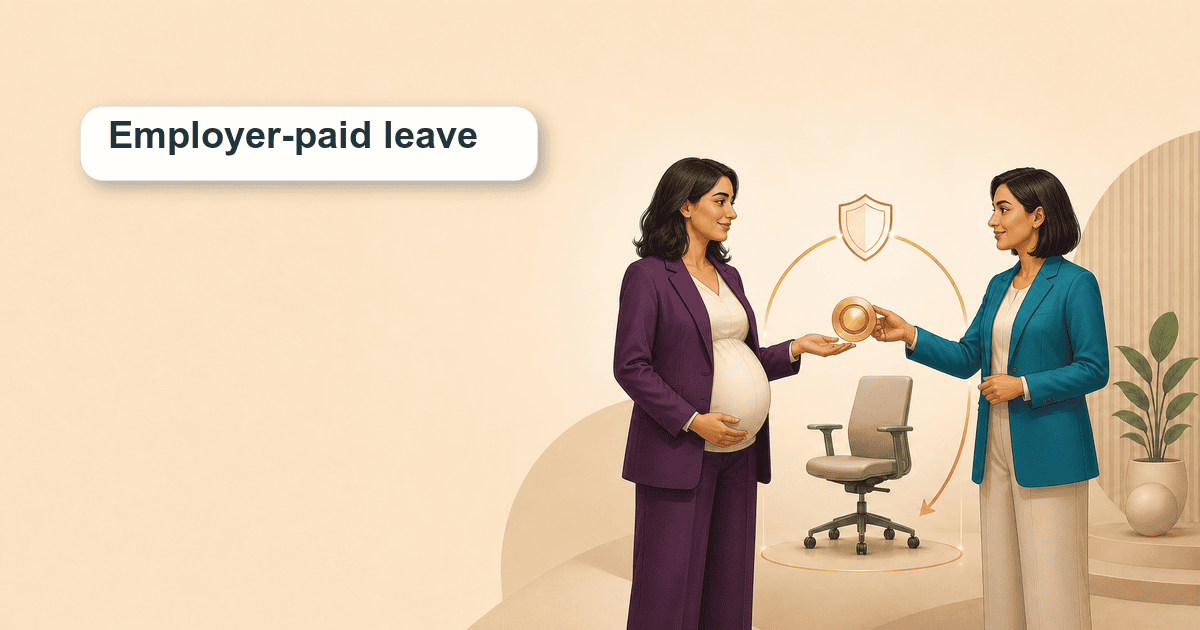
Maternity leave in Qatar is 50 days of paid leave under the Qatar Labour Law, with the employer responsible for paying the employee’s full wages during the leave period. The entitlement is set out in article 90 of Law No. 14 of 2004 (the Labour Law), and applies to every female employee in the private sector who has been employed for at least one year. There is no social insurance fund that replaces the salary — the employer bears the full cost.
This guide covers Qatari maternity leave in 2026: the 50-day entitlement, employer payment duties, job protection, and the return-to-work rules.
Key takeaways
- Article 90 of the Qatar Labour Law grants female employees 50 days of maternity leave with full pay.
- The employer pays full wages for the entire 50-day period — there is no government fund that offsets the cost.
- The employee must have been employed for at least one year before the expected date of delivery.
- The leave can commence up to five weeks before the expected date of delivery.
- The employer cannot terminate the employee during the leave and must hold the position open.
The 50-day entitlement
Article 90 of the Qatar Labour Law provides that every female employee is entitled to 50 days of maternity leave. The leave is with full pay and may be taken before and after the birth, as follows:
- Up to five weeks before the expected date of delivery.
- The remaining period after the birth, such that the total does not exceed 50 days.
- The leave must be taken continuously — the employee cannot split it into parts.
The employee must provide a medical certificate confirming the pregnancy and expected date of delivery. The employer cannot require the employee to work during the leave period.
| Factor | Detail |
|---|---|
| Total leave | 50 days |
| Payment | Full wages (paid by employer) |
| Advance leave | Up to 5 weeks before expected delivery |
| Qualifying period | 1 year of continuous employment |
| Payment method | Directly from employer |
Employer payment obligations
Unlike countries with social insurance-funded maternity benefits, Qatar requires the employer to pay the employee’s full wages during the 50-day leave. There is no government reimbursement or social security fund that offsets the cost.
The employer must:
- Pay full salary and allowances for the entire 50-day period.
- Continue to make statutory deductions — including social insurance contributions (for Qatari employees) — from the maternity pay.
- Not reduce the employee’s benefits below what she received before the leave commenced.
The cost is borne entirely by the employer, which is a consideration for small businesses in Qatar’s private sector. Employment contracts may not reduce the maternity pay below the statutory 50-day full-pay requirement.
Job protection
An employer who terminates or penalises an employee for taking maternity leave is in breach of article 90 of the Qatar Labour Law. The employee has the right to:
- Return to the same position or an equivalent one after the leave period.
- Be free from dismissal, demotion, or reduction in benefits related to the pregnancy or leave.
- Continue accruing benefits — including leave, seniority, and end-of-service gratuity — during the leave period.
The prohibition on discrimination extends to the hiring stage. An employer cannot refuse to hire a candidate because she is pregnant or is of childbearing age.
Return to work
The employee must return to work at the end of the 50-day period. The employer must:
- Reinstate the employee to her position or a reasonably equivalent one.
- Not require a fresh probationary period upon return.
- Continue career progression as though the leave had not been taken.
Where the employee is unable to return for medical reasons, she should apply for sick leave under the terms of her employment contract. The employer cannot treat the failure to return on the expected date as a resignation.
Employer obligations
Qatari employers have five core maternity leave duties:
- Grant 50 days of maternity leave upon the employee’s application with a medical certificate.
- Pay full wages for the entire leave period, with statutory deductions continuing.
- Apply the one-year qualifying period — do not deny leave to employees who have been employed for at least one year.
- Protect the employee’s position for the duration of the leave and upon return.
- Not reduce the maternity pay below the statutory full-pay requirement.
Common pitfalls
1. Requiring the employee to use annual leave first
The employer cannot require the employee to exhaust annual leave before or during maternity leave. The entitlements are separate.
2. Paying less than full wages
Some employers attempt to pay a reduced percentage during maternity leave. Article 90 requires full wages — a contractual clause reducing pay below this floor is unenforceable.
3. Not granting the full leave before birth
The employee is entitled to take up to five weeks before the expected date of delivery. The employer cannot force the employee to delay the start of leave.
4. Failing to keep the position open
The employee must return to the same role or an equivalent one. Filling the role permanently during the leave and offering a different position on return is a breach.
For more context, see our guide to types of leave and absence management.
Frequently asked questions
Who pays for maternity leave in Qatar?
The employer pays the employee’s full wages for the 50-day period. There is no government fund that replaces the salary in the private sector.
Can the employee extend the leave beyond 50 days?
If the employee is unable to return due to medical reasons, she can apply for sick leave under her employment contract. The employer is not legally required to extend the maternity leave itself beyond 50 days.
What if the employee does not meet the one-year qualifying period?
The employee is not entitled to statutory maternity leave under the Labour Law if she has not been employed for at least one year, but the employer may still grant leave under the employment contract or company policy.
Does the employee keep her job?
Yes. The employer cannot terminate or demote the employee for taking maternity leave, and the position must be available when the employee returns.
Does the employer have to pay if the employee resigns during the leave?
The employer must pay wages for the portion of the leave already taken. If the employee resigns before the leave commences or during the leave, the employer is not obligated to pay for the remaining period.
Putting it into practice
Three checks cover most Qatari maternity leave compliance:
- Calculate the full wage cost of the 50-day leave period before the employee commences leave, so there are no surprises in the payroll cycle.
- Track the five-week-before-birth commencement date to ensure the employee does not start leave earlier than permitted.
- Verify the one-year qualifying period before approving the leave request.
A leave management system that calculates the wage cost, tracks the qualifying period, and captures the medical certificate keeps the employer compliant with article 90 without manual tracking.
Sources
- Qatar Labour Law, Law No. 14 of 2004, article 90 (primary source)
- Ministry of Administrative Development, Labour and Social Affairs
Last updated: 26 July 2026. This article is general information, not legal advice. Confirm current obligations with the Ministry of Administrative Development, Labour and Social Affairs or a qualified Qatari employment lawyer.