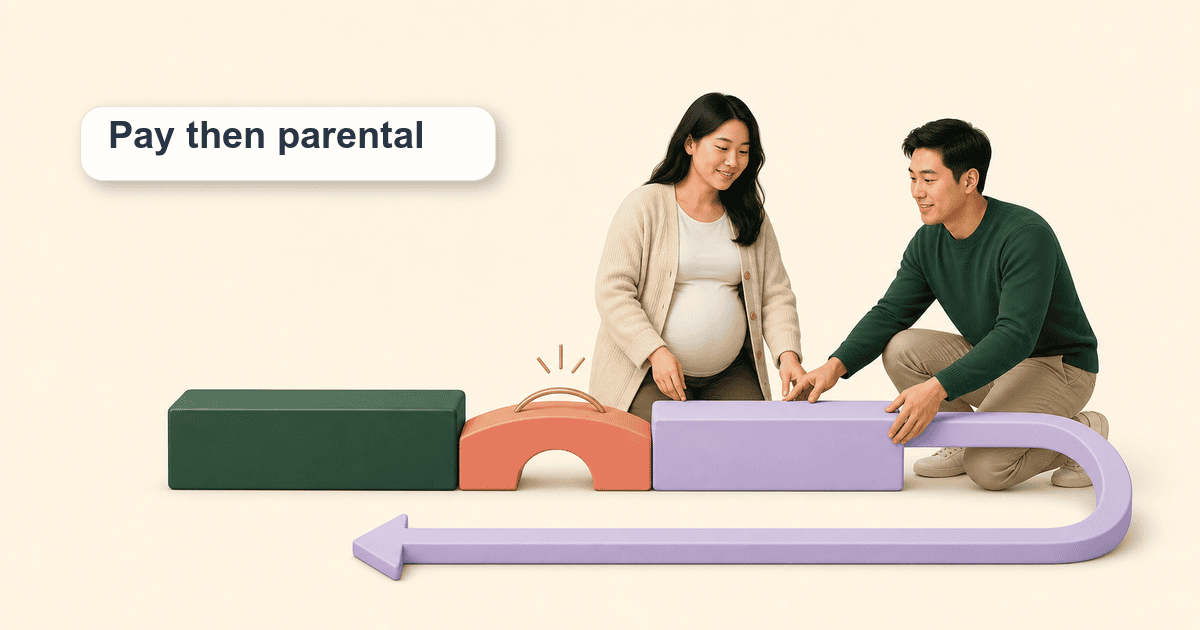
Maternity leave in South Korea is 90 days of paid leave under the Labour Standards Act, with income replacement through the Employment Insurance (고용보험) system at 100% of the employee’s average daily wage for the first 60 days. The employer pays the salary and is then reimbursed by Employment Insurance, though the reimbursement caps mean many employers bear a portion of the cost. South Korea’s system also provides a separate parental leave entitlement that extends the total paid absence to up to 12 months.
This guide covers South Korean maternity leave in 2026: the 90-day entitlement, Employment Insurance reimbursement, the employer’s cost, and the transition to parental leave.
Key takeaways
- Article 73 of the Labour Standards Act grants female employees 90 days of maternity leave.
- Employment Insurance reimburses the employer at 100% of the employee’s average daily wage for the first 60 days, and at a flat rate for the remaining 30 days.
- The employer must pay the employee’s full salary during the leave and then claim reimbursement from Employment Insurance.
- The leave can commence up to 45 days before the expected date of delivery.
- The employee may transition to parental leave (bogi-kyeol-e) for up to one year after the maternity period.
The 90-day entitlement
Article 73 of the Labour Standards Act provides that every female employee is entitled to 90 days of maternity leave. The leave is with pay and may be taken as follows:
- Up to 45 days before the expected date of delivery.
- The remaining period after the birth, such that the total does not exceed 90 days.
- The leave must be taken continuously — the employee cannot split it into parts.
The employee must provide a medical certificate confirming the pregnancy and expected date of delivery. The employer cannot require the employee to work during the leave period.
| Factor | Detail |
|---|---|
| Total leave | 90 days |
| Payment | Full salary (reimbursed by Employment Insurance) |
| Advance leave | Up to 45 days before expected delivery |
| Qualifying period | At least 1 month of Employment Insurance contributions |
| Reimbursement | 100% for first 60 days, flat rate for remaining 30 |
How Employment Insurance reimbursement works
The employer pays the employee’s full salary during the 90-day leave period and then claims reimbursement from the Employment Insurance (고용보험) system. The reimbursement is structured as follows:
- Days 1–60: 100% of the employee’s average daily wage for the 3 months before the leave, subject to the Employment Insurance daily wage ceiling.
- Days 61–90: A flat rate of approximately KRW 150,000 per day (the exact amount is adjusted annually).
The employer is the claimant — not the employee. The employer must file the reimbursement claim with the Employment Insurance Office (고용보험사무소) within six months of the leave commencing.
Worked example
An employee with an average daily wage of KRW 200,000 commences 90 days of maternity leave. The Employment Insurance reimbursement is:
- Days 1–60: KRW 200,000 per day × 60 days = KRW 12,000,000 (100% reimbursement).
- Days 61–90: KRW 150,000 per day × 30 days = KRW 4,500,000 (flat-rate reimbursement).
- Total reimbursement: KRW 16,500,000.
If the employee’s daily wage exceeds the Employment Insurance ceiling, the employer absorbs the difference. In high-salary cases, this can represent a significant employer cost.
Employer obligations
South Korean employers have six core maternity leave duties:
- Grant 90 days of maternity leave upon the employee’s application with a medical certificate.
- Pay the employee’s full salary for the entire 90-day period.
- File the Employment Insurance reimbursement claim within six months of the leave commencing.
- Continue social insurance contributions — national health insurance, national pension, and employment insurance — during the leave period.
- Protect the employee’s position for the duration of the leave.
- Not terminate the employee during the leave period.
The employer is prohibited from:
- Requiring the employee to work during the leave period.
- Dismissing the employee during the leave.
- Reducing the employee’s benefits or seniority as a result of the leave.
Transition to parental leave
After the 90-day maternity leave, the employee may transition to parental leave (육아휴직) under the Child Care and Family Care Leave Act. Key features:
- Duration: Up to one year per parent. For a second or subsequent child born within the parental leave period, the leave can be extended.
- Benefit rate: 100% of the employee’s average daily wage for the first 6 months, 50% for months 7–12, subject to a ceiling and a floor (minimum KRW 1,000,000 per month for the first 6 months).
- Application: The employee must apply to the employer at least 30 days before the intended start of parental leave.
- Both parents: Both the mother and father are entitled to parental leave. The father’s entitlement is subject to the same conditions.
The transition from maternity to parental leave is the step that most often requires employer attention. The employee must apply for parental leave separately, and the employer must process the application within the statutory timeframe.
Job protection
An employer who terminates an employee during maternity leave or parental leave commits a breach of both the Labour Standards Act and the Child Care and Family Care Leave Act. The employee has the right to:
- Return to the same position or an equivalent one after the leave period.
- Be free from dismissal, demotion, or reduction in benefits related to the pregnancy or leave.
- Continue accruing benefits — including seniority and pension — during the leave period.
The prohibition on discrimination extends to hiring. An employer cannot refuse to hire a candidate because she is pregnant or is of childbearing age.
Return to work
The employee must return to work at the end of the maternity or parental leave period. The employer must:
- Reinstate the employee to her position or a reasonably equivalent one.
- Not require a fresh probationary period upon return.
- Continue career progression as though the leave had not been taken.
Where the employee is unable to return for medical reasons, she should apply for sick leave under the terms of her employment contract. The employer cannot treat the failure to return on the expected date as a resignation.
Common pitfalls
1. Not filing the Employment Insurance claim
The employer is responsible for filing the reimbursement claim. Late filing results in the employer bearing the full cost without reimbursement.
2. Not processing the parental leave application
The employer must process the application within the statutory timeframe. Failure to do so is a breach of the Child Care and Family Care Leave Act.
3. Dismissing during leave
The protection extends for the full duration of both maternity and parental leave. Dismissal during this period is automatically unfair.
4. Under-reimbursing the employee
The employer must pay the employee’s full salary during the leave. The Employment Insurance reimbursement is a separate claim — the employer cannot delay the salary pending the reimbursement.
For more context, see our guide to types of leave and absence management.
Frequently asked questions
How long is maternity leave in South Korea?
Maternity leave in South Korea is 90 days under article 73 of the Labour Standards Act. The employee may also transition to parental leave for up to one year after the maternity period.
Who pays for maternity leave in South Korea?
The employer pays the employee’s full salary during the 90-day period and is then reimbursed by Employment Insurance at 100% for the first 60 days and a flat rate for the remaining 30 days.
Can the employee extend the leave beyond 90 days?
The employee may apply for parental leave after the 90-day maternity period. Parental leave extends the total paid absence for up to one year.
Can the employer terminate the employee during the leave?
No. The employer cannot terminate the employee during maternity leave or parental leave. The position must be held open for the full duration.
Does the father get leave?
Yes. The father is entitled to parental leave under the Child Care and Family Care Leave Act, with the same benefit rates and duration as the mother’s entitlement.
Putting it into practice
Three checks cover most South Korean maternity leave compliance:
- Calculate the Employment Insurance reimbursement and the employer’s net cost before the employee commences leave — the flat-rate cap on days 61–90 creates a gap for high-salary employees.
- File the reimbursement claim within six months of the leave commencing — the employer’s delay is the employer’s lost money.
- Process the parental leave application within 30 days of the employee’s request so there is no gap between the two leave periods.
A leave management system that calculates the Employment Insurance reimbursement, tracks the parental leave application deadline, and manages the transition between the two leave types keeps the employer compliant without manual filing.
Sources
- Labour Standards Act, article 73 (primary source)
- Child Care and Family Care Leave Act
- Employment Insurance Act (고용보험법)
- Ministry of Employment and Labour (고용노동부)
Last updated: 26 July 2026. This article is general information, not legal advice. Employment Insurance rates and benefit ceilings change annually — confirm current figures with the Ministry of Employment and Labour or a qualified Korean employment lawyer.