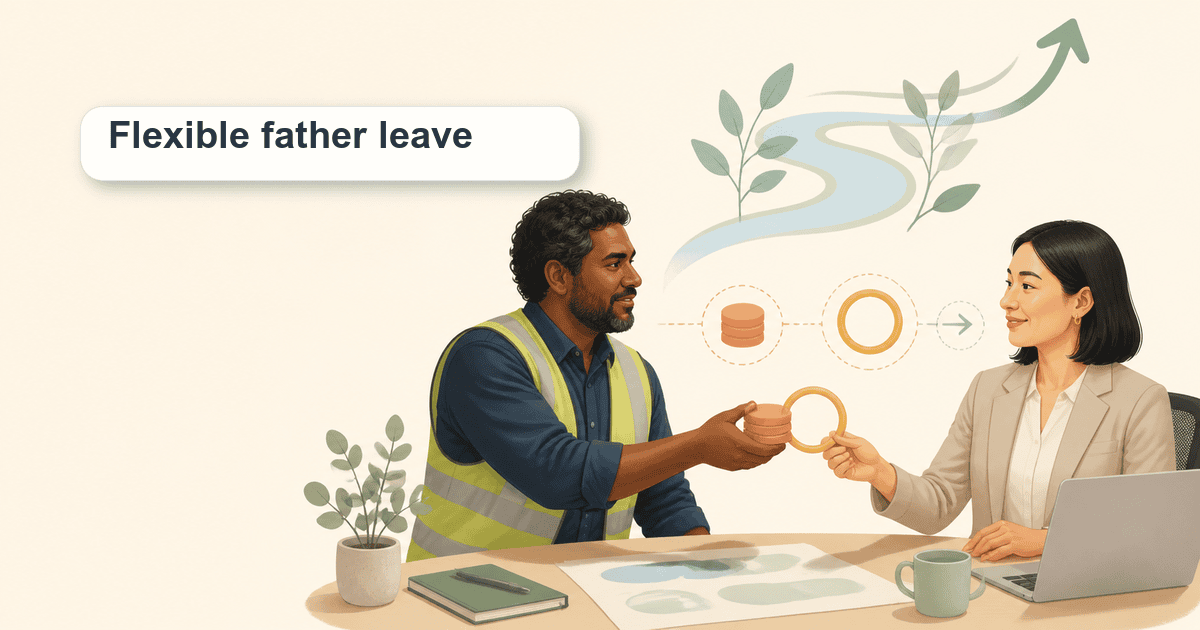
Paternity leave in Australia provides eligible fathers 2 weeks of government-funded Paid Parental Leave (PPL) under the Paid Parental Leave scheme administered by Services Australia. The payment is made directly to the employee or, by agreement, to the employer, and covers a period equivalent to the federal minimum wage.
This guide covers Australia’s paternity leave framework: the 2-week Paid Parental Leave entitlement, eligibility criteria, the application and payment process, how it interacts with employer-provided leave, and employer obligations.
Key takeaways
- Eligible fathers receive 2 weeks (10 business days) of Paid Parental Leave through Services Australia.
- The payment is equivalent to the federal minimum wage (currently $24.50 per hour as of 1 July 2026), paid for up to 10 business days.
- There is no national statutory paternity leave separate from the government PPL scheme — entitlements beyond PPL depend on employer policy or the National Employment Standards.
- The father must be the primary carer or take leave in a “flexible” arrangement within the first 12 months after the child’s birth or adoption.
- PPL can be shared between parents — the total household allocation is up to 20 weeks (from July 2026).
The Paid Parental Leave scheme for fathers
Australia does not have a standalone “paternity leave” statute. Instead, fathers access the government Paid Parental Leave (PPL) scheme, which provides up to 20 weeks of government-funded leave per family. The father’s portion is up to 2 weeks (10 business days) if he takes leave as the primary carer during the first 12 months after the child’s birth or adoption.
From 1 July 2026, the PPL scheme provides:
| Detail | Value |
|---|---|
| Father’s allocation | Up to 2 weeks (10 business days) |
| Total household allocation | Up to 20 weeks |
| Payment rate | Federal minimum wage ($24.50/hour as of 1 July 2026) |
| Payment method | Directly to employee or employer (by agreement) |
| When taken | Within 12 months from birth or adoption |
| Flexible usage | Can be taken in blocks or as part-time |
The 2-week allocation can be taken as a continuous block or as individual days over a 12-month period. The flexible arrangement allows fathers to take leave during school holidays, weekends, or specific events.
Eligibility criteria
To qualify for the 2-week Paid Parental Leave as a father, the following conditions must be met:
- Australian resident — the father must be an Australian resident living in Australia.
- Income test — the father’s adjusted taxable income must be $168,865 or less per year (as of 2026).
- Work test — the father must have worked at least 10 of the 13 months before the child’s birth or adoption, and at least 330 hours in that 10-month period.
- Not the primary PPL claimant — if the mother or other parent has claimed the full 20 weeks, the father’s allocation is reduced.
- Not receiving Parenting Payment — the father cannot be receiving Parenting Payment from Centrelink at the same time.
- Child is under 12 months — the PPL must be taken within 12 months from the child’s date of birth or adoption.
The income test is the most common disqualifier. High-income households may find they do not meet the threshold, particularly where both parents earn above the median.
How the PPL payment works
The PPL payment is processed through Services Australia (Centrelink). The father applies online or through a Services Australia office.
The payment flow:
- Father applies — submit the claim through myGov or at a Services Australia service centre.
- Centrelink assesses the claim — verifies eligibility, income, and work test.
- Payment is approved — the father receives a start date.
- Payment is made — either directly to the father’s bank account or to the employer (by written agreement).
- Employer records the leave — if the employer receives the payment, they pass it to the employee through payroll.
If the employer receives the PPL payment, they must pay the employee the full amount and not retain any portion. The employer is not required to pay any amount above the PPL rate unless their policy provides for top-up pay.
Interaction with employer-provided leave
The National Employment Standards (NES) under the Fair Work Act 2009 provide a framework for parental leave, but there is no NES-mandated paid paternity leave. The NES provides:
- Unpaid parental leave — up to 12 months per parent (extendable by agreement).
- Unpaid “keep in touch” days — up to 10 days during unpaid parental leave.
Beyond the NES, many Australian employers offer paid paternity leave as a company benefit. Typical private sector entitlements include:
| Sector | Typical paternity leave | Notes |
|---|---|---|
| Large corporates | 1–4 weeks paid | Often part of a broader parental leave policy |
| Government agencies | 2–4 weeks paid | Varies by jurisdiction |
| SMEs | 0–2 weeks paid | Rarely formalised |
| Professional services | 1–2 weeks paid | Growing trend |
The PPL payment can be used alongside employer-provided leave. If an employer offers 2 weeks of paid paternity leave, the father can use the PPL payment for those 2 weeks and the employer bears no additional cost.
Employer obligations
Australian employers have the following obligations:
- Do not refuse parental leave — under the NES, employees with at least 12 months of service are entitled to unpaid parental leave. Refusal requires a valid business reason.
- Process PPL payments — if the employer has agreed to receive the PPL payment, they must pass the full amount to the employee.
- Maintain employment — the employee’s position must be available when they return, or a position at the same level and pay.
- Keep records — record the leave period, any PPL payments received, and the employee’s return date.
- Consult on changes — if the employee’s role is significantly changed during the leave, the employer must consult with the employee.
The Fair Work Act prohibits adverse action against an employee because of, or for the purpose of, parental leave. Dismissal during or shortly after parental leave is treated as adverse action unless the employer can demonstrate a genuine, unrelated reason.
Worked example
Sarah and James are expecting their first child. The baby is born on 1 August 2026. Sarah claims the primary PPL allocation of 18 weeks. James applies for the father’s allocation of 2 weeks (10 business days).
- James meets the work and income tests.
- His payment is 10 business days × 8 hours × $24.50 = $1,960.
- James takes the 10 business days starting 1 August, using flexible PPL days.
- James’s employer offers an additional 1 week of paid paternity leave. James takes this week using his employer benefit, with no PPL cost to the employer.
Common pitfalls
1. Assuming PPL replaces employer leave
PPL is a government payment, not an employer obligation. The employer is not required to offer paid paternity leave unless their policy or the NES requires it. PPL can be used alongside employer-provided leave.
2. Missing the 12-month window
PPL must be taken within 12 months from the child’s birth or adoption. Failing to take the leave within this period means the entitlement is lost.
3. Not checking the income test
The income test ($168,865 in 2026) is the most common disqualifier. High-income earners may not qualify even if they meet the work test.
4. Incorrectly applying the flexible PPL rules
The flexible PPL arrangement allows leave to be taken as individual days, but each day must be taken within the 12-month window. Planning is needed to ensure all 10 days are used before the deadline.
Frequently asked questions
Is there statutory paternity leave in Australia?
Australia does not have a standalone statutory paternity leave entitlement. Fathers access the government Paid Parental Leave scheme, which provides up to 2 weeks (10 business days) of paid leave.
How much is Paid Parental Leave for fathers?
The payment is equivalent to the federal minimum wage ($24.50 per hour as of 1 July 2026) for up to 10 business days, totalling approximately $1,960.
Can both parents take Paid Parental Leave?
Yes. The total household allocation is up to 20 weeks, which can be shared between parents. If one parent takes 18 weeks, the other receives 2 weeks.
Does the employer pay for paternity leave?
The government PPL is funded by the federal government, not the employer. Some employers offer additional paid paternity leave as a company benefit, but this is not required by law.
What if the father doesn’t meet the work test?
If the father does not meet the 10-of-13-month work test, he is not eligible for PPL. The father may still be entitled to unpaid parental leave under the NES, depending on length of service.
For more context, see our guide to annual leave in Australia and types of leave.
Managing parental leave allocations, PPL payments, and flexible leave arrangements across your workforce is exactly what a leave management system is built for.
Sources
- Services Australia — Paid Parental Leave (primary source)
- Fair Work Act 2009 — National Employment Standards (legislation)
- Fair Work Ombudsman — Parental Leave (government)
Last updated: 26 July 2026. This article is general information, not legal advice. Confirm current entitlements with Services Australia or the Fair Work Ombudsman.