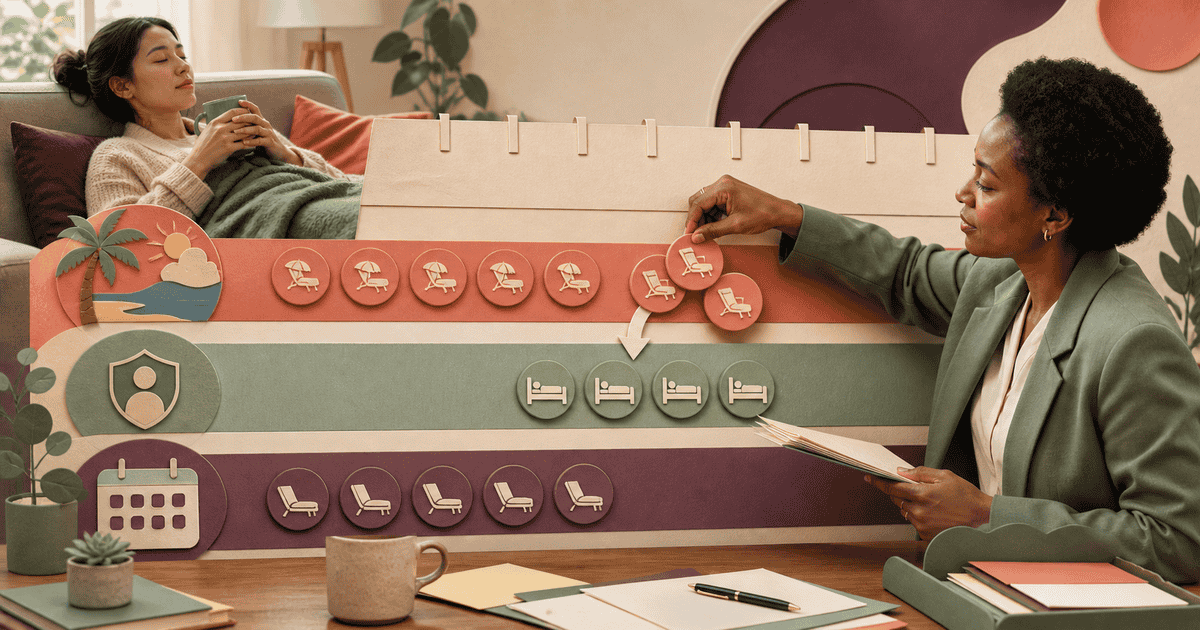
If you fall sick during annual leave in the UK, you can convert those days to sick leave and keep the holiday to use another time. Acas states it directly: a worker who reports their sickness can keep the time they were sick to use as holiday another time and receive Statutory Sick Pay for those days if they are eligible.
The catch is in the first four words of that sentence. The right depends on reporting the sickness, and reporting it in the way your employer’s policy requires. Come back from a fortnight in Spain, mention on Tuesday that you spent five days of it with food poisoning, and you will very likely have lost those five days.
Key Takeaways
- Sickness during booked annual leave can be reclassified as sick leave, restoring the holiday days to your balance.
- You must report the sickness while it is happening, following your employer’s normal absence-reporting rules.
- Those days are paid as sick pay, not holiday pay — SSP is £123.25 a week for 2026/27, or 80% of average weekly earnings if lower.
- The same principle applies if you fall sick before a booked holiday starts: the leave can be moved rather than lost.
What Is the Rule If You Get Sick on Annual Leave?
The underlying principle is that annual leave and sick leave serve different purposes. Annual leave exists so you can rest and enjoy a break from work. Sick leave exists because you are unwell and unfit for work. A week spent ill in bed is not the rest the holiday was for, so it does not have to count as the holiday.
This principle comes from retained European case law on the Working Time Directive, now embedded in how UK tribunals read the Working Time Regulations 1998. It is the same reasoning that keeps annual leave accruing during long-term sickness.
Two consequences follow:
- Sickness during leave. Days you were genuinely unfit for work can be reclassified as sick leave and the holiday returned to your balance.
- Sickness before leave. If you are signed off before a booked holiday starts, you can ask to move the holiday rather than have it consumed by the absence.
How Do You Reclaim Annual Leave Lost to Sickness?
Follow the same steps you would for any other sick day. The fact that you are on holiday changes nothing about the reporting obligation — if anything it raises the bar, because the claim is inherently harder to verify after the fact.
- Report the sickness on the day it starts, through the normal channel — call, app, HR system, whatever your policy specifies. Do not wait until you are back.
- Say explicitly that you want the days treated as sick leave, not holiday. Reporting the illness without making the request is the most common failure point.
- Keep evidence. For absences of 7 days or fewer you self-certify. For more than 7 days in a row you need a fit note. If you were abroad, a local medical note is usually accepted, though your employer is not obliged to accept it in place of a UK fit note.
- Confirm the outcome in writing when you return: which dates became sick leave, how many holiday days went back to your balance, and how the days will be paid.
- Rebook the reclaimed days within your leave year, or agree carry-over if the year is nearly over.
What can your employer ask for?
Whatever their normal sickness evidence policy requires — no more, no less. They can ask you to self-certify on return for absences of a week or less, and to produce a fit note beyond that. They cannot invent a stricter standard just because the absence happened during a holiday, though they can reasonably ask why the sickness was not reported at the time if it was not.
Do You Get Paid Sick Pay or Holiday Pay for Those Days?
Sick pay. Once a day is reclassified as sickness, it is paid on the sick pay basis, which is usually less than holiday pay. That trade is deliberate: you accept lower pay now in exchange for keeping the holiday day to use later.
| If you leave it as holiday | If you reclaim it as sick leave | |
|---|---|---|
| Pay for those days | Full holiday pay | Company sick pay, or SSP at £123.25/week |
| Holiday balance | Reduced | Restored |
| Net effect | Paid more now, no day left to take | Paid less now, day available later |
Work an example. Tom takes a two-week holiday. He is ill for four working days of it. His holiday pay would be £150 a day. On SSP alone, four days is roughly £98.60 in total, so reclaiming costs him about £501 in immediate pay — and returns four days of annual leave worth £600 in holiday pay when he takes them later.
The SSP figure comes from the 2026/27 rate of £123.25 a week; our UK Statutory Sick Pay guide sets out who qualifies and for how long.
If Tom has generous company sick pay, reclaiming is close to free. If he is on SSP and was going to lose the days at year end anyway, it is a bad trade. The decision is genuinely his to make, which is why the reporting step matters: it keeps the option open.
What If You Are Signed Off Before the Holiday Starts?
Ask to move the holiday. If you are on sick leave when a booked holiday was due to begin, the default should be that the booking is cancelled and the days returned to your balance, because you cannot take annual leave and sick leave on the same day.
You can also do the opposite and choose to take the holiday as planned — see our guide to taking annual leave while off sick for when that makes sense financially. What your employer cannot do is decide for you and treat the booked days as holiday to run down the absence.
If your absence is long enough that you cannot use the restored days before the leave year ends, they are protected. Up to four weeks carries into the next leave year and must be used within 18 months of the end of the leave year it accrued in — the full mechanics are in our guide to carrying over annual leave in the UK.
What This Means for You
Employees: report it the day it happens, ask for the days back in the same message, and keep whatever medical evidence you can get. Doing that costs you five minutes and preserves a right that is otherwise very hard to claim retrospectively.
Employers: put the rule and the reporting requirement in the absence policy in the same paragraph, so people know the right exists and know it is conditional. Then make sure your records can turn approved holiday days back into sick days without the balance going out of step — the ledger error is far more common than the legal dispute.
Leave Balance handles the swap in one action: reclassify the dates as sickness and the holiday days return to the employee’s balance automatically, with an audit trail of who changed what and when. Flat $10/month, unlimited employees, 14-day free trial.
leave emails? Track your employee's leave with Leave Balance
This article is general information, not legal advice. Statutory entitlements described are correct as at July 2026; check GOV.UK or take advice for your specific circumstances.