If your team has fewer than ten people and straightforward leave entitlements, a spreadsheet is a perfectly reasonable way to track annual leave. Plenty of Australian businesses have run on a shared Google Sheet or Excel file for years without incident. The trouble starts when the spreadsheet quietly stops being adequate — and you only find out when something goes wrong. A miscalculated leave loading payment. A Fair Work audit request you cannot answer with confidence. An employee dispute over a balance that nobody can verify.
This article is not about bashing spreadsheets. It is about recognising the point at which they become a liability, understanding what dedicated leave management software actually solves, and making a clear-eyed cost comparison so you can decide when — or whether — to make the switch.
When Spreadsheets Work (and When They Stop)
A leave tracking spreadsheet works well under specific conditions: a small team, one or two leave types, all employees on the same Modern Award or enterprise agreement, and one person responsible for maintaining the file. In that scenario, the overhead is minimal and the risk of error is low.
The inflection point typically arrives when one or more of these things happen:
- Your team grows past 15-20 employees. The number of leave requests, accrual calculations, and balance checks increases faster than headcount. Cross-referencing becomes error-prone.
- You employ a mix of full-time, part-time, and casual workers. Pro-rata accrual calculations for part-time employees require different formulas for each employment type. Casual employees have no annual leave entitlement but are entitled to unpaid carer’s leave. The spreadsheet gets complicated quickly.
- Employees span multiple Modern Awards or states. Different awards mean different leave loading rates, different personal leave entitlements, and different long service leave rules by state. A single spreadsheet tab cannot handle this without becoming unwieldy.
- You need to demonstrate compliance. The Fair Work Act 2009 requires employers to keep accurate leave records for seven years. Spreadsheets have no audit trail — no log of who changed a value, when, or why.
If your business has crossed any of these thresholds, the spreadsheet is not saving you money. It is accumulating risk.
Five Problems Spreadsheets Cannot Solve
1. No audit trail
Every cell in a spreadsheet can be overwritten without a trace. If an employee disputes their balance, or if Fair Work requests your leave records, you have no way to prove what the spreadsheet showed at a given point in time. Since January 2025, intentional wage theft is a criminal offence in Australia, carrying fines up to AUD $1.65 million for individuals and up to 10 years’ imprisonment. Incomplete records are treated as an aggravating factor in enforcement actions, not a mitigating one.
2. No approval workflow
Leave requests arrive by email, Slack message, verbal conversation, or some combination of all three. The person maintaining the spreadsheet has to manually enter each request, check the balance, confirm with the manager, update the sheet, and reply to the employee. There is no standardised process, no automatic balance check, and no record of who approved what.
3. Formula errors compound silently
A small accrual error — say, 0.5 days per employee per year — is invisible in the short term. Over three years across 30 employees, that becomes a 45-day liability that nobody noticed. Spreadsheet formulas break when rows are inserted, columns are moved, or someone accidentally edits a formula cell. These errors do not announce themselves.
4. Leave loading and award complexity
Under many Modern Awards, employees are entitled to a leave loading of 17.5% on annual leave payments. Some awards provide a choice between leave loading and the employee’s regular roster loadings and penalties. Calculating this correctly for each employee, each pay period, in a spreadsheet requires formula logic that most office managers did not sign up to maintain.
5. No employee self-service
In a spreadsheet system, the only way for an employee to check their balance is to ask HR. That query interrupts someone’s workflow, and the answer may not arrive until the next day. Employees who cannot see their own entitlements feel less trusted and less in control — and they ask more often, creating a cycle of interruption.
What Leave Management Software Actually Does
Dedicated leave tracking software is not a fancier spreadsheet. It solves a fundamentally different problem: it automates the workflow, not just the data storage. Here is what changes when you move from a spreadsheet to purpose-built software:
| Capability | Spreadsheet | Leave management software |
|---|---|---|
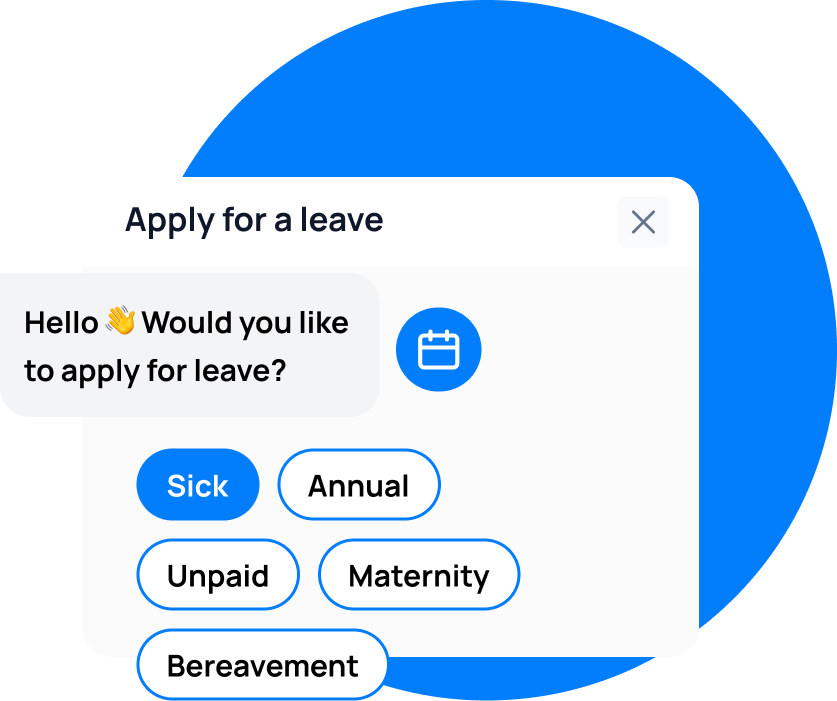
| Leave request submission | Email, Slack DM, verbal | Structured form in Slack, Teams, or web portal |
| Approval workflow | Manual — manager emails HR, HR updates sheet | One-click approval with automatic balance check |
| Accrual calculation | Manual formulas, prone to error | Automatic, based on employment type and policy |
| Leave loading | Manual calculation per award | Configured once, applied automatically |
| Balance visibility | Ask HR and wait | Self-service — employees check anytime |
| Audit trail | None | Every change logged with timestamp and user |
| Part-time pro-rata | Custom formula per employee | Automatic based on ordinary hours |
| Reporting | Manual pivot tables | On-demand reports, exportable for payroll |
| Team calendar | Separate calendar or colour-coded sheet | Real-time team availability view |
| Record-keeping for Fair Work | Unreliable | Compliant, timestamped, exportable |
The difference is not cosmetic. It is the difference between a system that requires constant human maintenance and one that runs on its own once configured.
Cost Comparison: Spreadsheets vs Software for a 30-Person Team
Spreadsheets look free because there is no line item on the budget. But as we covered in our guide to the true cost of manual leave tracking for Australian businesses, the hidden costs are substantial.
Here is a side-by-side comparison for a 30-person Australian business:
| Cost category | Spreadsheet (annual) | Leave Balance (annual) |
|---|---|---|
| Software subscription | $0 | AUD $348 (AUD $29/month) |
| Admin time (6-8 hrs/month at $36/hr) | AUD $2,590–$3,460 | Minimal — most tasks automated |
| Payroll error corrections (1-2 incidents/year) | AUD $2,000–$5,000 | Near-zero — balances calculated automatically |
| Compliance risk (probability-weighted) | AUD $2,000–$8,000 | Mitigated — full audit trail and records |
| Employee productivity loss (balance queries, slow approvals) | AUD $1,000–$2,000 | Eliminated — self-service and instant approvals |
| Estimated total annual cost | AUD $7,590–$18,460 | AUD $348 |
The comparison is not close. Even if you discount the compliance risk entirely, the admin time savings alone pay for the software within the first month.
For larger teams, the gap widens further. Spreadsheet costs scale with headcount. Leave Balance stays at AUD $29/month whether you have 30 employees or 200.
How does Leave Balance compare to other Australian options?
| Tool | Monthly cost (30 employees) | Pricing model |
|---|---|---|
| Spreadsheet | ”Free” (AUD $630–$1,540/month in hidden costs) | Your team’s time |
| Tanda | AUD $384–$480/month | Per-user ($1.60–$16/user) |
| Employment Hero | AUD $600–$1,800/month | Per-user + minimum spend |
| Deputy | AUD $150–$270/month | Per-user ($5–$9/user) |
| Leave Balance | AUD $29/month | Flat rate, unlimited employees |
For a deeper comparison of Australian leave management platforms, see our guide to the best leave management software in Australia.
leave emails? Track your employee's leave with Leave Balance
How to Know It Is Time to Switch
You do not need to wait for a compliance incident to justify the move. Here are five signals that your spreadsheet has reached its limit:
-
More than one person touches the leave spreadsheet. Multiple editors mean conflicting updates, overwritten formulas, and no clear ownership. If two people update the same employee’s balance in the same week, one of those changes will be lost.
-
You have employees on different awards or in different states. Managing leave loading rates, long service leave thresholds, and personal leave entitlements across multiple awards in a single spreadsheet is a compliance risk that grows with every new hire.
-
You spend more than four hours per month on leave administration. At that point, the time cost alone exceeds the cost of software. Those hours have a dollar value, and they are being spent on work that should be automated.
-
An employee has disputed their balance and you could not prove the correct figure. This is the clearest sign. If your records cannot withstand scrutiny from an employee, they will not withstand scrutiny from Fair Work.
-
You are growing. If your team grew by 20% or more in the past year, your leave administration workload grew by more than 20% — because complexity scales faster than headcount.
Migrating From a Spreadsheet to Leave Balance
The most common objection to switching is not cost — it is the perceived effort of migration. In practice, the move from a spreadsheet to Leave Balance takes less time than a single month of manual leave administration.
Here is what the migration looks like:
- Export your current data. Pull your employee list and current leave balances from your spreadsheet into a CSV file.
- Set up your leave policies. Configure your annual leave, personal leave, long service leave, and any other policies in Leave Balance. This takes 10-15 minutes for most businesses.
- Upload your team. Use Leave Balance’s bulk CSV import to add all employees at once with their current balances.
- Connect Slack or Microsoft Teams. Your team starts requesting and approving leave in the tools they already use every day.
- Stop updating the spreadsheet. From this point forward, accruals, balances, and records are handled automatically.
Most teams are fully operational within a single afternoon. There is no implementation project, no IT involvement required, and no training beyond a two-minute walkthrough for managers.
Frequently Asked Questions
Is a spreadsheet good enough for Fair Work compliance?
A spreadsheet can hold the data Fair Work requires, but it lacks the audit trail, version control, and access logging that make those records defensible. Fair Work requires employers to keep accurate leave records for seven years. Without a log of who changed each value and when, your records have limited evidentiary value in a dispute or audit.
How much does leave management software cost in Australia?
Prices range widely. Per-user platforms like Tanda (AUD $1.60-$16/user/month) and Employment Hero (AUD $20-$60/employee/month) scale with team size. Leave Balance charges a flat AUD $29/month regardless of how many employees you have — making it the most affordable option for teams of any size.
Can I migrate my spreadsheet data to leave management software?
Yes. Most leave management tools, including Leave Balance, support CSV imports. You export your employee list and current balances from your spreadsheet, upload the file, and the system picks up from there. The process typically takes less than an hour.
At what team size should I switch from spreadsheets to software?
There is no universal number, but most businesses find that spreadsheets become unreliable somewhere between 10 and 20 employees — especially when the team includes a mix of full-time and part-time workers, or employees across multiple Modern Awards or states.
The Bottom Line
Spreadsheets are a reasonable starting point for leave tracking. They are familiar, flexible, and free. But they carry hidden costs in admin time, payroll errors, compliance risk, and employee experience that grow with your team. For Australian businesses with more than 10-15 employees, the question is not whether software is worth it — it is how much the spreadsheet is already costing you.
Leave Balance replaces your leave tracking spreadsheet for AUD $29 per month flat — unlimited employees, unlimited policies, Slack and Teams integration, and a full audit trail. Set up takes 15 minutes, migration takes an afternoon, and the return on investment is immediate.
leave emails? Track your employee's leave with Leave Balance