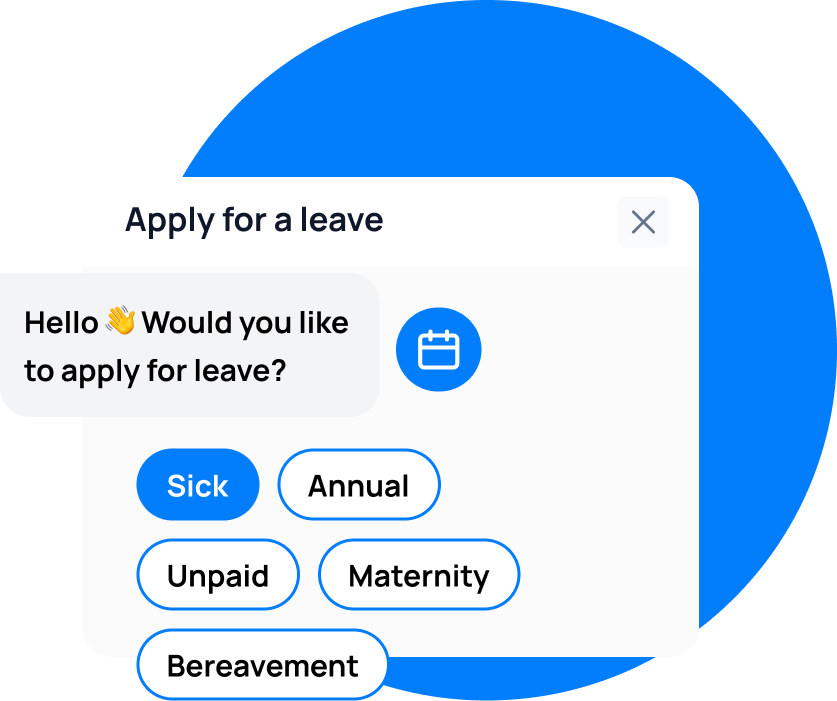
A leave request workflow is the structured process that a time-off request follows from the moment an employee submits it to the moment it is approved, rejected, or escalated. It defines who reviews the request, what rules are checked, and how exceptions are handled. A well-designed workflow balances employee autonomy with business coverage requirements.
The workflow is the backbone of leave management. Without one, requests arrive by email, Slack, or hallway conversation — and nobody knows whether they have been approved until someone checks.
Key Takeaways
- A leave request workflow defines the steps from submission through approval, rejection, or escalation.
- Best practice workflows include at least two stages: manager review and HR validation.
- Automation enforces policy rules, checks team coverage, and routes requests to the right approver.
- The workflow should handle delegations, emergencies, and bulk requests without manual intervention.
- A transparent workflow reduces disputes, improves compliance, and gives managers data to plan coverage.
How a Leave Request Workflow Works
The typical workflow follows five stages:
1. Submission
The employee selects the leave type, dates, and any supporting information. A good system shows the employee their current balance and any policy restrictions before they submit. This prevents requests that will be automatically rejected.
2. Validation
The system checks the request against policy rules:
- Is there sufficient leave balance?
- Does the request meet the notice period requirement?
- Is the employee eligible for the selected leave type?
- Does the request fall within a blackout or embargo period?
Requests that fail validation are returned to the employee with a clear explanation. This eliminates back-and-forth between the employee and HR.
3. Manager Review
The request is routed to the employee’s direct manager. The manager sees:
- The employee’s current leave balance
- Team availability during the requested dates
- Any overlapping leave requests from the same team
- The business impact of approving the request
The manager can approve, reject, or request more information. Rejection reasons should be documented in the system for audit purposes.
4. Secondary Approval (If Required)
Some organisations require a second level of approval for extended leave, specific leave types, or when the manager is the one requesting leave. Common triggers for secondary approval:
- Leave exceeding 10 consecutive days
- Parental leave or long service leave
- Requests during critical business periods
- Requests where the manager has a conflict of interest
5. Confirmation
Once approved, the system:
- Updates the employee’s leave balance
- Adds the absence to the team calendar
- Sends confirmation to the employee and manager
- Records the approval with a timestamp and approver name
If rejected, the employee receives a notification with the reason and can resubmit or escalate.
Leave Request Workflow Steps at a Glance
| Step | Action | Actor |
|---|---|---|
| Submit | Employee selects dates and leave type | Employee |
| Validate | System checks balance, eligibility, and rules | System |
| Review | Manager assesses coverage and approves or rejects | Manager |
| Escalate | Secondary approver reviews if required | HR / Senior manager |
| Confirm | System updates balances and calendar | System |
Approval Chains: How to Set Them Up
An approval chain defines the sequence of reviewers for a leave request. The chain depends on the leave type, the employee’s role, and the organisation’s size.
Simple Two-Stage Chain
For most small to mid-size businesses:
- Direct manager reviews and approves or rejects
- HR is notified for record-keeping
This works when managers are empowered to make leave decisions and the policy is straightforward.
Multi-Stage Chain
For larger organisations or specific leave types:
- Direct manager performs initial review
- Department head approves if the request exceeds a threshold (e.g., more than 5 days)
- HR validates for compliance and records the final decision
Cross-Functional Chain
When a request affects multiple teams:
- Direct manager approves the employee’s absence
- Project manager or team lead confirms the impact on deliverables
- HR finalises the approval
Automated Routing Rules
Modern leave management systems route requests automatically based on configurable rules:
- If leave type = parental leave, route to HR directly
- If leave days > 10, add secondary approval step
- If manager is on leave, delegate to the manager’s backup
- If the request falls during a blackout period, route to HR for exception review
Best Practice for Leave Request Workflows
Set Clear Notice Periods
Define minimum notice periods for each leave type. The UK Working Time Regulations require at least twice the length of leave requested for notice, but employers can set longer periods. Common practice:
| Leave Type | Minimum Notice |
|---|---|
| Single day (annual leave) | 2 weeks |
| Multiple days (annual leave) | 4 weeks |
| Long service leave | 4 weeks |
| Parental leave | 10 weeks |
| Compassionate leave | As soon as practicable |
Automate Policy Enforcement
Managers should not have to manually check whether a request complies with policy. Automate balance checks, notice period validation, and blackout date enforcement. This removes the burden from managers and ensures consistent application.
Provide Delegation Coverage
Every approval chain needs a fallback. If a manager is on leave or unavailable, the system should automatically route requests to a designated backup. Without this, requests stack up and employees wait days for a response.
Use Team Calendars for Coverage Visibility
Managers should see a visual representation of team absences before approving a request. This is the single most useful feature for preventing coverage gaps. A calendar view showing who is off on which days makes approval decisions straightforward.
Document Rejection Reasons
Every rejection should be documented in the system. This protects the employer in case of disputes and provides data for identifying patterns — for example, if a particular team consistently rejects leave requests, it may indicate a staffing issue.
Maintain an Audit Trail
The system should record every action in the workflow: who submitted, who reviewed, when it was approved or rejected, and any comments. This audit trail is essential for compliance, particularly under the NES and ACAS guidance.
Automating the Workflow
Manual workflows — email, Slack, or paper forms — create problems:
- Requests get lost in inboxes
- Managers forget to approve or reject
- No audit trail exists
- Policy rules are applied inconsistently
- Reporting requires manual data compilation
An automated leave management system solves all of these. The key automation capabilities to look for:
| Capability | Benefit |
|---|---|
| Auto-route to manager | No manual forwarding required |
| Auto-check balance | Prevents over-commitment |
| Auto-check notice period | Enforces policy without manager effort |
| Auto-delegate when approver is away | Prevents bottlenecks |
| Auto-notify on approval | Instant confirmation to employee |
| Auto-update calendar | Team visibility without manual entry |
| Auto-generate reports | Real-time data for HR and finance |
The goal is to remove humans from the mechanical parts of the workflow while keeping them in the decision-making parts. Managers should spend their time deciding whether a request makes business sense, not checking whether the employee has enough balance.
Frequently Asked Questions
How long does a leave request take to process with automation?
With an automated system, most leave requests are approved or rejected within 24 hours. Simple requests — single-day annual leave with no policy conflicts — can be auto-approved instantly if your policy allows. The bottleneck is typically the manager review step, not the system.
Can employees cancel a leave request after submitting it?
Yes, most systems allow employees to cancel pending requests. If the leave has already been approved, the cancellation may require manager approval. The system should restore the leave balance automatically upon cancellation.
What happens to pending requests when a manager leaves the company?
The system should have a delegation or backup approver configured. When a manager’s employment ends, pending requests are rerouted to the backup. Without this configuration, requests can languish indefinitely. Set up delegation rules before they are needed.
Should I auto-approve leave requests?
Auto-approval works for low-risk scenarios — requests with sufficient balance, adequate notice, no coverage conflicts, and within the standard entitlement. For extended leave, leave during critical periods, or requests that trigger policy exceptions, keep the manager review step. The goal is speed where it is safe and oversight where it is necessary.
How do I handle leave requests during a leave embargo?
Requests during an embargo should be routed to HR for exception review. The workflow should flag the embargo period and require the requestor to provide a reason. HR can then apply the embargo policy — honouring pre-approved leave, granting statutory exceptions, or rejecting requests that do not meet the exception criteria.
leave emails? Track your employee's leave with Leave Balance