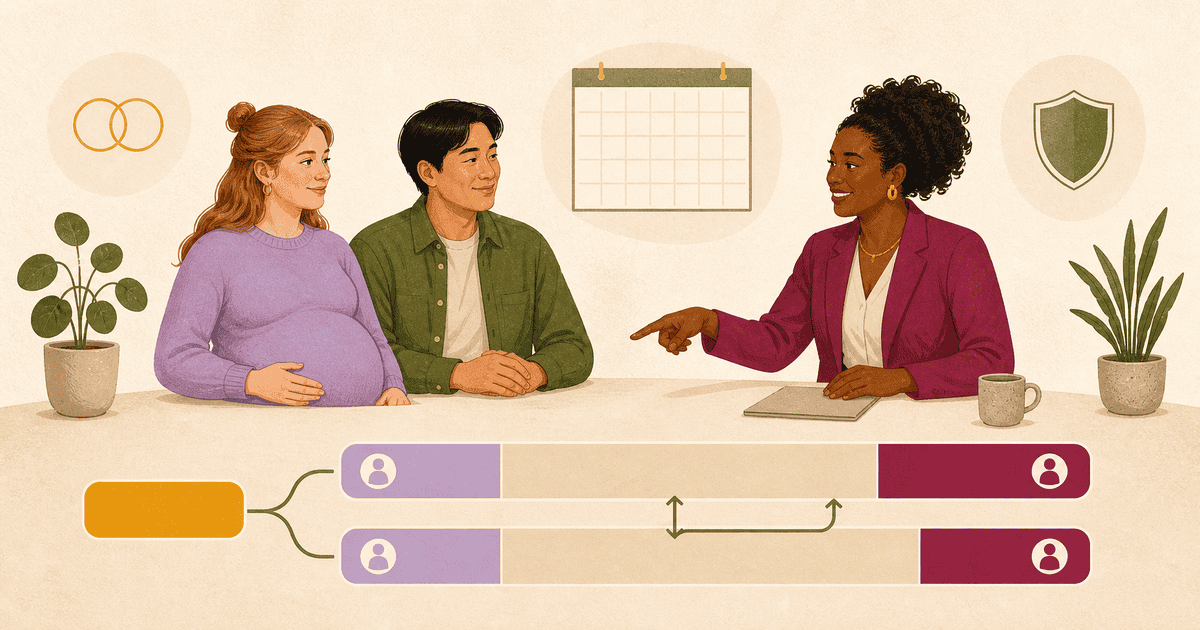
Finnish maternity leave begins with a pregnancy allowance paid by Kela before the child is even born, and continues through 160 days of parental leave after birth. Finland’s family leave reform, which took effect on 1 August 2022, transformed the old maternity/paternity/parental leave system into a modern, gender-equal model where both parents share a pool of leave days. The reform extended total leave to approximately 14 months per family and made shared parental leave the default.
This guide covers Finnish maternity and parental leave in 2026: the pregnancy allowance, the 160-day parental leave pool, how Kela benefits are calculated, the 2022 reform changes, and the obligations employers need to know.
Key takeaways
- Finland provides pregnancy allowance (äitiysraha) — about 40 working days paid by Kela before the expected birth date.
- After birth, parents share 160 days of parental leave (vanhempainraha) per parent, with 63 days non-transferable to the other parent.
- The total family leave is approximately approximately 14 months when pregnancy allowance, parental leave, and special care leave are combined.
- Kela pays the benefit directly — the employer does not fund parental leave, though many collective agreements include top-ups.
- The 2022 reform made shared parental leave the default, replacing the old maternity-only system.
The pregnancy allowance
Finnish parental leave begins before birth with the pregnancy allowance (äitiysraha). Under the Health Insurance Act (sosiaaliturvalaki 530/2021), Kela pays the expectant mother approximately 40 working days (about 8 weeks) of pregnancy allowance starting at the earliest 50 days before the expected birth date.
The pregnancy allowance serves two purposes: it provides income during the pre-birth period, and it transitions the mother into the formal parental leave that begins after birth.
| Allowance | Duration | When | Paid by |
|---|---|---|---|
| Pregnancy allowance | ~40 working days | Before birth (from 50 days before due date) | Kela |
| Parental leave | 160 days per parent | After birth | Kela |
The pregnancy allowance is paid at approximately 70% of the qualifying income, subject to a daily ceiling. It is not a flat rate — it is income-related, similar to the parental leave benefit that follows.
The 160-day parental leave pool
After the pregnancy allowance, the main parental leave begins. Under the 2022 reform, each parent receives 160 working days (approximately 32 weeks) of parental leave. This is a fundamental change from the old system, where maternity leave was 105 working days and paternity leave was limited to a smaller allocation.
The key rules for the 160 days:
- 63 days are non-transferable — if one parent does not use them, they are lost to the family.
- 97 days can be transferred between parents.
- Parents can take leave simultaneously or sequentially.
- Leave can be taken in blocks or flexibly, with notification to the employer.
Worked example: splitting 160 days
Couple: Aino (designer) and Ville (developer) Aino takes 160 days (all her non-transferable 63 + transferred 97 from Ville). Ville takes 63 days (his non-transferable minimum). Total family leave: 160 + 63 = 223 days (~45 weeks)
If Ville takes more than 63 days, the family uses more of the total pool. If Ville takes only 63, the family leaves 97 days unused.
The 2022 family leave reform
The reform that took effect on 1 August 2022 was one of the most significant changes to Finnish family leave in decades. It implemented the EU Work-Life Balance Directive and fundamentally restructured how leave is allocated.
Key changes from the reform:
| Feature | Pre-2022 | Post-2022 |
|---|---|---|
| Maternity leave | 105 working days | Replaced by 160-day parental leave per parent |
| Paternity leave | 54 days (limited) | 63 days non-transferable within the 160-day pool |
| Parental leave sharing | Limited | 97 days transferable between parents |
| Total family leave | ~12 months | ~14 months |
| Shared parental leave | Not available | Available — parents can both be on leave simultaneously |
The reform’s intent is gender equality — by giving each parent a substantial, non-transferable portion, the system incentivizes both parents to take significant time off work.
How Kela pays the benefit
Kela (the Social Insurance Institution of Finland) pays the parental leave benefit. The employer is not the funding source. The benefit is income-related, calculated based on the parent’s qualifying income.
The benefit rate is approximately 70% of the qualifying income, subject to a daily ceiling. For 2026, the daily ceiling is approximately EUR 172.29 (based on the Finland’s earnings-related allowance index).
| Component | Rate | Ceiling (2026 approx.) |
|---|---|---|
| Pregnancy allowance | ~70% of qualifying income | ~EUR 172/day |
| Parental leave benefit | ~70% of qualifying income | ~EUR 172/day |
| Special care allowance | ~70% of qualifying income | ~EUR 172/day |
For parents earning below the ceiling, the benefit is a straight 70% of salary. For parents earning above, the effective percentage drops.
Worked example
Employee: Liisa, product manager Monthly salary: EUR 5,500 Kela benefit: 70% × 5,500 = EUR 3,850/month equivalent Daily benefit: ~EUR 169 (below ceiling of EUR 172) Effective income replacement: ~70%
Employee: Mikko, director Monthly salary: EUR 8,500 Kela benefit: Capped at ceiling → ~EUR 5,170/month Effective income replacement: ~61%
Special care leave and other entitlements
Beyond the main 160-day parental leave, Finnish law provides additional leave types:
- Special care leave (erityishuoltajavapa): 60 working days per parent per child for caring for a sick child under 12. Paid at 70% by Kela.
- Childcare leave (lapsenhoitovapaa): Unpaid leave until the child turns 3, available to parents.
- Short-term care leave (lyhytaikainen hoitovapaa): Up to 4 days per month for caring for a sick child under 10.
These are separate from the 160-day parental leave pool and do not reduce it.
Employer obligations during leave
Finnish employers have duties under the Employment Contracts Act (työsopimuslaki, 55/2001) and the parental leave legislation:
- Grant leave — the employer must release the employee for parental leave. Refusal is not permitted.
- Hold the position — the employee has the right to return to the same or equivalent role.
- Not terminate during leave — termination during parental leave is prohibited except in narrow circumstances.
- Issue documentation — the employer must provide documentation needed for the Kela benefit application.
- Coordinate notification — the employee must notify the employer at least 2 months before the leave begins (or 14 days before for blocks shorter than 18 days).
The employer does not pay salary during parental leave. The Kela benefit replaces income. However, many Finnish collective agreements (työehtosopimukset) include employer top-ups.
Collective agreement top-ups in Finland
Finland’s collective bargaining system includes parental leave top-ups in many industries. Common provisions:
- Salary top-up for the first 6–12 months of leave, bridging part of the gap between the Kela benefit and full salary.
- Enhanced pension contributions beyond the statutory minimum.
- Flexible return arrangements not required by statute.
These provisions vary by employer and industry. HR teams must check the applicable collective agreement.
| Provision | Statutory minimum | Common collective agreement |
|---|---|---|
| Salary during leave | No — Kela benefit only | Often yes, partial top-up |
| Pension during continue | Yes — statutory minimum | Often enhanced |
| Notification period | 2 months | May be shorter by agreement |
Common pitfalls for HR teams
1. Confusing the old and new systems
The 2022 reform replaced the old maternity/paternity/parental leave structure entirely. HR teams using pre-2022 rules will miscalculate entitlements and communicate incorrect information to employees.
2. Not informing parents about transferable days
97 of the 160 days can be transferred between parents. If both parents do not understand this, the family may leave days unused that they could have shared.
3. Assuming the employer pays during leave
Kela pays the benefit. The employer’s role is to grant leave, hold the position, and pay any contractual top-ups. Confusing the two creates payroll errors.
4. Attempting to terminate during leave
Termination during parental leave is prohibited under Finnish law. Even during a redundancy process, employees on leave are protected.
5. Forgetting the 2-month notification period
Employees must notify the employer at least 2 months before the start of parental leave. Not communicating this requirement leads to unexpected absences and coordination failures.
Frequently asked questions
How long is maternity leave in Finland?
Finland’s 2022 reform replaced separate maternity leave with a shared parental leave system. Each parent receives 160 working days (approximately 32 weeks), with 63 non-transferable to the other parent. The pregnancy allowance adds approximately 40 working days before birth.
Who pays parental leave in Finland?
Kela (the Social Insurance Institution) pays the benefit at approximately 70% of the qualifying income. The employer does not fund parental leave, though many collective agreements include additional top-ups.
Can both parents take leave at the same time?
Yes. The 2022 reform allows simultaneous leave. Both parents can be on parental leave at the same time, which many families choose for the first months after birth.
What changed in the 2022 family leave reform?
The reform replaced the old maternity/paternity/parental leave system with a shared 160-day parental leave per parent. It extended total family leave to approximately 14 months, made shared parental leave the default, and gave each parent 63 non-transferable days.
What is the pregnancy allowance?
Kela pays approximately 40 working days of pregnancy allowance before the expected birth date, at approximately 70% of qualifying income. It provides income during the pre-birth period and transitions into the main parental leave after birth.
Tracking 160 days of parental leave per parent, 63 non-transferable days, transferable days between parents, and pregnancy allowance for your Finnish team requires a leave system built for Finnish rules. Leave Balance handles this automatically.
Sources
- Health Insurance Act (Sosiaaliturvalaki 530/2021) (primary source)
- Kela — Parental leave benefit
- EU Directive 2019/1158 on Work-Life Balance
- Finnish Ministry of Social Affairs — family leave reform
Last updated: 26 July 2026. This article is general information, not legal advice. Finnish parental leave is governed by the Health Insurance Act and Kela regulations — confirm current benefit ceilings and collective agreement provisions with Kela.